Backstory

Cerebral Angiography Before the CT Scan 1927 to 1971 Cerebral angiography

Cerebral angiography began in 1927 with a needle in the artery and a radioactive dye, and for decades it was the only way to see the blood vessels inside a living human head.

A man walks out of a mine collapse with a sore neck. He talks, and his pulse is steady. His pupils react, his grip is equal, and the radiograph of his cervical spine comes back unremarkable. In 1954 that was most of what a hospital could do for him, and it could miss a torn artery entirely.

What the Film Showed

An X-ray...

The Watts Riots of 1965 and Los Angeles Hospitals Thirty-four people died

Thirty-four people died and 1,032 were hurt in Los Angeles in August 1965, and the commission that investigated it recorded ambulance crews refusing to enter the area unescorted.

The Governor’s Commission on the Los Angeles Riots reported on 2 December 1965 under a title that was also a question. Most of what it gathered concerns police, schools and work. A few lines concern getting hurt, and those are the ones that explain what the hospitals did.

A Traffic Stop

On 11 August 1965 California...

The Karen Ann Quinlan Case of 1976 and the Right to Die On 31 March 1976

On 31 March 1976 the New Jersey Supreme Court let Karen Ann Quinlan’s father order her respirator switched off, and she went on breathing without it for another nine years.

The machine in the room was an MA-1 respirator, and the question put to the court was who had the right to switch it off. The Supreme Court of New Jersey answered in 1976, and the answer carried far past the one bed it was written for.

A Night in April

The Hastings Center, a bioethics research institute, puts the night at 14...

Willcox Arizona Cattle Trains and the Sulphur Springs Valley Willcox

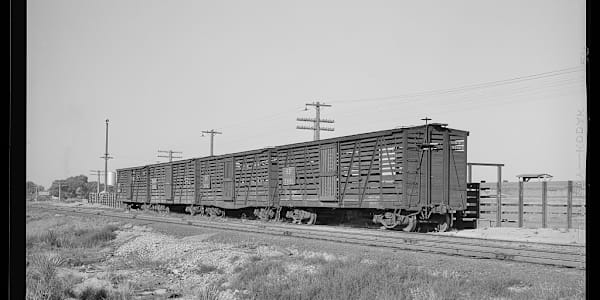
Willcox Arizona began in 1880 as a Southern Pacific siding, and for thirty years the Sulphur Springs Valley shipped about a hundred thousand head of range cattle a year through it.

The Sulphur Springs Valley runs nearly a hundred miles, from Sonora north to the Gila, and for most of that length it is flat enough that a surveyor could lay a straight line across it without argument. That is why Willcox is there. The town was not founded on a mine, a river crossing or a mission. It was founded...

The Last Wild Thick-Billed Parrots in Arizona 1938 The last confirmed flock

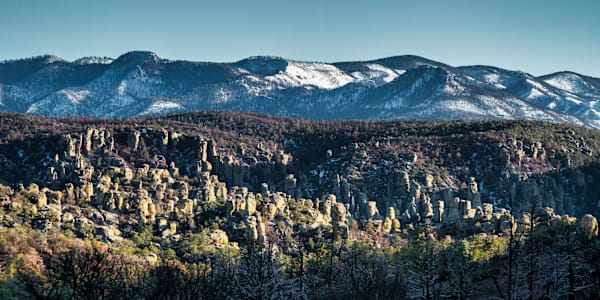
The last confirmed flock of wild thick-billed parrots in the United States was seen in 1938 in the Chiricahua Mountains of Arizona, and no record proves they ever nested there.

Arizona lost a parrot. Not a cage bird gone feral, but a green, red-shouldered bird of the high pine forest that crossed the Chiricahuas in flocks loud enough to hear before you saw them. Then it stopped coming. The people who study it are still arguing about what it had been doing here in the first place.

Parrots in the...

The June Robles Kidnapping of 1934 in Tucson Arizona On 25 April 1934 a

On 25 April 1934 a six-year-old girl was taken outside her Tucson school, and nineteen days later she was found chained inside an iron box buried in the desert east of town.

Federal agents worked the case for two and a half years and narrowed it to forty-three suspects. Nobody was charged. A federal grand jury was then persuaded to call the whole affair a hoax, and the file went quiet.

A Ford at Roskruge

June Robles was six, and walking home from Roskruge Elementary School in Tucson, when she...

Women in Medical School in the 1960s and LA County General In the mid-1960s

In the mid-1960s women were six percent of American medical students, and the county hospital on Mission Road in Los Angeles trained its doctors on the people who could not pay.

A woman who wanted to practice medicine in the United States in 1960 faced a sequence rather than a wall. Premedical science. An aptitude examination. An application. Four years of medical school. Then a year inside a hospital as an intern, moving through one service after another.

Every step was open to her on paper,...

The 1971 Sylmar Earthquake and Olive View Hospital At 6:00:41 on 9 February

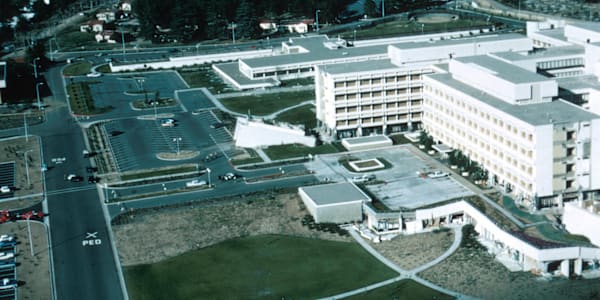
At 6:00:41 on 9 February 1971 a magnitude 6.6 earthquake threw down the stair towers of a Sylmar hospital six weeks old, and killed forty-nine at the veterans hospital nearby.

A hospital is the one building a community cannot afford to lose in an earthquake, because an earthquake is the hour it is most needed. The San Fernando Valley lost the use of two that morning, and the newer had been open six weeks.

Six in the Morning

The California Geological Survey puts the origin time at 6:00:41 a.m. on...

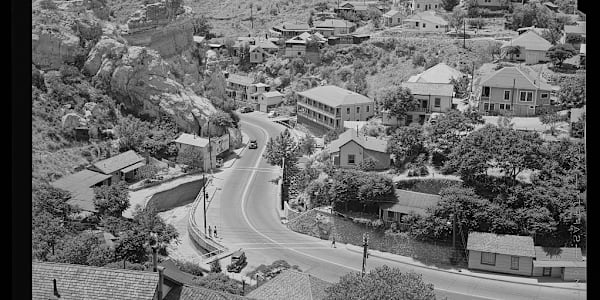
Underground at the Copper Queen Mine in Bisbee Arizona Bisbee’s hard-rock

Bisbee’s hard-rock miners drove more than two thousand miles of tunnel under the Mule Mountains, and the underground work did not stop when the Lavender Pit opened in 1954.

The ore at Bisbee was lying in plain sight. It stood out of the hillside across from what is now downtown, and the first man to file a claim on it decided it was not worth keeping.

In William Ascarza’s account in the Arizona Daily Star, that man was Hugh Jones, who found the deposit in 1877, dismissed it as copper-stained...
Prohibition in Arizona: Moonshine and the Mexican Border Arizona went dry

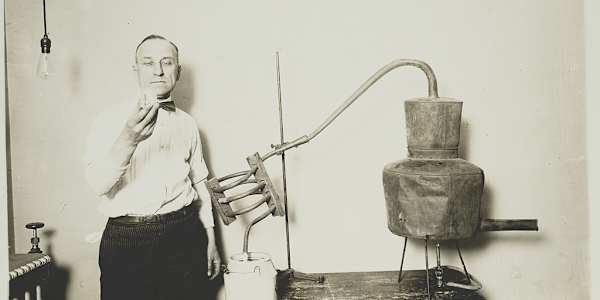
Arizona went dry on 1 January 1915, five years ahead of the nation, and for nearly nineteen years its liquor came from mountain stills and from across the line in Sonora.

The story of Prohibition usually begins with the Volstead Act and ends with the Twenty-first Amendment. Arizona’s version began sooner and finished sooner. In between, the state learned what every dry place learns: a law against liquor mostly changes where the liquor comes from.

Thirteenth to Go Dry

On 3 November 1914, Arizona...

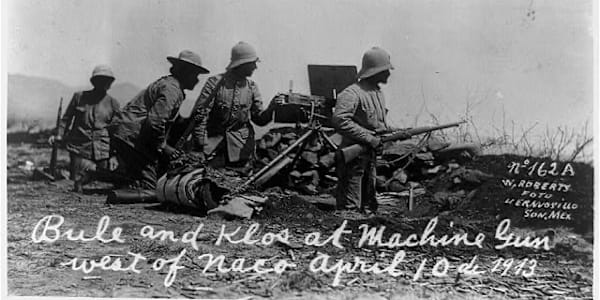
The Hotchkiss Machine Gun in the Mexican Revolution In 1910 Porfirio Díaz

In 1910 Porfirio Díaz bought fifty-six Hotchkiss machine guns in France. Five years later, machine guns, barbed wire and trenches broke Pancho Villa’s cavalry at Celaya.

The weapon the old regime bought to protect itself ended up deciding which of its enemies would inherit the country. Mexico’s federal army was not new to automatic fire: according to Mexico’s National Institute of Anthropology and History, it had acquired six Maxim guns in 1897. The larger order came in 1910, while Francisco...

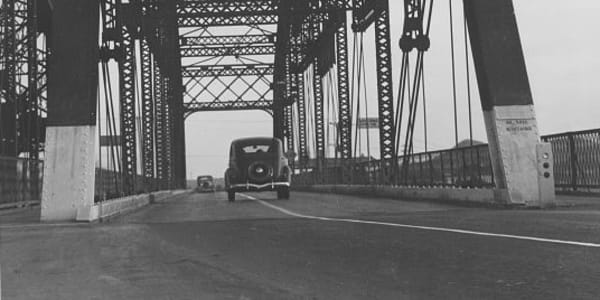
US Route 80 in Arizona: Bisbee, Tombstone and Benson US Route 80 ran from

US Route 80 ran from Savannah to San Diego, and its Arizona stretch went through Douglas, Lowell, Bisbee, Tombstone and Benson before the number was taken away again.

The road came first and the number came second, and in southeastern Arizona the gap between the two was about fifty years. What became US Route 80 across Cochise County was laid down by freight wagons and stagecoaches after 1877, when silver was found at Tombstone and copper at Bisbee in the same year. The Arizona Department of...

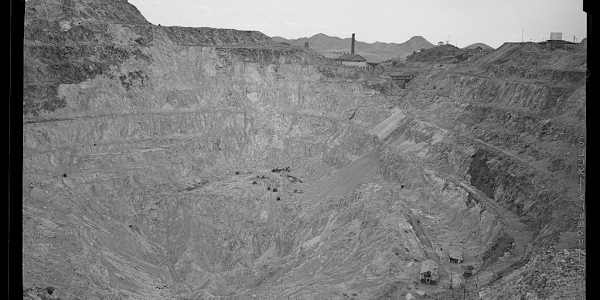
The Lavender Pit and the Town of Lowell, 1954 to 1974 The Lavender Pit at

The Lavender Pit at Bisbee began producing copper in 1954, and by the time it closed it had moved 351 million tons of rock and taken most of the neighboring town of Lowell.

Bisbee had been a copper town for seventy years before anyone cut the Lavender Pit, and by 1950 the ore that made it rich was largely gone. What remained under Sacramento Hill was copper spread too thin through the rock to pay for a shaft and a crew underground. The pit was the answer, and the answer was to stop being...

The Copper Queen Hospital: Company Medicine in Bisbee In 1883 a doctor

In 1883 a doctor treated Bisbee’s typhoid cases in an abandoned explosives tunnel, and for the next ninety-three years the town’s hospital belonged to the copper company.

Thomas Darlington came to Bisbee in 1883 to deal with typhoid. He had no hospital, so he used what the camp had — an abandoned explosives tunnel below the Glory Hole on Bucky O’Neill Hill. What replaced the tunnel was a pair of frame buildings with cardboard walls, put up near Sacramento Hill and enlarged whenever the camp...

Steam Pump Ranch and George Pusch, 1874 to 1921 George Pusch fired a steam

George Pusch fired a steam pump with mesquite wood over a well north of Tucson in the 1870s, and the ranch that grew around it became the last reliable water on the road north.

What put a place on the map of southern Arizona was not a town site or a fort. It was water a stranger could count on. A well that failed in June was worth nothing to a freighter with sixteen mules. A well that held was worth stopping for, and a stop was worth money.

Twenty miles north of Tucson, on the road running up...

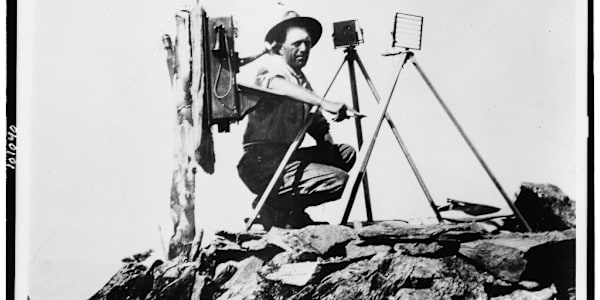
The 1886 Army Heliograph Network in Arizona and New Mexico By August 1886

By August 1886 the US Army was working twenty-three heliograph stations across Arizona and New Mexico, flashing Morse code off mirrors to hunt a band of thirty-seven Chiricahua.

General Nelson A. Miles took command of the Department of Arizona in April 1886, and within a month he was asking his staff about mirrors. What he put on the peaks that summer was the most advanced field communications system the United States Army had ever deployed. A declassified National Security Agency history says...

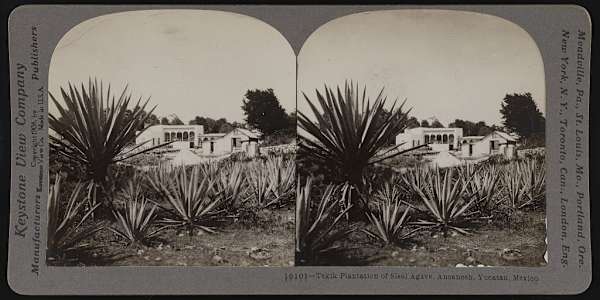
Yaqui Deportations to the Yucatan Henequen Fields Between 1902 and 1908 the

Between 1902 and 1908 the Díaz government shipped thousands of Yaqui people out of Sonora to the henequen plantations of Yucatán, where the planters paid sixty-five pesos a head.

In 1908 an American journalist named John Kenneth Turner travelled through Mexico posing as a wealthy investor shopping for plantation land. What he was doing was counting people who had been sold. The articles he published the following year, gathered into the book “Barbarous Mexico,” described a labour system the...

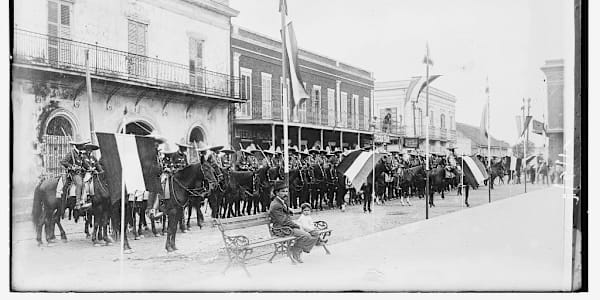
The Rurales: Mexico’s Rural Police and the Myth of Order Porfirio Díaz’s

Porfirio Díaz’s rural police were the most photographed force in Mexico, never numbered much more than two thousand men, and a third of them deserted in the corps’ last decade.

The rurales are in every account of Porfirian Mexico somewhere: charro suits, a line of mounted men at the edge of a village, and the understanding that whoever deals with them has no appeal. The picture is right about the effect and wrong about nearly everything else: the corps was small, thinly staffed, and could not...

The Yaqui Wars: Mazocoba and the Sierra de Bacatete On 18 January 1900 the

On 18 January 1900 the Mexican army trapped a Yaqui force at Mazocoba, in the Sierra de Bacatete, and killed more than four hundred. It was still bombing that mountain in 1927.

The Sierra de Bacatete is not much of a range. It stands east of Guaymas, between the lower Yaqui river and the Gulf of California, low and dry and broken, and on a map it looks like nothing much. For half a century it was the most expensive ground in northwestern Mexico, and the government kept announcing that it had...

Buffalo Soldiers at Fort Huachuca, 1913 to 1945 The 10th Cavalry rode into

The 10th Cavalry rode into Fort Huachuca in 1913 and Black regiments held the Arizona post for thirty years, until two segregated divisions trained there for the Second World War.

Fort Huachuca stands at the foot of the Huachuca Mountains in southeastern Arizona, close enough to the Mexican border that the line is a morning’s ride. It is the last of Arizona’s frontier posts still in operation. Its remoteness is why it was built where it was, and why it outlived every other post in the...