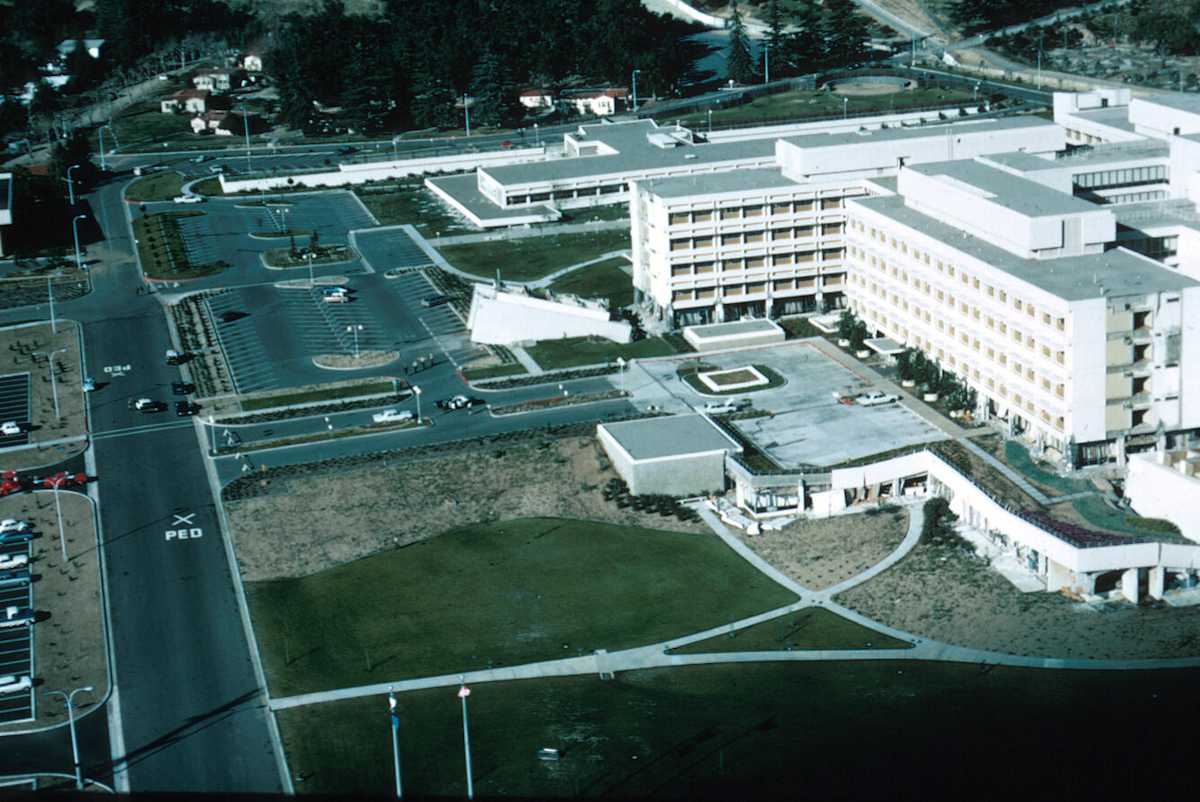
At 6:00:41 on 9 February 1971 a magnitude 6.6 earthquake threw down the stair towers of a Sylmar hospital six weeks old, and killed forty-nine at the veterans hospital nearby.
A hospital is the one building a community cannot afford to lose in an earthquake, because an earthquake is the hour it is most needed. The San Fernando Valley lost the use of two that morning, and the newer had been open six weeks.
Six in the Morning
The California Geological Survey puts the origin time at 6:00:41 a.m. on Tuesday 9 February 1971 and the magnitude at 6.6. Movement on the fault reached the surface and ran twelve and a half miles, from Sylmar at the north end of the valley down to Big Tujunga Wash. Freeway interchanges came down, more than two thousand people were hurt, and losses passed half a billion dollars. The Lower Van Norman Dam was left in imminent danger of failure, and nearly eighty thousand people living below it were moved out while the reservoir was drawn down.
The death toll is given two ways by bodies that ought to agree. The California Geological Survey and the Federal Emergency Management Agency say sixty-five; the United States Geological Survey says sixty-four. Either count leads to the same place: most of the dead were in hospitals.
Six Weeks Old
Olive View opened in 1920 as a tuberculosis sanatorium built on the cottage plan, small patient cottages set around a central hospital. Fires in 1962 and 1966 took much of it. The finding aid held by the University of Southern California Libraries says the replacement was completed in 1970 and dedicated as Olive View Medical Center.
The Federal Emergency Management Agency names the piece that failed: a five-storey Medical Treatment and Care Building of reinforced concrete, completed in December 1970, of whose four stair towers three collapsed. The Geological Survey describes the same failure from outside: four five-storey wings pulled away from the main structure and three of them toppled. The photographs show the towers lying beside the hospital, still recognisable as stairs.
Three people died at Olive View, and how they died is the part worth holding on to. A background paper prepared for the California Senate’s health committee records one death from a collapsing structure and two more from the loss of power to their life support systems. The building did not have to fall on a patient to kill one. It only had to stop working.
The hospital was a total loss. The rebuild took sixteen years; a new Olive View opened in Sylmar in 1987.
The Older Hospital
The larger toll was at the San Fernando Veterans Administration hospital, where the Geological Survey counts forty-nine dead and two buildings completely destroyed. What followed there was national rather than local. The Department of Veterans Affairs set up a Seismic Vulnerability Assessment Program to find and strengthen hospital buildings needing work, and the Geological Survey installed recording accelerographs in sixty veterans’ hospital buildings around the country, to measure what a hospital does when the ground moves.
What the Law Changed
California answered in pieces. A Strong Motion Instrumentation Program came in 1971; the Alquist-Priolo Special Studies Zone Act followed in 1972, restricting building across the traces of active faults; concrete practice changed too, with more steel and better confinement.
The hospital law is the one this story turns on, and even its date is disputed. The Federal Emergency Management Agency and the California Geological Survey both call it the Hospital Safety Act of 1972. The background paper written for the state Senate’s own health committee says the Legislature passed the Alfred E. Alquist Seismic Safety Act in 1973, requiring all new hospital construction to meet stringent seismic safety standards. The year moves; the requirement does not. A California hospital now had to be built to keep working through an earthquake, not merely to keep standing.
The Ward Downstream
Out of Touch, the second Legacy’s Child novel, opens on the evening of Monday 8 February 1971 and the morning after. Helen Calloway is an obstetrician at Los Angeles County General Hospital, the concrete tower east of downtown built between 1927 and 1933 and celebrated on completion, the Los Angeles Conservancy notes, as the largest single-unit hospital building in the world.
She learns it from an announcer reading place-names faster than he can sort them: damage at the veterans hospital in Sylmar, major damage at Olive View, newer overpasses down, the authorities watching Van Norman.
The novel never goes to Sylmar. It stays where the consequences arrive. Triage tags hang from coat buttons in a lobby turned emergency room, the lifts are stacked with stretchers, and a woman thirty-eight weeks pregnant arrives as an evacuation transfer with two prenatal pages, a blood pressure written at 5:20 and no fetal heart documented after it. That is what a hospital failing at the far end of the county looks like from a hospital that did not.
Helen Calloway began on a company hospital ward in Arizona, which has a post of its own: https://duanekeelingbooks.com/blog/the-copper-queen-hospital-company-medicine-in-bisbee
Out of Touch follows her from that morning across twenty-three years of a Los Angeles practice: https://duanekeelingbooks.com/books/out-of-touch
Sources
- United States Geological Survey, on the San Fernando earthquake
- California Geological Survey, Department of Conservation
- Federal Emergency Management Agency, on building code lessons
- California Senate Committee on Health, its background paper on hospital seismic safety requirements
- University of Southern California Libraries, Special Collections, the Olive View finding aid
- Los Angeles Conservancy, on Los Angeles General Hospital