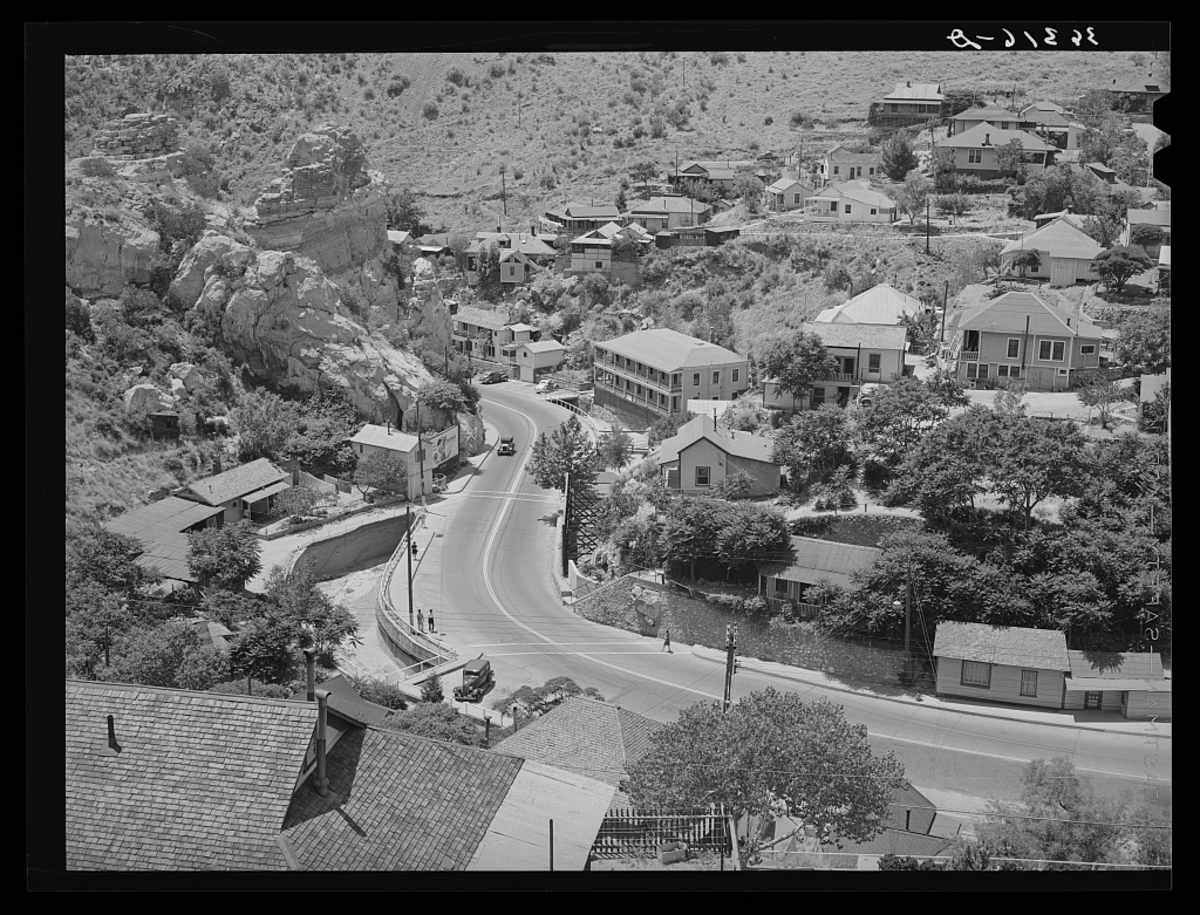
In 1883 a doctor treated Bisbee’s typhoid cases in an abandoned explosives tunnel, and for the next ninety-three years the town’s hospital belonged to the copper company.
Thomas Darlington came to Bisbee in 1883 to deal with typhoid. He had no hospital, so he used what the camp had — an abandoned explosives tunnel below the Glory Hole on Bucky O’Neill Hill. What replaced the tunnel was a pair of frame buildings with cardboard walls, put up near Sacramento Hill and enlarged whenever the camp outgrew them. Bisbee called them the Cracker Boxes.
That is the hospital’s own account of its beginning, and the shape of it held for the better part of a century. Medicine in Bisbee was something the mining company supplied, in a building the company owned, on ground the company was still digging out from under itself. Where the hospital stood was never a medical decision.
Moved by the Mine
In 1900 the Copper Queen Company replaced the Cracker Boxes with a larger two-wing, two-floor white building fronted by large columns. It lasted nine years. Underground work destabilized the foundation, and in 1909 the company moved the hospital to Lowell by railroad — not the patients, the building.
Twenty years later the mine caught it again. By 1929 the workings threatened the Lowell site, and Phelps Dodge, by then the successor company, brought the hospital back into Bisbee.
Two accounts disagree about a date here. The Copper Queen Plaza marker lists a Copper Queen Hospital among the company’s buildings and puts it at 1914; the hospital’s own history keeps the institution in Lowell from 1909 until 1929. Nothing available today settles that.
Forty Beds Upstairs
The building it came back to is the one a Bisbee nurse of the 1950s walked into. A dispensary and clinic opened onto Main Street. Above it, on the second floor, was a forty-bed hospital with its own entrance around on Howell Avenue. A nurses’ residence went up next door.
It stood in a row of company property. The plaza marker lists what the mining company built there and why — the headquarters of 1897, the hotel of 1902, the post office and library of 1907, the store rebuilt in 1939 — put up, in the marker’s words, to serve the company’s and community’s needs. The hospital sat in that row. So did the payroll office.
What the Fee Covered
Company medicine in American mining ran on a deduction. Pierce Williams set the arrangement out for the National Bureau of Economic Research in 1932: on the Lake Superior iron ranges the usual deduction was $1.25 per employee per month, turned over by the employer to the contracting surgeon, who was expected to provide all necessary service. In Michigan copper, Calumet and Hecla took $1.50 a month, covering the man and his family’s medicines and medical attendance, with hospital board billed separately. Industrial injury was not in the fee at all. That was workmen’s compensation, a different ledger.
No figure for the Copper Queen’s own deduction turned up in the sources reachable for this piece, and it is left out rather than guessed. The principle needs no figure. What the fee bought had an edge, and the edge was the payroll. The same company that ran the hospital ran the hiring, and what that reach could do in a bad month is the subject of The Bisbee Deportation of 1917.
The Pit Decade
By the 1950s the high-grade ore that paid for all of it was mostly gone. Bisbee came out of the war into a copper slump and got through on lead and zinc. Then, in 1951, Harrison Lavender, a Phelps Dodge general manager of Western Operations, concluded that an open pit could pay on the low-grade rock the underground work had left behind.
What followed set the town’s clock for another two decades. The pit was cut in fifty-foot benches. Holes were drilled sixty feet down and loaded with twelve hundred pounds of powder, and a blast commonly broke seventy-five thousand tons of rock. It was usually fired at twenty-five minutes past three in the afternoon. Mining in the pit stopped in 1974.
The pit took Sacramento Hill, the ground the Cracker Boxes had stood beside. And in 1961 the hospital moved one last time, out of the plaza to a new building Phelps Dodge opened in Warren, thirty-two years after it had come back. The company held it until 1976, when the fully equipped facility was given to the Cochise County Hospital Association.
Why This Book
A Stone’s Throw opens in March 1955 and never leaves the head of Helen Calloway, a ward nurse at Copper Queen. Its Bisbee is the one above: ice in the shaded gutters along Tombstone Canyon, men coming in with rock dust in their hair and coughs they pretended not to hear, a miner’s wife leaving peaches at the nurses’ station in a flour sack.
What the novel is about, though, is the edge of the record. An old Yaqui man walks out of Copper Queen with an indigent chart and no address worth trusting, and the county files him away with the men who came down from the hills, bled, healed or died, and left no forwarding line for anyone to follow. He is dead before page one. Helen spends fourteen years and a medical degree working outward from that blank card.
A company hospital keeps excellent records of the people it is for.
A Stone’s Throw is book one of Legacy’s Child.
Sources
- Copper Queen Community Hospital, its published history of the institution
- The Historical Marker Database, the Copper Queen Plaza marker and the Viewing the Pit marker at Bisbee
- Pierce Williams, The Purchase of Medical Care Through Fixed Periodic Payment, National Bureau of Economic Research, 1932
- The Center for Land Use Interpretation, its land use database entry for the Lavender Pit
- Library of Congress, Prints and Photographs Division, Farm Security Administration and Office of War Information collection