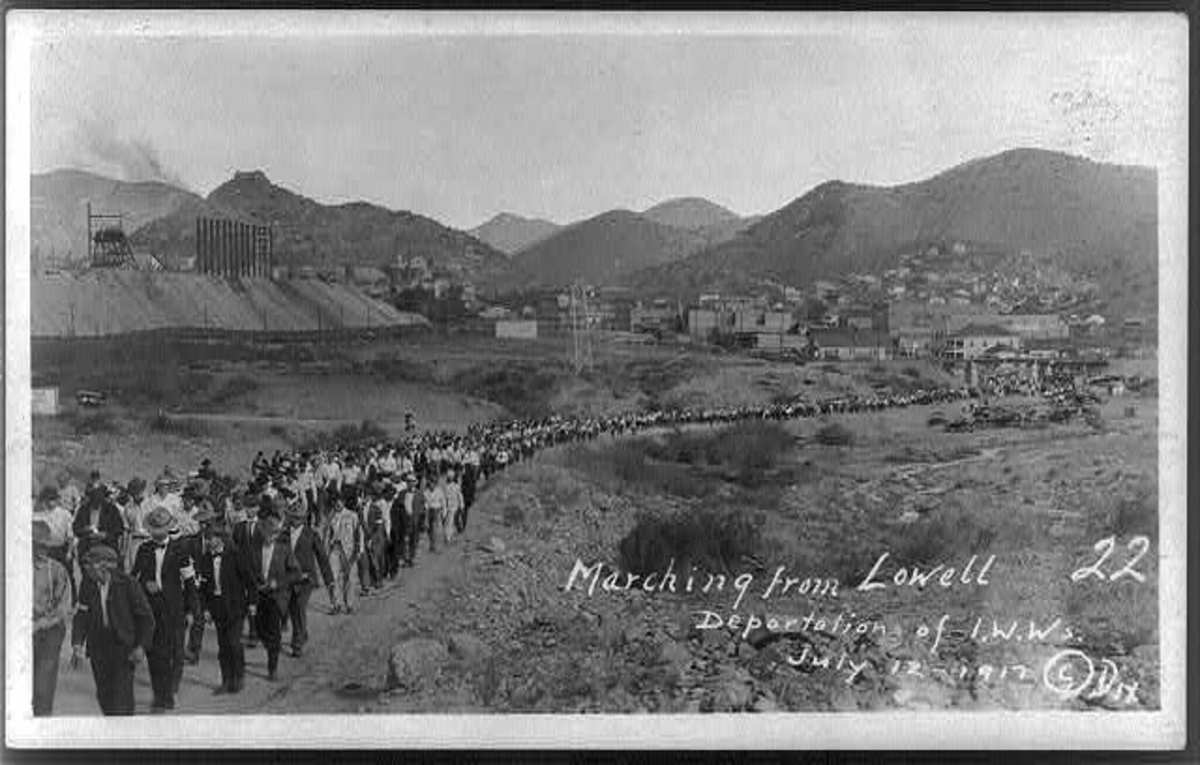
On 12 July 1917, two thousand sworn deputies rounded up 1,186 men in Bisbee, Arizona, loaded them into cattle cars and left them in the New Mexico desert without food or water.
The Bisbee Deportation of 1917: 1,186 Men in Cattle Cars
Bisbee sat in a narrow canyon in the Mule Mountains, a few miles north of the Mexican border. In 1917 it was one of the richest copper districts in the world, and it belonged, in every practical sense, to two companies: Phelps Dodge and the Calumet & Arizona. Between them they held the mines, the smelters at Douglas, the railroad that hauled the ore and the hospital.
On the morning of 12 July that year the sheriff of Cochise County deputised some two thousand men and used them to remove 1,186 people from the district before lunch. No one was ever convicted of anything.
Half the Workforce
The Industrial Workers of the World had been organising the Bisbee mines through the spring. On 24 June 1917 the union sent the companies its demands: better safety underground, two men on a drilling machine and two on an ore hoist, an end to the post-shift physical examinations, an end to the sliding wage scale tied to the price of copper, and an end to discrimination by race and by union membership.
The companies declined to meet the union at all, and within days something over half the district’s miners were out. Accounts differ on which day the walkout began — 26 June, 27 June and the first days of July all appear in the record.
The timing did more work than the demands. The United States had entered the war in April, copper was a war material, and a strike in Bisbee could be described as sedition rather than as a wage dispute.
The Ballpark
Deputising went on through the night of 11 July. By sunrise roughly fifteen hundred men had been sworn in, with more arriving from Douglas. The Western Union office was asked to hold outgoing telegrams until the mine managers released them.
The roundup began around half past six. Deputies worked through Old Bisbee and Lowell, taking men out of boarding houses and off the street, strikers and non-strikers together. At one rooming house a boilerman’s helper named Jim Brew fired through his door, killed a Calumet & Arizona shift boss named Orson McRae who was serving as a deputy, and was shot dead where he stood. They were the only two deaths of the day.
The men were marched two miles to the ballpark at Warren and held under guard. Roughly seven hundred were released after agreeing to renounce the IWW and go back to work.
Twenty-Three Cattle Cars
That left 1,186. By late morning they were being loaded into twenty-three box and cattle cars on the El Paso and Southwestern — Phelps Dodge’s own railroad. The floors had not been cleaned.
The train ran two hundred miles east. At Camp Furlong, the Army post at Columbus, New Mexico, the officer in charge refused them: he had no orders and nowhere to put them. The train backed west and put the men off at Hermanas, a siding in open desert, at about three in the morning, without food, water or shelter.
The Army collected them two days later and housed them at Columbus in tents pitched for Mexican refugees. The camp emptied slowly; in early August some eight hundred and fifty were still in it. They had been told not to come back to Bisbee, and most of them did not.
Wholly Illegal
President Wilson appointed a mediation commission, which took evidence and reported on 6 November 1917. Its finding was flat: the deportation was “wholly illegal and without authority in law, either State or Federal.” The commission held that it had been planned in Bisbee by, among others, officers of Phelps Dodge and the Calumet & Arizona.
A federal grand jury indicted Sheriff Harry Wheeler and about two dozen others in 1918. The trial judge threw the case out, and on 13 December 1920 the Supreme Court agreed. In United States v. Wheeler, 254 U.S. 281, it held that seizing citizens and carrying them out of a state was not a federal offence — that power had been reserved to the states. Congress did not make interstate kidnapping a federal crime until 1932.
Arizona tried one man. H. E. Wootton stood in April 1920 as a representative defendant for two hundred and ten others, and the jury acquitted him in sixteen minutes. No one else came to trial.
The Town in 1955
A Stone’s Throw is not about the deportation. It opens in March 1955, thirty-eight years later, with a ward nurse named Helen Calloway at the Copper Queen Hospital in Bisbee.
But the Copper Queen was a company hospital. The company put a doctor into the camp in 1883 to fight the typhoid that came through every summer, moved the whole building to Lowell on a railroad spur in 1909, and rebuilt it on Copper Queen Plaza in 1929. Phelps Dodge ran it until 1961.
So the town in the novel is still the company’s town. The men on Helen’s ward are Phelps Dodge men with the mineral line under their nails that no hospital soap reaches, and the rails outside are the rails that did the hauling in 1917. The book never mentions the deportation, and in Bisbee it would not have had to.
A Stone’s Throw is book one of the Legacy’s Child series.
Sources
- University of Arizona Libraries, Special Collections — “Remembering the Bisbee Deportation of 1917” and the Bisbee Deportation legal papers and exhibits
- Daniel F. Cracchiolo Law Library, University of Arizona — Bisbee Deportation Case digital collection
- Report of the President’s Mediation Commission to the President of the United States, 6 November 1917
- United States v. Wheeler, 254 U.S. 281 (1920)
- Arizona Geographic Alliance, Arizona State University — “An Overview of the Bisbee Deportation of 1917”
- ABA Journal, “Dec. 13, 1920: The Bisbee deportations are upheld”
- Copper Queen Community Hospital — hospital history