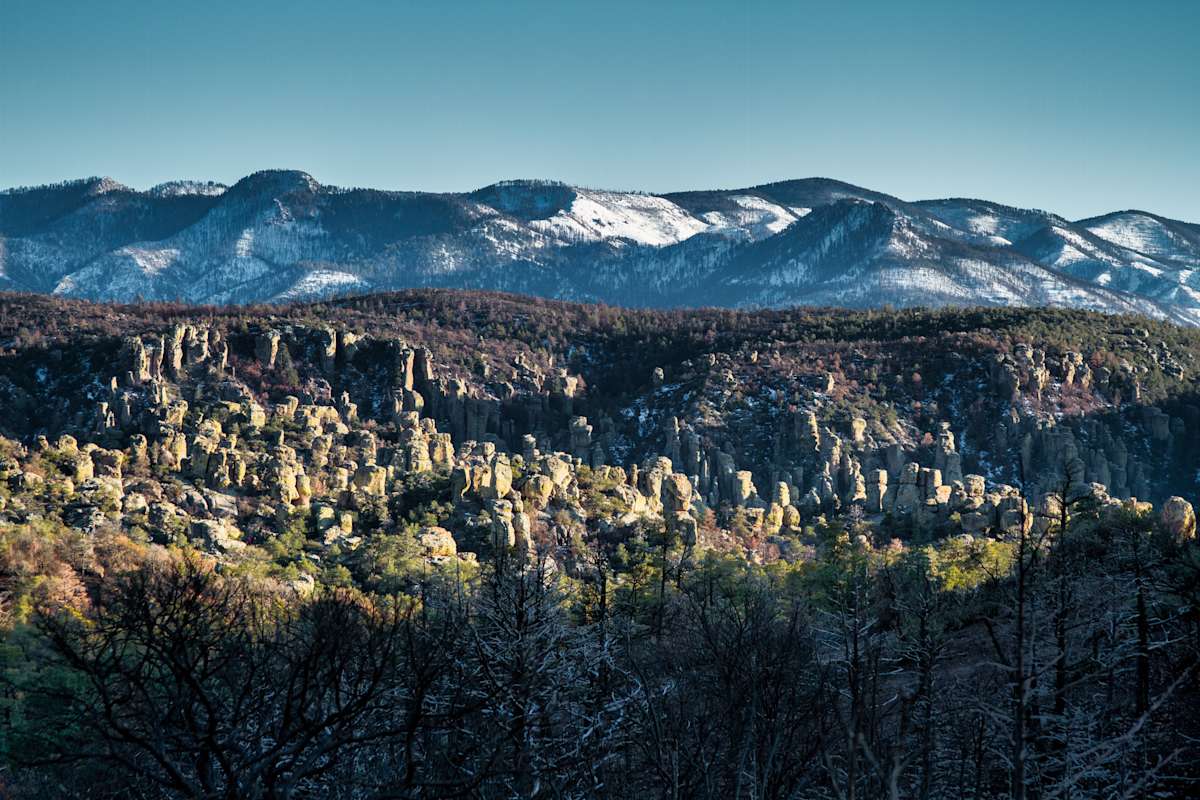
The last confirmed flock of wild thick-billed parrots in the United States was seen in 1938 in the Chiricahua Mountains of Arizona, and no record proves they ever nested there.
Arizona lost a parrot. Not a cage bird gone feral, but a green, red-shouldered bird of the high pine forest that crossed the Chiricahuas in flocks loud enough to hear before you saw them. Then it stopped coming. The people who study it are still arguing about what it had been doing here in the first place.
Parrots in the Pines
The thick-billed parrot, Rhynchopsitta pachyrhyncha, is a bird of mountain conifer forest, and its stronghold is the Sierra Madre Occidental in Mexico. The Federal Register notice accompanying the species recovery plan puts the older picture plainly: the range extended from Mexico into southern Arizona and possibly southwestern New Mexico.
The National Park Service describes flocks that once roamed the Sky Islands of the American Southwest, foraging for pine cone seeds at elevations between six thousand and nine thousand feet. The recovery plan ties nesting above roughly six and a half thousand feet to the high-elevation occurrence of Mexican white pine. Take away the mature pine and you have taken away both the larder and the nest.
The 1917 Irruption
The best documented American appearance is not a settled population but an invasion. Alexander Wetmore, writing in 1935, collected accounts of thick-billed parrots in several canyons of the Chiricahua Mountains, present from the summer of 1917 through the spring of 1918. The recovery plan records the detail that matters: no nests were reported.
A 2025 paper by Benjamin E. Leese in the journal Huitzil gives the likeliest reason. Many parrots migrated north into Arizona from July 1917 to March 1918, he writes, probably because of drought in their normal range. A pine crop fails in the Sierra Madre, birds that live on pine seed go looking, and some of that looking carries them over the border.
Which leaves the question the record has never closed. The recovery plan states it flatly: whether the species ever bred historically in the United States has not been confirmed.
The Last Flock
The birds were easy to kill. The National Park Service: the parrots are noisy, which made them easy for hunters to follow and shoot, usually for food, in the late eighteen hundreds and early nineteen hundreds.
Noel Snyder and four colleagues, writing in The Condor in 1994, reached the same conclusion. Extirpation from the United States, they wrote, may have resulted mainly from widespread shooting, and the birds have rarely been seen outside Mexico since the nineteen twenties.
The Park Service, the Sonoran Joint Venture and the Fish and Wildlife Service recovery plan all give the same date and the same place: the last confirmed sighting of a wild flock in the United States was in 1938, in the Chiricahua Mountains. One loose thread remains, which the recovery plan names without endorsing: an unconfirmed 1964 report of a flock in the Animas Mountains of New Mexico. The species was listed as endangered on 2 June 1970.
Back and Gone Again
Arizona tried to put them back. Releases began in 1986, and Snyder and his colleagues reported the results. Birds taken as wild-caught adults survived well and some bred in the wild. Captive-reared birds did badly, mainly because they could not forage and could not hold a flock together, and were taken heavily by predators.
Then the food failed. A near total collapse of the cone crop in 1989 in southern and central Arizona scattered the nucleus of released birds. A later release in late 1992 had to be confined to West Turkey Creek in the Chiricahuas because no other canyon had a good cone supply, and within half a year the birds had eaten every visible cone there and dispersed. The Park Service records the last reintroduced parrot as seen in 1995.
In Mexico the species holds on. Monthly surveys across five breeding areas in 2012 returned a minimum of 1,870 birds and a maximum of 2,097. The Sonoran Joint Venture reports at least 1,043 counted across six sites in 2013. The two are not measuring the same thing. What is not disputed is the pressure: extensive logging of large, mature pines since the early nineteen forties, the removal of nesting snags, severe fire, the illegal pet trade, and a temperate forest cover in Mexico that fell by a quarter between the nineteen seventies and 2002.
Voices in the Grove
The Memory Keepers is the third novel in The Ridge Watcher, and the parrots give it its title. Bee Adkins, a predator hunter working a lion bounty, follows a track into a Chiricahua basin hollowed out by old Spanish mine workings, and in a grove of ancient hollow sycamores he finds a resident flock of thick-billed parrots. The birds hold fragments of human speech — Spanish mining commands, a Yaqui curse, a phrase of English — absorbed from the miners and refugees who sheltered under those trees. Nantan, the Yaqui guide, calls them memory keepers.
The novel says where that came from. Its introduction opens: This book is inspired by a true story, as related by my grandfather, Bee Adkins. The story of a lone hunter deep in the mountains and hearing voices in the night.
Sound in those canyons behaves oddly for reasons that have nothing to do with ghosts, and that has a post of its own: https://duanekeelingbooks.com/blog/the-ghost-of-a-winchester-30-30-acoustic-shadow-in-canyon-country
The Memory Keepers is here: https://duanekeelingbooks.com/books/the-memory-keepers
Sources
- United States Fish and Wildlife Service, the recovery plan addendum for the thick-billed parrot
- The Federal Register, the notice of that recovery plan addendum, 2 July 2013
- National Park Service, Chiricahua National Monument, on the thick-billed parrot
- The Sonoran Joint Venture, on conserving thick-billed parrots
- Noel F. R. Snyder, Susan E. Koenig, James Koschmann, Helen A. Snyder and Terry B. Johnson, “Thick-Billed Parrot Releases in Arizona,” in The Condor, volume 96, 1994
- Benjamin E. Leese, “Historical winter records of the Thick-billed Parrot (Rhynchopsitta pachyrhyncha) in Chihuahua,” in Huitzil, volume 26, 2025
- Photograph: Chiricahua Mountains by Duane Keeling Photography, Copyright 2012. Used with permission.