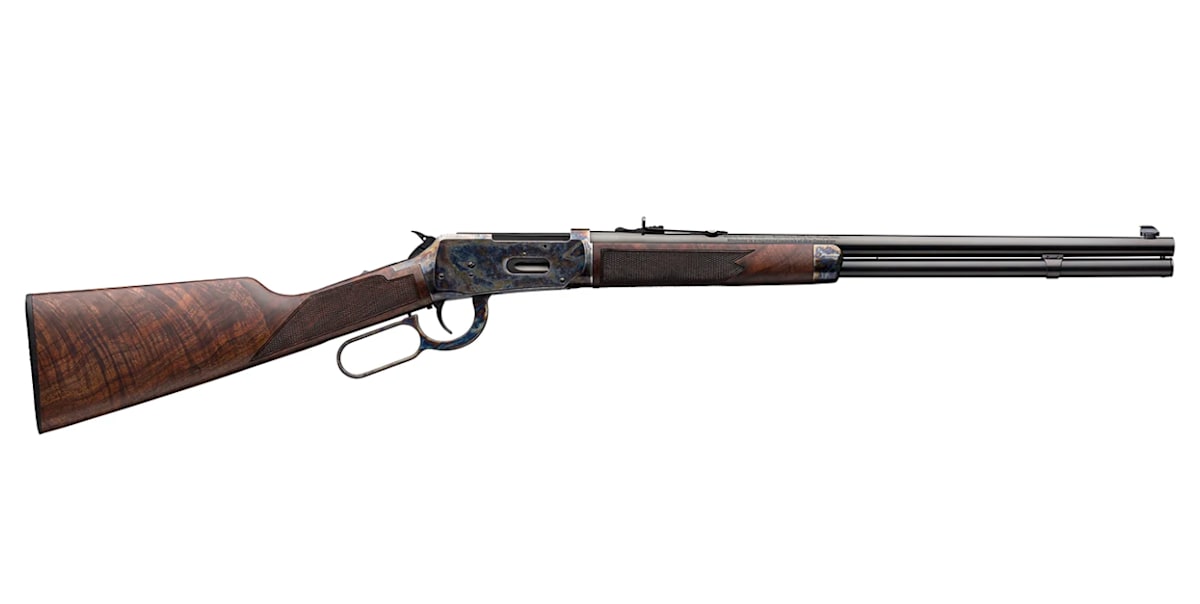
An acoustic shadow can swallow a rifle shot fired a few hundred yards off while the same shot carries clearly for miles. It is the air that does that, not the canyon wall.
A .30-30 leaves the muzzle at roughly twice the speed of sound. It should be impossible to miss. In the Chiricahuas it is not.
Twice the Speed of Sound
The cartridge arrived in 1895, in the Winchester Model 1894, and it is still the rifle most likely to be behind a saddle in that country. A standard 150-grain load leaves a 24-inch barrel at 2,390 feet per second; a 170-grain at 2,200. Sound itself moves at about 1,125.
So the bullet outruns its own report, and anyone off to the side gets the supersonic crack of its passage before the muzzle blast arrives at all. This is not a quiet rifle at any distance a man is likely to be standing.
And yet there are places where you can watch the smoke and hear nothing.
The Air, Not the Rock
The usual explanation is that steep rock walls deflect the sound upward — the canyon as a giant silencer. That has it backwards. Rock reflects. A ravine is the opposite of a silencer; it is a reverberation chamber.
What removes the sound is the atmosphere, and acousticians give three mechanisms for it.
Absorption. Material between you and the shot soaks up the energy — an intervening ridge, heavy timber, broken ground.
Wind shear. Wind moves faster with height. A sound travelling upwind has its lower edge held back relative to its upper edge, which tilts the whole wavefront and lifts it over your head. Nineteenth- century experiments found an upwind shadow beginning as close as twenty yards from the source.
Temperature gradient. On an ordinary hot afternoon the air is warmest at the ground, which bends sound upward and away from a listener at ground level. Under an inversion — cold air at the surface, warmer air above — the bending reverses and sound carries far beyond any reasonable distance.
Together these produce something stranger than simple silence: concentric rings of audibility and quiet around a loud noise. You can be standing in the dead ring while someone much farther off hears it perfectly.
Ten Miles and Pittsburgh
The best-documented cases come from the Civil War, where the consequences were measured in lives.
At Seven Pines on 31 May 1862, General Joseph Johnston could not hear a full-scale battle two miles from where he stood. Civilians in Richmond, five to ten miles away, heard it clearly.
Gettysburg was more extreme still. The Acoustical Society of America notes that sounds from the battle which could not be heard ten miles off were heard clearly in Pittsburgh, a hundred and fifty miles away.
Commanders lost battles to this. A man in a ravine in Arizona only loses a hunt — but the physics is identical, and so is the feeling of standing in a silence that ought not to be there.
It cuts the other way too, and that is the part worth remembering in rough country. If you cannot hear a shot fired a few hundred yards off, you also cannot tell where the man who fired it is standing, or whether he is alone, or whether he has heard you. Silence in a canyon is not the absence of information. It is bad information.
The Stone Is a Liar
Rock does something else, and it is the half the first version of this post left out. It does not swallow sound. It relocates it.
Concave walls throw a report back distorted and delayed, so it arrives from a bearing that has nothing to do with where it was fired. In an old mining basin, honeycombed with Spanish workings and walled with limestone, a voice can seem to come from everywhere and nowhere at once. A man calling for help down there is impossible to place. So is a man who does not want to be found.
There is one more layer in the Chiricahuas, and it is the reason I wrote a novel about it. My grandfather, Bee Adkins, told a story about hunting alone in those mountains and hearing voices in the night — and, after several days, working out that the voices belonged to feral parrots, repeating words and phrases they had learned from people long dead.
The Memory Keepers is built on that story: Bee in the Chiricahuas in 1942, in country where the air hides gunshots, the stone misplaces them, and the birds keep what the dead said.
Sources
- Charles D. Ross, Acoustic Shadows in the Civil War, Acoustical Society of America
- Refraction of Sound in the Atmosphere, Acoustics Today
- Winchester Repeating Arms, .30-30 Winchester factory ballistics
- Family account of Bee Adkins, 1903–1954, as related to the author