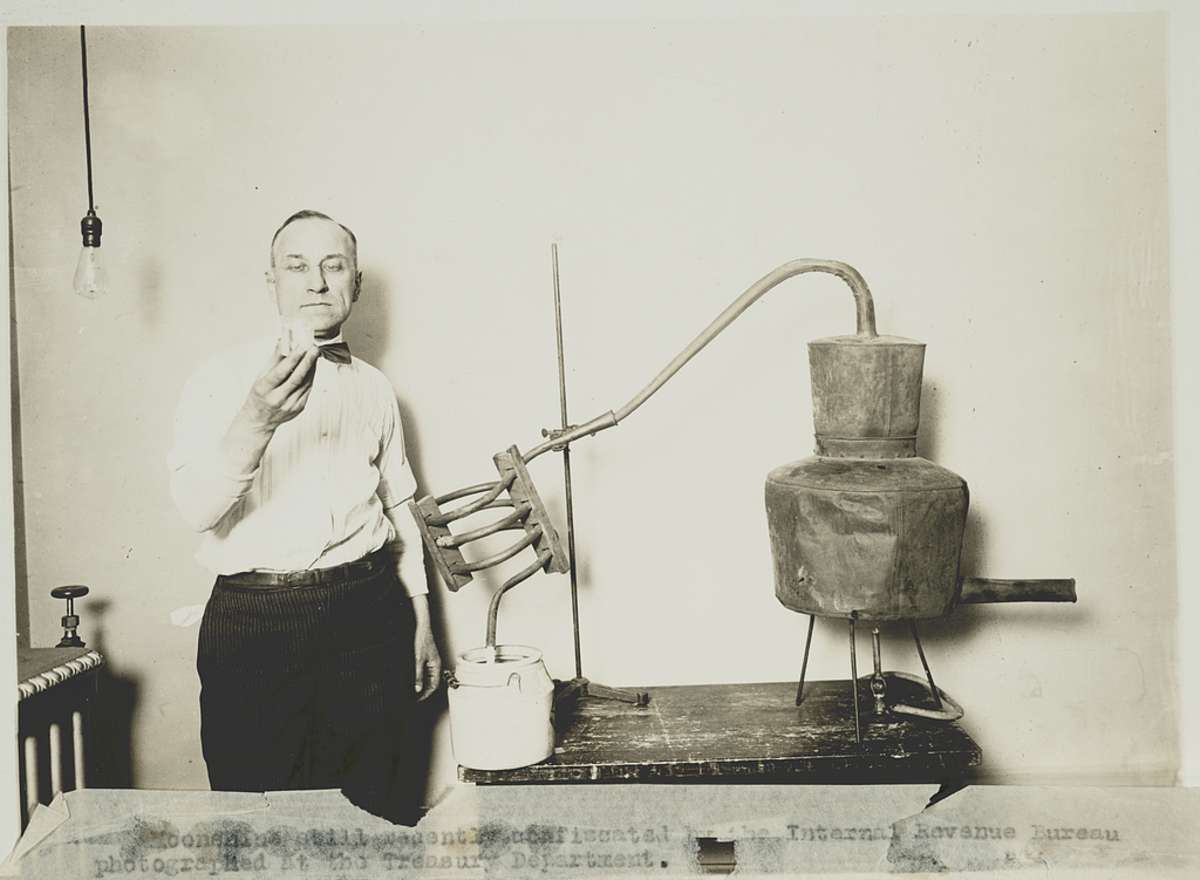
Arizona went dry on 1 January 1915, five years ahead of the nation, and for nearly nineteen years its liquor came from mountain stills and from across the line in Sonora.
The story of Prohibition usually begins with the Volstead Act and ends with the Twenty-first Amendment. Arizona’s version began sooner and finished sooner. In between, the state learned what every dry place learns: a law against liquor mostly changes where the liquor comes from.
Thirteenth to Go Dry
On 3 November 1914, Arizona voters amended their constitution to ban the making and selling of liquor, and bringing it into the state — “ardent spirits, ale, beer, wine, or intoxicating liquor or liquors of whatever kind.” It was close. Ballotpedia’s record of the returns gives 25,887 for and 22,743 against.
Arizona women had won the vote two years earlier, on 5 November 1912, by 13,422 to 6,202 — the largest margin for suffrage in the country, according to the University of Arizona’s Special Collections. Homer Thiel, a historical archaeologist at Desert Archaeology in Tucson, credits the dry vote to strong support from those new voters.
The law took effect on 1 January 1915, and Arizona became the thirteenth state to go dry. In Tucson, Thiel writes, men packed the saloons on New Year’s Eve for their last legal drinks. The penalty afterward, as the Heritage Square museum in Phoenix quotes the statute, ran from ten days to two years in jail and a fine of twenty-five to three hundred dollars.
South to Nogales
The nearest wet ground was across the border. Many of the men who drank that last legal round in Tucson, Thiel writes, were soon crossing into Nogales, Sonora, for beer or hard liquor. The traffic ran north as well. In June 1918 the Nogales Daily Morning Oasis reported two men convicted of carrying liquor illegally; they drew ninety days in the county jail and fines of $100 and $150.
National Prohibition caught up in January 1920. Congress had passed the Volstead Act on 28 October 1919 over President Wilson’s veto. It drew the line at one-half of one per cent alcohol, which took in beer and wine as well as whiskey, and a first offence of making or selling liquor carried a fine of up to $1,000 or up to six months in jail. Arizona was already dry. What changed was who could come looking.
Stills in the Canyons
Most Arizona liquor never crossed a border. It was made in the high country, where water, firewood and privacy came together. The Rim Country Museum in Payson, citing an Arizona Highways article by Vernon Haught, puts thirty to forty stills in operation around that one town, and says the local product, Payson Dew, was in demand as far away as Los Angeles. By the Depression years, as a Rim Country historian told the museum, the reason was simple: “People were starving. I mean, there was no money. And this was a way they had to make money.”
Closer to Tucson, Thiel records bootleggers at work in the old well building at Steam Pump Ranch, in what is now Oro Valley — the ranch whose earlier life is told here: https://duanekeelingbooks.com/blog/steam-pump-ranch-and-george-pusch-1874-to-1921
Pack Trains at Night
On the line itself, enforcement was split among agencies. Congress authorized mounted guards for the border in March 1915, and on 28 May 1924 it created the U.S. Border Patrol. U.S. Customs and Border Protection counts three federal border patrols in the Prohibition years; the third was formed in 1927 inside the new Bureau of Prohibition. Whiskey bootleggers, the agency’s history says, avoided the bridges and moved their cargo by pack mule.
On 25 July 1926, Patrol Inspector Lon Parker was following mounted liquor smugglers west of the Huachuca Mountains. The National Border Patrol Museum records that he was shot in the back, killed the smuggler, Artilio Espinosa, and Espinosa’s horse, and rode two and a half miles to the Wills Ranch before he collapsed. The Nogales Border Vidette reported twenty gallons of liquor lying beside the dead man.
Arizona gave up first. On 8 November 1932 its voters repealed the state’s prohibition amendment, 63,850 to 36,218. The state ratified the Twenty-first Amendment on 5 September 1933, and national Prohibition ended on 5 December.
A Model A Coupe
Trail of Shadows, the second Bee Adkins novel, is built on the life of the author’s grandfather, and it puts him in these canyons with a trap line, a wife, a small daughter and not enough money. Hunting bobcats in the Tucson Mountains, Bee walks into a still and turns down an offer to run jars. Two years on, he finds the same pair of moonshiners working the Catalinas and says yes: a dollar a jar for delivery, three collected at each door, and the assurance that a couple of the local judges are regular customers.
Bulging saddlebags draw looks in town, so he buys a banged-up Model A coupe that his brother finds for him in Chandler — a hundred and fifty dollars, and an afternoon of stalling it in the yard before the drive home. That night his wife, Viola, learns where the money came from, and lies awake: A beautiful machine, paid for with sin.
Later he sets up a still of his own, with a copper pot bought from a retiring moonshiner in Nogales. A few years after that, with Prohibition gone, the whiskey money is drying up.
Trail of Shadows is book two of the Bee Adkins Series: https://duanekeelingbooks.com/books/trail-of-shadows-bee-adkins-book-2
Sources
- Homer Thiel, “A Cooling Drink of Beer or a Bracing Glass of Something Stronger: A Short History of Alcohol in Tucson,” Desert Archaeology, Inc.
- The Square PHX (Heritage Square, Phoenix), “Bottoms Up: A History of Prohibition in Arizona”
- Ballotpedia, Arizona Measure Nos. 100–101 (1914) and Nos. 104–105 (1932)
- University of Arizona Libraries Special Collections, online exhibit on Arizona women’s suffrage
- Rim Country Museum, “Prohibition and Payson Dew”
- Constitution Annotated, Congressional Research Service, “Volstead Act”; National Prohibition Act, Title II, Section 29
- U.S. Customs and Border Protection, Border Patrol history, and “During the Prohibition Era There Were 3 Federal Border Patrols”
- National Border Patrol Museum, agent memorials: Patrol Inspector Lon Parker
- El Inde Arizona, “Nothing New About Santa Cruz Smuggling,” citing the Nogales Daily Morning Oasis (1918) and the Nogales Border Vidette (1926)
- Arizona Department of Liquor Licenses and Control, “The History of Liquor in Arizona”