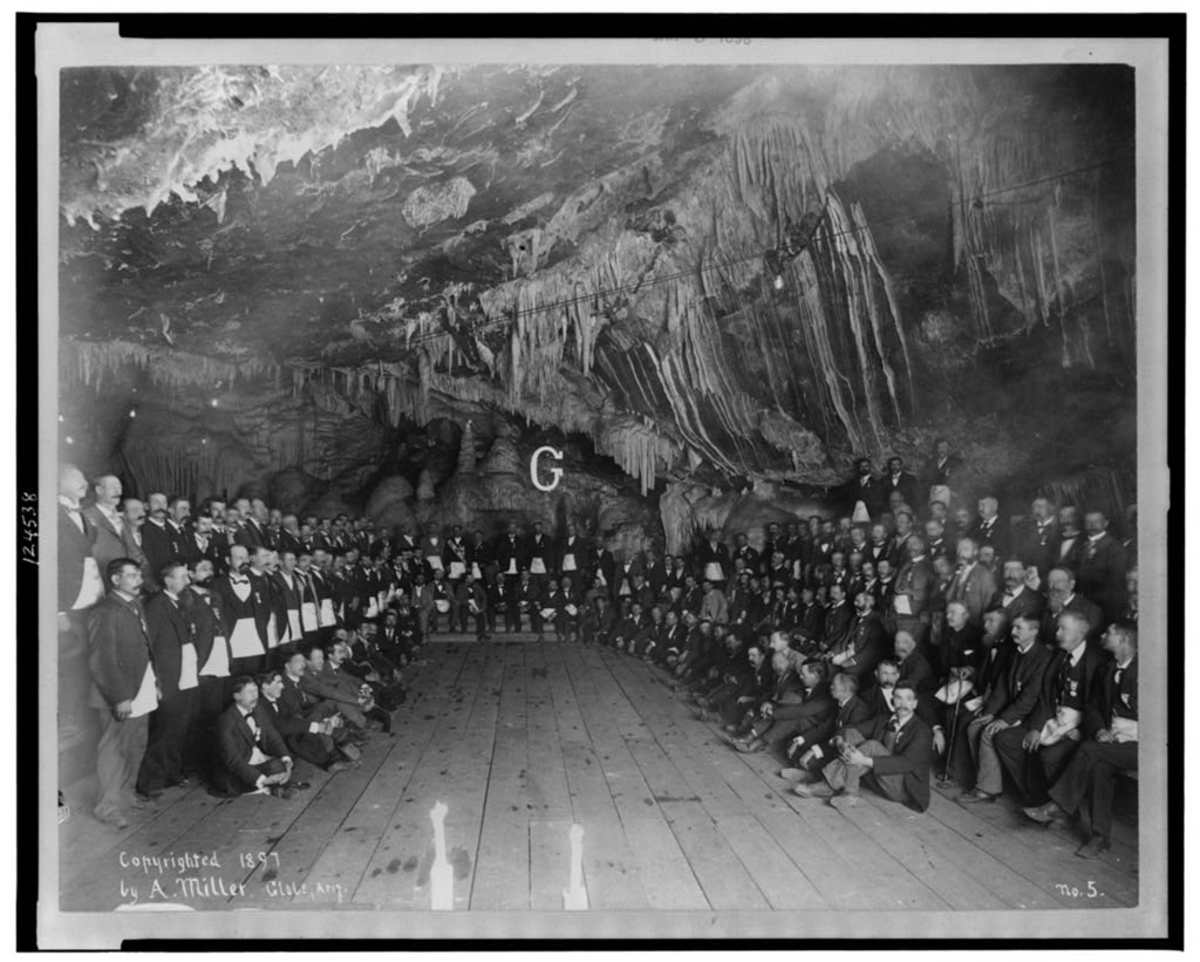
Bisbee’s hard-rock miners drove more than two thousand miles of tunnel under the Mule Mountains, and the underground work did not stop when the Lavender Pit opened in 1954.
The ore at Bisbee was lying in plain sight. It stood out of the hillside across from what is now downtown, and the first man to file a claim on it decided it was not worth keeping.
In William Ascarza’s account in the Arizona Daily Star, that man was Hugh Jones, who found the deposit in 1877, dismissed it as copper-stained rock and let the claim go. It passed to George Eddlemann and M. A. Herring, and then to John Ballard and William H. Martin, who worked it as the Copper Queen. The ore they were breaking averaged twenty-three per cent copper.
The Glory Hole
Mining began where the ore did. The Mining History Association’s account of the workings puts it plainly: mining started at the surface in the Glory Hole, and then followed the ore deep underground. George Center built the camp’s first smelter in 1880, a thirty-six-inch water-jacketed cupola. In 1881, on the recommendation of the metallurgist James Douglas, Phelps Dodge bought the adjoining Atlanta claim for forty thousand dollars and spent seventy thousand more proving the ground, which turned up an orebody running under both properties. The two became the Copper Queen Consolidated Mining Company in 1885, and the railroad reached Bisbee on 1 February 1889.
Square Sets
After that, the work was mostly a problem of holding the mountain up. The ore bodies were irregular and the ground around them was not always sound, so the miners built the roof they needed out of timber. The Mining History Association describes the method: when the surrounding rock was unstable, the miners constructed timber square sets to support the walls of the stope. It was, that account adds, a very costly way to mine — and the high percentage of copper in Copper Queen ore was what made it practical.
The rest of the underground was improvised at the same scale. Men drilled by hand before compressed air reached the levels. Shafts lowered them in cages worked by bell signals rung from below. Ore went down chutes. Somewhere in the middle of it a shift foreman kept an office underground, and a bicycle to get from one part of the mine to another.
Two Thousand Miles
The Bisbee Mining and Historical Museum counts the result: hard-rock miners who blasted, drilled and mucked more than two thousand miles of tunnels through the surrounding mountains. A United States Geological Survey map of 1904 already showed a maze of horizontal tunnels across several mines, with vertical shafts and raises tying the levels to each other. What came out was not only copper — James Douglas’s collection of Bisbee mineral specimens went to the Smithsonian Institution.
What the work felt like survives mostly as recollection rather than record. The museum’s oral history collection is indexed under headings like mucking and stope work, mining accidents and leasing accidents: old men, taped decades afterwards, describing a place almost nobody photographed.
Pit and Drift
In 1951 Harrison Lavender, then manager of the Copper Queen branch of Phelps Dodge, judged that an open pit would reach ore the drifts could not reach economically. Production in the Lavender Pit began on 7 August 1954, and the pit is the part of Bisbee most visitors see today. That story is told here: https://duanekeelingbooks.com/blog/the-lavender-pit-and-the-town-of-lowell-1954-to-1974
It is also only half of what was happening. The underground did not close. Through the 1940s the district’s principal products had been lead and zinc rather than copper, and men kept going down long after the shovels started. The pit played out in 1974. Underground mining shut down by the middle of 1975, when 488 employees were laid off, and the Center for Land Use Interpretation records that all mining at the Copper Queen ceased that year, with the copper price falling. For two decades a Bisbee miner could have been working either one.
Twenty-Two Years
That overlap is why The Last Report can put an injured underground man in a Bisbee hospital bed in August 1954 and be exactly right. Its narrator wakes beside a miner in a Phelps Dodge cap, his leg broken when a timber gave, who volunteers that he has twenty-two years underground behind him and this is the first time the work has got him.
It is a whole career stated in one line, and it is the career described above: square sets and bell codes, a cage down and a cage up, from before the pit was thought of until after it opened. The nurse on that ward thinks of her patients as the miners with their crushed hands and silicosis lungs. That is what two thousand miles of tunnel cost, counted in one hospital corridor.
The Last Report is the fourth Ridge Watcher novel, and it begins in Bisbee in the first days of August 1954, four days before the shovels started: https://duanekeelingbooks.com/books/the-last-report
Sources
- William Ascarza, Mine Tales, Arizona Daily Star
- The Mining History Association, its Bisbee field trip guide and Copper Queen Mine pages
- The Bisbee Mining and Historical Museum, a Smithsonian Affiliate, its Digging In exhibit and its oral history collection
- The Center for Land Use Interpretation, its land use database entry for the Lavender Pit
- Library of Congress, Prints and Photographs Division