The Lavender Pit at Bisbee began producing copper in 1954, and by the time it closed it had moved 351 million tons of rock and taken most of the neighboring town of Lowell.
Bisbee had been a copper town for seventy years before anyone cut the Lavender Pit, and by 1950 the ore that made it rich was largely gone. What remained under Sacramento Hill was copper spread too thin through the rock to pay for a shaft and a crew underground. The pit was the answer, and the answer was to stop being selective.
Not the First Pit
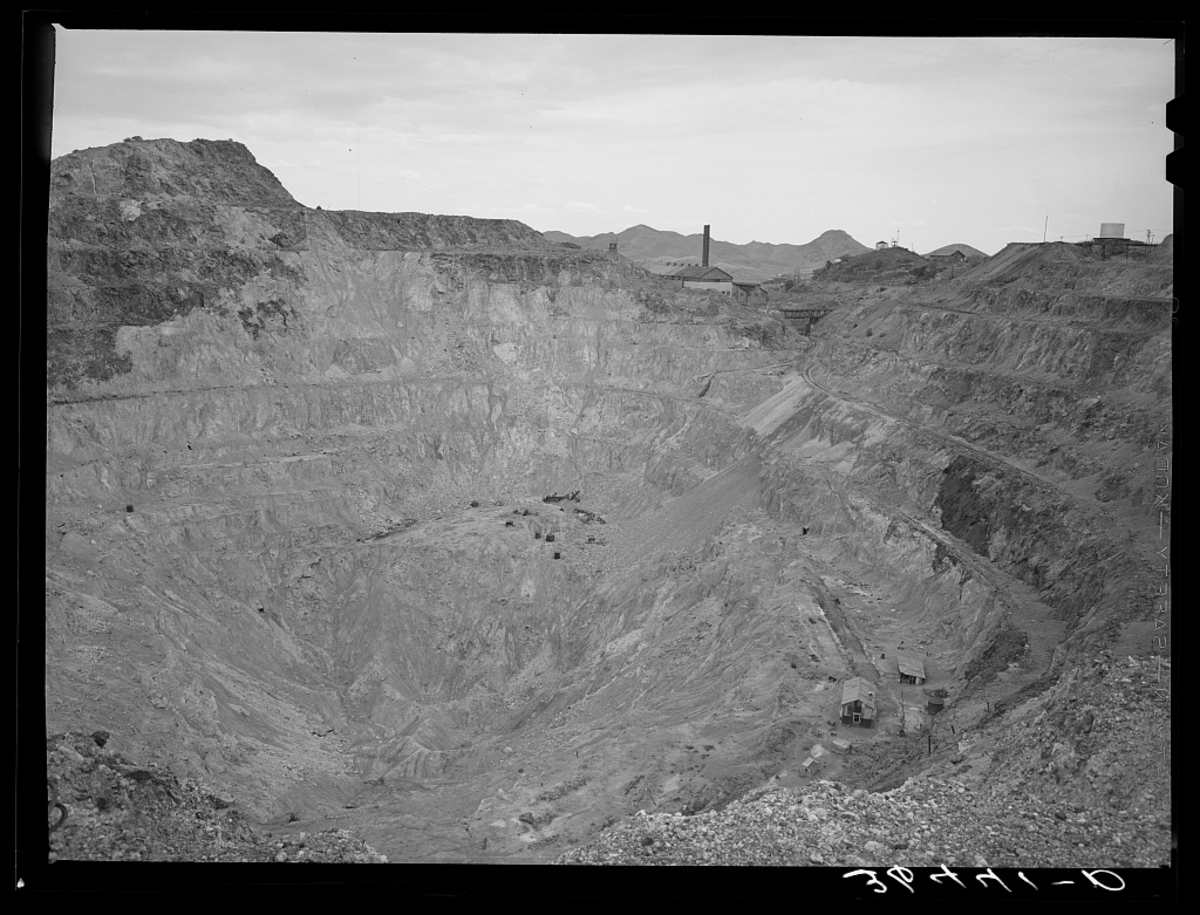
The Lavender was Bisbee’s second open pit, not its first. The Sacramento Pit had been cut into the same hill a generation earlier, and a Farm Security Administration photographer, Russell Lee, photographed what was left of it in May 1940. The Library of Congress caption on his negative is a history in itself: a shaft sunk into the east wall in 1911, a dynamite charge in 1917 that blew off the top rock of the crown, and by 1931 a pit floor grown too narrow for the dredges to work in. The caption gives the pit as 435 feet deep across thirty-five acres, and its yield between 1917 and 1931 as 20,843,667 tons of ore.
That is not the only count. The historian William Ascarza, writing in the Arizona Daily Star, gives the same thirty-five acres but puts the total at ten million tons and the end of the work in 1929. The marker at the overlook says only that open-pit mining at Bisbee began in 1917 and ended in 1974, counting both holes as one.
A Grade Worth Moving
The decision that made the second pit belongs to one man. The Center for Land Use Interpretation records that work at the Copper Queen went on in underground tunnels and shafts until 1951, when Harrison Lavender, then manager of the Copper Queen branch of Phelps Dodge, determined that an open pit would be an economical way to increase the ore yield. He did not live to see it. The dedication marker, erected in 1954, gives his dates as 1890 to 1952 and credits him with making “the hitherto unprofitable low grade copper bearing rock of the area into a commercial copper producing ore.” The pit is named for the man, not for a color.
That plan is the whole story. The Bisbee Mining and Historical Museum, a Smithsonian Affiliate, puts the pit’s total at 351 million tons of rock removed, producing 600,000 tons of copper. The Arizona Geological Survey counts the ore separately and more narrowly, at some 75 million tons produced between 1954 and 1970. Most of what came out of the Lavender Pit was never ore. It was the rock that had to move first.
Fifty Foot Benches
The hill came down in fifty-foot benches. Holes were drilled to a depth of sixty feet, loaded with twelve hundred pounds of powder, and shot. A blast commonly broke 75,000 tons of rock, and the blasts were usually fired at 3:25 each afternoon — the same minute, day after day, in a town built up the canyon walls within sight of it.
How deep the finished hole is depends on who is counting. The overlook marker and Ascarza both give 850 feet, the museum gives 900, and the Center for Land Use Interpretation gives 950. The other dimensions are less disputed: roughly 4,000 feet north to south, 5,000 feet long, across about 300 acres.
What Happened to Lowell
Ground on that scale has to come from somewhere, and in Bisbee it came from Lowell. Lowell was a separate townsite east of Old Bisbee, and the Mining History Association records that it was home to 6,000 residents at its height before most of it was consumed by the expansion of the pit. The City of Bisbee’s own National Register nomination says the same thing in the flat language of a planning document: a portion of the Lowell Townsite was removed as a result of the expansion of the Lavender Pit.
Mining in the pit stopped in 1974. All work at the Copper Queen ceased the following year, when the price of copper fell. The marker at the overlook gives the whole district’s output, across nearly a century, as some eight billion pounds of copper.
August 1954
Ascarza dates the start of production in the pit to 7 August 1954. The Last Report opens on 3 August 1954, four days earlier, which puts the whole novel inside the pit’s first months. Tohua, a Yaqui man of sixty-one who has lived alone in the Chiricahuas for thirty years, collapses on his own trail and wakes in the Copper Queen hospital with a Phelps Dodge miner in the next bed. Later in the book a call comes into the ward: a section of drift has given way at the pit, six men, two critical.
The novel is not about the mine. It is about a man being told he cannot go home, and the pit is the weather he is told it in. Underground work at the Copper Queen continued alongside the open pit until 1975, so a Phelps Dodge man in Bisbee in 1954 could have been working either, or both. For the hospital he wakes in, there is a companion piece here: https://duanekeelingbooks.com/blog/the-copper-queen-hospital-company-medicine-in-bisbee
The Last Report is the fourth Ridge Watcher novel, and Bisbee in 1954 — the company hospital, the company town, and the hole at the edge of it — is where it begins: https://duanekeelingbooks.com/books/the-last-report
Sources
- The Center for Land Use Interpretation, its land use database entry for the Lavender Pit
- The Bisbee Mining and Historical Museum, a Smithsonian Affiliate, its postcard archive
- The Arizona Geological Survey
- Library of Congress, Prints and Photographs Division, Farm Security Administration and Office of War Information collection
- The Historical Marker Database, the Lavender Pit dedication marker of 1954 and the Viewing the Pit marker at the overlook
- The Mining History Association, its Bisbee field trip guide
- William Ascarza, Mine Tales, Arizona Daily Star
- City of Bisbee, its National Register of Historic Places nomination for the Bisbee Historic District