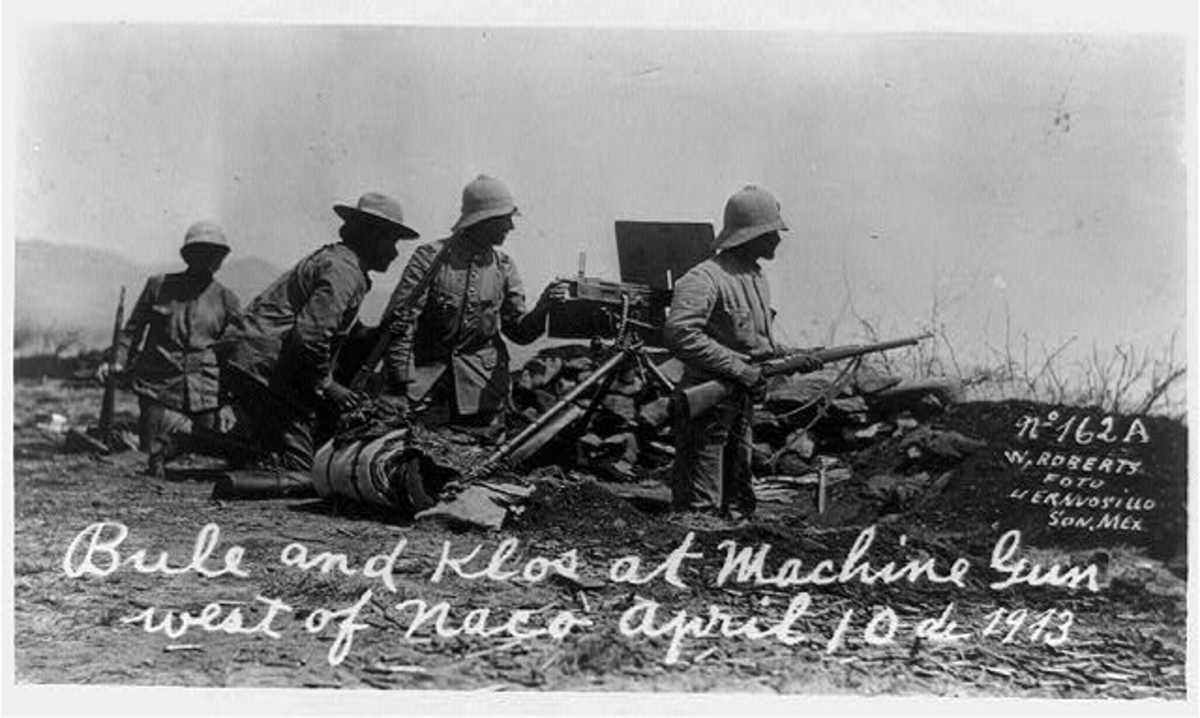
In 1910 Porfirio Díaz bought fifty-six Hotchkiss machine guns in France. Five years later, machine guns, barbed wire and trenches broke Pancho Villa’s cavalry at Celaya.
The weapon the old regime bought to protect itself ended up deciding which of its enemies would inherit the country. Mexico’s federal army was not new to automatic fire: according to Mexico’s National Institute of Anthropology and History, it had acquired six Maxim guns in 1897. The larger order came in 1910, while Francisco Madero’s presidential campaign was stirring the country, and it went to a French firm, Hotchkiss et Cie. That October, Madero called for a rising on 20 November.
Stamped in French
One of those guns survives at the Museo Nacional de las Intervenciones in Mexico City. Its receiver is stamped mitrailleuse automatique portative Hotchkiss, calibre 7 m/m, number 856 — a portable automatic machine gun, seven millimetres. The institute’s record describes the Hotchkiss as among the deadliest automatic weapons of the early twentieth century, a gun that went on to serve in both World Wars.
Mexico bought it at the moment the peace it was meant to guard came apart.
Air, Not Water
The design was not French in origin. The Smithsonian’s National Air and Space Museum, which holds a later Hotchkiss, traces it to an Austrian officer, Captain Baron Adolph Odkolek von Augeza, and calls it gas operated and air cooled — an attempt to match the success of Hiram Maxim’s guns without infringing his patents. France adopted it as the modèle 1897 and, after a run of minor changes, as the modèle 1914.
The mechanism explains its appeal in dry country. The Hotchkiss tapped gas from the barrel to drive a piston, and it cooled itself in open air, which in the words of the Imperial War Museums “obviated the need to find and transport water for cooling.” In the deserts of Sonora and Chihuahua that was not a small thing. The cost was heat: sustained fire risked overheating the barrel.
Celaya, April 1915
By 1915 the Revolution had become a war among the revolutionaries. Pancho Villa’s strength was cavalry — Britannica calls it the most formidable contingent among the revolutionary armies. Álvaro Obregón, commanding for Venustiano Carranza, dug in at Celaya, in Guanajuato, behind trenches, barbed wire and machine guns, and waited for the charge.
It came twice. In the Library of Congress’s account, Villa sent some 25,000 men against the line in the second assault on 13 April, while Obregón kept 6,000 cavalry hidden in reserve. Villa lost around 10,000 — killed, wounded, captured or deserted. The Constitutionalists counted roughly 922 dead. Obregón, the Library says, used Villa’s famous cavalry charges against him. Britannica ranks Celaya among the largest and bloodiest battles in Mexican history. Villa went north.
Lights at Agua Prieta
His last great attack came on the Arizona line. On 19 October 1915 the United States recognized Carranza as provisional president, and the National Park Service records that President Wilson then let Carranza’s troops use the railroads of the American Southwest to move reinforcements to Agua Prieta, the Sonoran town facing Douglas across the border. By the Library of Congress’s count, a garrison built for 1,200 men held 3,000, with 3,000 more sent by Carranza.
Villa attacked at night, with cavalry, on 1 November. The Library’s account of what happened next is one sentence long: When the Villistas attacked, Obregón simply lit the night with searchlights and ordered his men to open fire with their machine guns. It was over in less than three hours. Afterward, the Library says, Villa could no longer wage an offensive war. Four months later, on 9 March 1916, he raided Columbus, New Mexico.
Some of the men in Obregón’s army were Yaqui. Gale’s encyclopedia of Native American tribes says Yaqui participation in the Revolution rested on a promise from Obregón to return their land. It was not kept, and a new revolt ran until the end of 1929.
Iron in the Wash
Tohua! puts two Yaqui cousins inside that army. Antonio and Victorio join the Constitutionalists on a promise of deeds to Yaqui land, march on Hermosillo, and come through Agua Prieta. In chapter 7 their column is strung out along a dry wash near Corralitos, in Chihuahua, when Antonio stops it: “Machine gun. Hotchkiss. Ridge at eleven o’clock. Maybe a mile.”
Victorio does what the manual says, and what Villa did at Celaya: he leads forty men straight at the gun. Antonio goes around it. Afterward he walks among the dead gun crew and finds their boots worn through like his own. Their rifles were the same Mausers, just pointed the other direction. The machine gun that had seemed so mighty was just metal, already rusting in the desert air.
The gun comes back late in the book, in a sandbagged nest at a mountain checkpoint, and by then Tohua has learned something about it that the generals never wrote down: Loud things are deaf.
Tohua! is the first Ridge Watcher novel, and the war is only where it begins: https://duanekeelingbooks.com/books/tohua
Sources
- Instituto Nacional de Antropología e Historia, Mediateca, “Ametralladora Hotchkiss,” Museo Nacional de las Intervenciones, inventory 10-261194
- Smithsonian National Air and Space Museum, collection record, Machine Gun, Hotchkiss Model 1914, 8mm
- Imperial War Museums, collection record, Hotchkiss M1914
- Library of Congress, The Mexican Revolution and the United States, exhibition pages on notable battles and the timeline
- National Park Service, Village of Columbus and Camp Furlong
- Encyclopaedia Britannica, “Battle of Celaya”
- Gale, UXL Encyclopedia of Native American Tribes, “Yaqui”