Thirty-four people died and 1,032 were hurt in Los Angeles in August 1965, and the commission that investigated it recorded ambulance crews refusing to enter the area unescorted.
The Governor’s Commission on the Los Angeles Riots reported on 2 December 1965 under a title that was also a question. Most of what it gathered concerns police, schools and work. A few lines concern getting hurt, and those are the ones that explain what the hospitals did.
A Traffic Stop
On 11 August 1965 California Highway Patrol officers arrested Marquette Frye for suspected drunken driving in the Watts neighbourhood of south Los Angeles. A confrontation followed the arrest, and out of it came six days of burning, shooting and arrest across the southern districts. What to call those days has never settled. The commission the governor appointed was named for riots and used the word throughout. The health sciences library at Charles R. Drew University of Medicine and Science, which keeps the research guide to the sources, uses riot and revolt interchangeably, and dates the events 11 to 16 August. This post follows the commission’s word because the report is the document it is built on. The choice has never been a neutral one.
Six Days and Nights
The commission’s own count: thirty-four persons dead, the wounded and hurt numbering 1,032 more, and 3,952 people arrested for one crime or another. More than six hundred buildings were damaged by burning and looting and more than two hundred totally destroyed by fire. Property damage was about forty million dollars. On the Saturday it became necessary to impose a curfew on a 46.5 square mile area, making it a crime to be on the streets there after eight at night, and by the Tuesday the governor was able to lift it. The National Guard came in by stages the report gives hour by hour: 1,336 troops assembled by six on the Friday evening, 3,356 guardsmen on the streets by three on Saturday morning, and a full commitment of 13,900 reached by midnight that night.
Who Would Not Go
One sentence in the report does more work than its length suggests. Ambulance drivers and firemen, it records, were refusing to go into the riot area without an armed escort. Read from a hospital’s side, that says the ordinary direction of emergency medicine reversed for part of the week. Help did not travel to the injured. The injured travelled, in their own cars and other people’s and in whatever else was moving, to whichever door would open. The injuries follow from what the week was made of: cuts from shop windows that came down in sheets, burns across hands and wrists, smoke in the chest. No institutional source read for this post sets out how many of the 1,032 reached a hospital, or which ones. The dead were counted precisely. The treated were not.
Fifteen Miles to County
The district had no hospital of its own, and the Historic American Landscapes Survey record for the Martin Luther King, Jr. Medical Center Campus states the position in one line: lack of a local hospital required Willowbrook area residents to travel over fifteen miles to county facilities located near downtown Los Angeles for emergency or outpatient services. Fifteen miles across Los Angeles is a dull errand in an ordinary week. In a week with a curfew after eight and soldiers at the intersections it is a different distance altogether, and it was the distance a cut arm had to cover. The road ended at the county hospital above Boyle Heights. An earlier post follows the training that hospital gave, and what it cost to get into it: https://duanekeelingbooks.com/blog/women-in-medical-school-in-the-1960s-and-la-county-general
The Hospital That Followed
The commission looked at health along with everything else, and found that south Los Angeles had a greater incidence of disease, fewer medical facilities, inadequate private hospitals and a lack of medical professionals. It recommended a new, comprehensively equipped hospital in the area. That recommendation is quoted in the National Park Service survey record of the campus that came of it. A design team led by Adrian Wilson and Associates was selected in March 1966. Ground was broken on 4 May 1968 at 12021 Wilmington Avenue in Willowbrook. The new hospital accepted its first patient on 27 March 1972, and it carried the name of Martin Luther King, Jr.
What the Novel Takes
A Stone’s Throw puts a woman on the receiving floor that week. Helen Calloway begins her internship at the county hospital on the first of July 1965, so August falls six weeks into it. The novel never names the event. It stays on the ward, where triage slips are sorted by whether a patient can still talk, where the cuts are glass and the burns across hands, and cots go into a lecture hall for staff who cannot get home. Women arrive in labour from streets the buses have quit — one who could not get home before the curfew, another brought in in the back of a bakery truck — and the hospital does what an overloaded hospital does. It makes lists. Name, age, address if known, time seen, time no bed available. The book is not about the week. It is about fourteen years of one woman’s working life, and the week is a few pages of it. They are the right pages, because a ward sees a city at a scale no commission figure reaches.
A Stone’s Throw is the first book of the Legacy’s Child series: https://duanekeelingbooks.com/books/a-stone-s-throw
Sources
The Governor’s Commission on the Los Angeles Riots, Violence in the City — An End or a Beginning?, 2 December 1965, in the online document library of the Los Angeles County Metropolitan Transportation Authority
The Historic American Landscapes Survey record for the Martin Luther King, Jr. Medical Center Campus, Willowbrook, prepared for the National Park Service and held by the Library of Congress
The health sciences library at Charles R. Drew University of Medicine and Science, its research guide to the August 1965 events
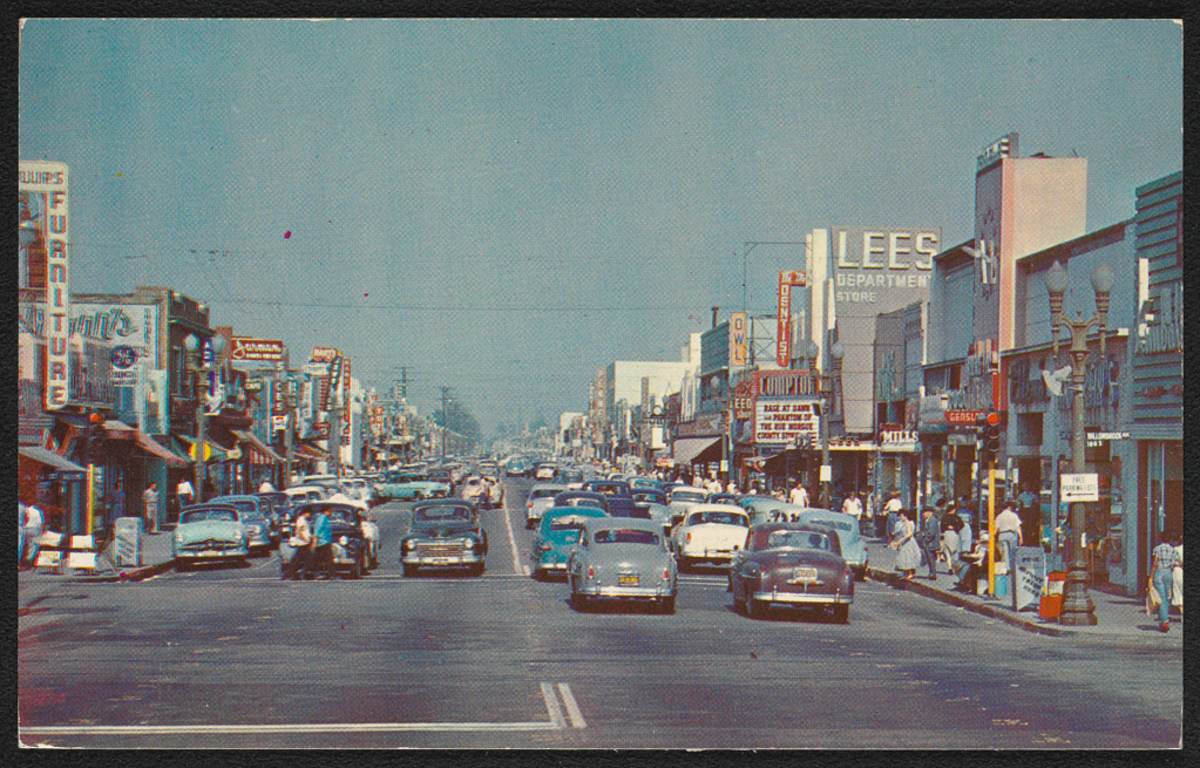
Library of Congress, Prints and Photographs Division, the Postcard filing series, the featured view of Compton Boulevard near Willowbrook Avenue in Compton, California, 1956, photographer unrecorded