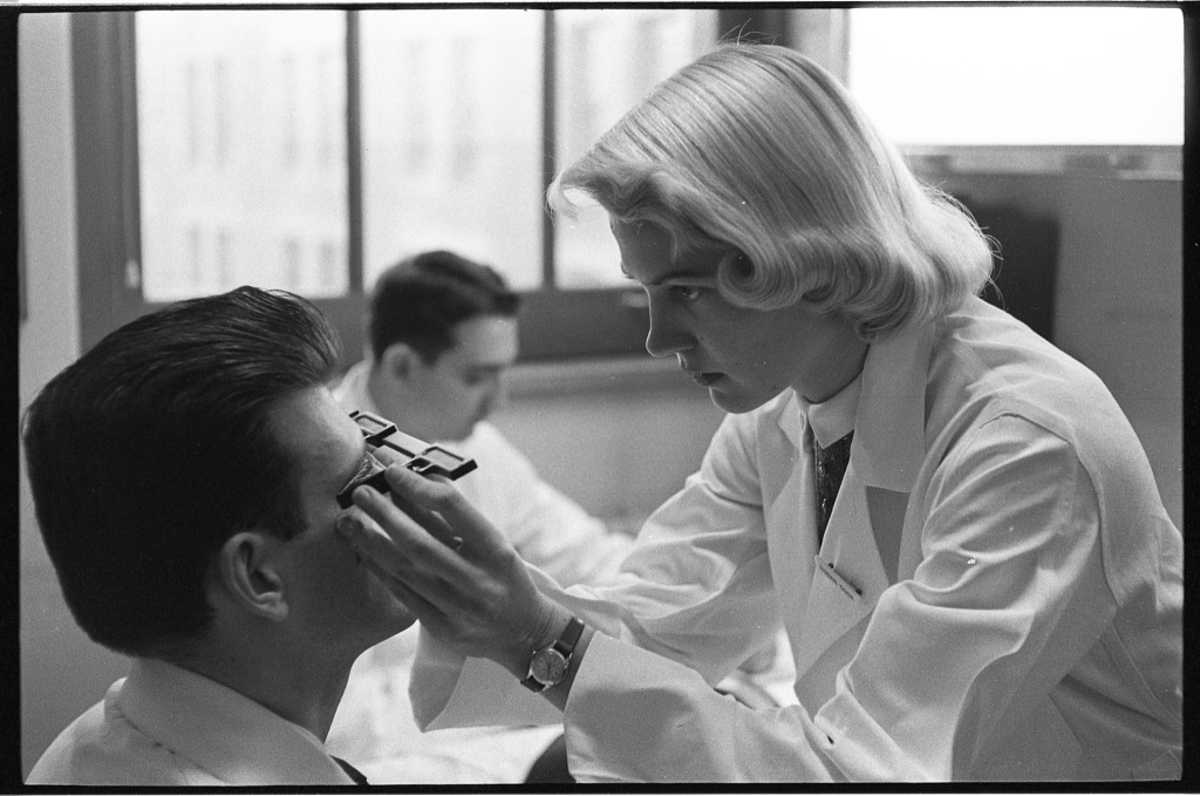
In the mid-1960s women were six percent of American medical students, and the county hospital on Mission Road in Los Angeles trained its doctors on the people who could not pay.
A woman who wanted to practice medicine in the United States in 1960 faced a sequence rather than a wall. Premedical science. An aptitude examination. An application. Four years of medical school. Then a year inside a hospital as an intern, moving through one service after another.
Every step was open to her on paper, and at every step somebody stood holding a file. That is the part that gets lost. The obstacles of that decade were rarely announced. They were administrative — a requirement certified or left uncertified, a recommendation written or withheld, a seat counted.
Six Percent
The American Medical Association’s own ethics journal states the figure without decoration: in the mid-1960s, only 6 percent of the students enrolled in United States medical schools were women. By the mid-1970s the share of women graduating had risen to 16 percent.
Ten years separate those two numbers, and what moved between them was not medicine. In May 1970 Bernice Sandler and Elizabeth Boyer of the Women’s Equity Action League testified before a Senate subcommittee about discrimination against women in universities and colleges. That June and July a House special subcommittee chaired by Representative Edith Green held seven days of hearings on discrimination in federally assisted education. Title IX of the Education Amendments was signed into law on 23 June 1972.
A woman applying to medical school in 1960 had none of that behind her. She had a transcript, a test score, and whatever anyone was willing to put in writing about her.
The Aptitude Test
The examination was older than it looked. The Association of American Medical Colleges dates its ancestry to 1931, when a Scholastic Aptitude Test for Medical Schools was piloted under Fred Moss. A revision in 1946 cut the test from eight sections to four — verbal ability, quantitative ability, science achievement, and understanding modern society — and in 1948 it was renamed the Medical College Admission Test and brought under the association’s guidance.
So a candidate sitting it in 1960 sat a national instrument with thirty years behind it, built to rank her against every other applicant in the country on the same four axes. It measured what it measured. It had nothing to say about how she had spent the previous fifteen years, and for a woman coming out of nursing that cut both ways.
Mission Road
The hospital at the far end of that sequence had begun as a poorhouse ward. In 1878 the County of Los Angeles opened a hundred-bed hospital on Mission Road to care for the county’s indigent population. In 1885 the county formed a partnership with the medical school of the University of Southern California, founded that same year, to supply the care.
That bargain is the foundation of American academic medicine and it was never disguised. The county provided the patients. The school provided the physicians. The patients were people with no other way to be treated. Doctors were trained on the poor, and the poor were treated by people still learning.
The concrete building that replaced the original opened in 1933 and runs to a million square feet on the ridge above Boyle Heights. It is a teaching hospital still, with more than nine hundred physicians working through graduate medical education on the site.
The Intern Year
Getting into an internship had been chaos within living memory. The National Resident Matching Program’s own account of its origins describes hospitals sending offers to students by telegram and telephone as early as their second year of medical school, with only hours to accept or refuse. A central clearing house was proposed by 1950, the first match ran in 1952, and the body was incorporated the following year as the National Internship Matching Program.
What the match handed a new graduate was the rotating internship — in the words of a later editorial in Mayo Clinic Proceedings, a year of broad, practical, hospital-based training immediately after medical school. Medicine, surgery, pediatrics, obstetrics, each service with its own customs and its own opinion of beginners. At a county hospital it also meant volume, at all hours, arranged around the beds rather than around the intern.
Why This Book
A Stone’s Throw follows Helen Calloway from a ward at the Copper Queen Hospital in Bisbee to a delivery room at Los Angeles County General, and the novel’s structure is that sequence exactly: ward nurse, undergraduate, medical student, intern, attending. She matriculates in September 1961 at thirty-nine, out of an Arizona hospital and, before that, the Army Nurse Corps in France.
The book is unsentimental about the arithmetic of a seat. Helen has learned to expect the question in all its forms — “why, at your age, why medicine, why now, why take a seat, why not stay where you belong.” What almost stops her is not the examination. It is a premedical science requirement that somebody has to certify, and the dean who advised her is not the officer who rules on it.
Her first intern block is medicine, ward 8B. The charge nurse hands her three problems before she has her coat off, and she takes the chart.
The ward she came from is here: https://duanekeelingbooks.com/blog/the-copper-queen-hospital-company-medicine-in-bisbee
A Stone’s Throw: https://duanekeelingbooks.com/books/a-stone-s-throw
Sources
The American Medical Association’s Journal of Ethics, Roberta Springer Loewy, “Women in Medicine: Recognition and Responsibility,” July 2008
The Association of American Medical Colleges, its published history of the association and of the Medical College Admission Test
The National Resident Matching Program, “The Single Match: Reflections on the National Resident Matching Program”
Los Angeles County Department of Health Services, institutional history of Los Angeles General Medical Center
Keck School of Medicine of the University of Southern California, school history
The Law Library of Congress, research guide to Title IX of the Education Amendments of 1972
Mayo Clinic Proceedings, Richard A. DeRemee, “What Became of the Rotating Internship?”, 1981
Library of Congress, Prints and Photographs Division, the LOOK Magazine Photograph Collection, the featured photograph of a medical student in Chicago by Charlotte Brooks, 1959