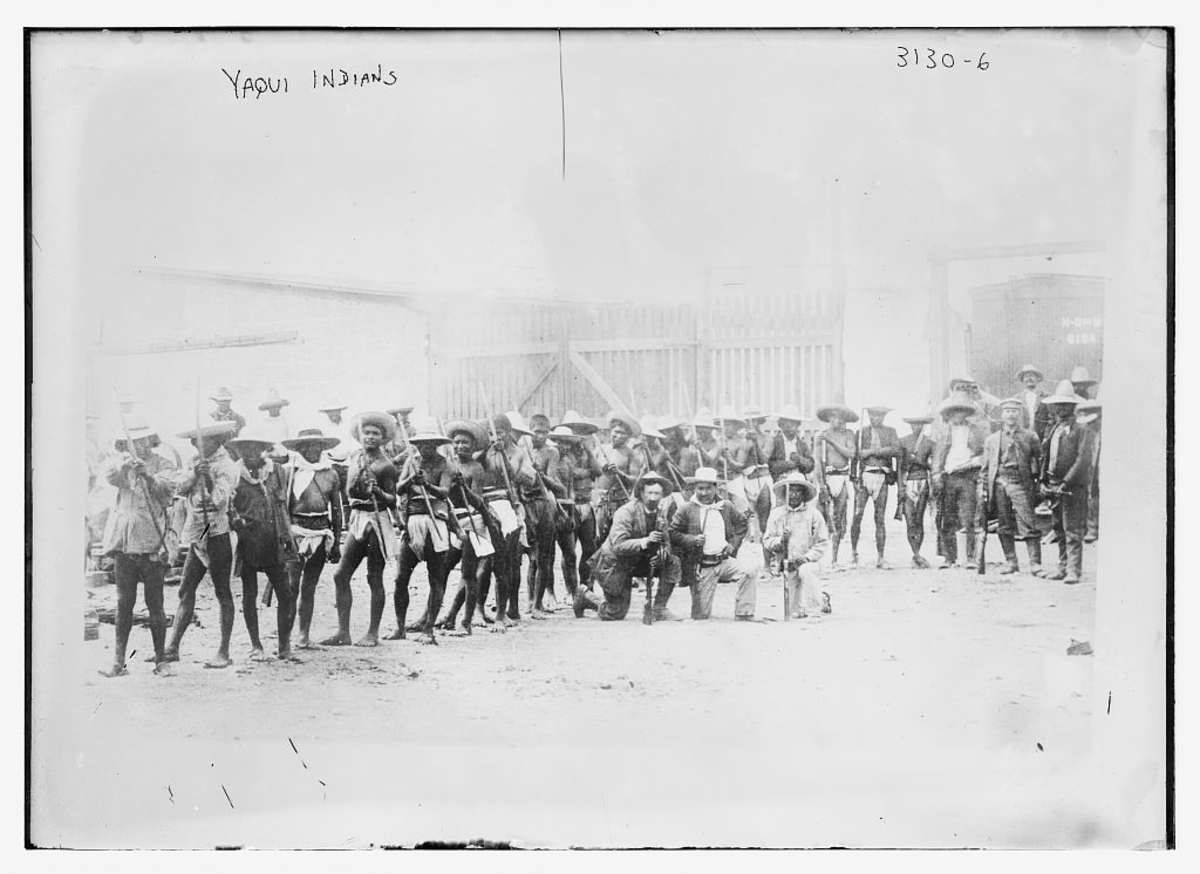
On 18 January 1900 the Mexican army trapped a Yaqui force at Mazocoba, in the Sierra de Bacatete, and killed more than four hundred. It was still bombing that mountain in 1927.
The Sierra de Bacatete is not much of a range. It stands east of Guaymas, between the lower Yaqui river and the Gulf of California, low and dry and broken, and on a map it looks like nothing much. For half a century it was the most expensive ground in northwestern Mexico, and the government kept announcing that it had finally been taken.
The Mountain Itself
What gave the range its value was what lay beside it. The Yaqui river bottom was the best farmland in Sonora, and the eight Yaqui towns strung along it had worked it since long before Spanish soldiers first reached the river in 1533. Every government that wanted that valley met the same difficulty. The towns could be taken whenever anyone cared to take them; holding them could not, because when pressed the people of the river went up into the Bacatete, where there was water, cover and high ground from which to watch a column come.
Cajeme’s Republic
The most complete answer the Yaqui built to that problem was a man. José María Leyva, called Cajeme, had served in the Mexican army and used what he learned there. Between 1875 and 1886 he ran what the historian Evelyn Hu-DeHart describes as a state within a state — his own assemblies, his own taxes, his own military organisation, drawing at its height on some three thousand Yaqui and Mayo fighters. Federal forces broke it in 1886. Cajeme was captured on 12 April 1887 and, the Museum of the Yaquis records, killed on the way to a cell in Cócorit under the convention by which prisoners were shot while escaping.
Eighteenth of January
What replaced Cajeme was harder to fight, because it had no capital to take. Juan Maldonado, called Tetabiate, led the fighting bands out of the Bacatete for a decade. In 1894 and 1895 General Luis Torres answered with police work rather than battle: an informer system through the valley, and a careful survey of the whole Sierra. In May 1897 Torres and Tetabiate signed a peace at Ortiz with considerable ceremony. Hu-DeHart’s reading is that the two sides never meant the same thing by it, and the fighting resumed.
On 18 January 1900 federal troops caught a large Yaqui force at Mazocoba, inside the range. Hu-DeHart gives more than four hundred killed and eight hundred taken prisoner. The Texas Band of Yaquis, in its own tribal history, counts 397 dead — men, women and some children — and records that others went off the cliffs rather than be captured. The counts do not reconcile. Tetabiate was killed in July 1901, and that August the government declared the Yaqui campaign formally closed.
Broncos and Pacíficos
It was not closed, and what came next was administrative rather than military. Sonora sorted the Yaqui into two categories: broncos, the ones in the mountains, and pacíficos, the ones who worked. Every district prefect was required to register each month every Yaqui over fifteen years of age and issue them papers. A Yaqui without papers was a rebel by definition, liable to arrest and to deportation out of the state. A man could become a rebel by losing a piece of paper.
Deportation meant the henequen plantations of Yucatán, and between 1902 and 1908 it was the government’s main instrument against the mountain. How many people were sent is unsettled. Figures above fifteen thousand circulated at the time; Hu-DeHart doubts them, noting that the 1910 census found only 2,757 Sonorans living in Yucatán. The Texas Band of Yaquis gives a range of eight to fifteen thousand. No honest ledger was kept.
Surrendered, Not Taken
By early 1909 the last large fighting faction, under Luis Bule, gave in and was folded into the federal forces. A small band stayed in the Sierra de Bacatete. That is the shape the whole war keeps: the mountain is declared taken, and then it is not.
The Revolution scrambled the arithmetic for a decade. The last full campaign came afterward. Between 1926 and 1929, according to Edna Lucía García Rivera’s study in Historia Mexicana, the federal government put some fifteen thousand troops into Sonora against a Yaqui force under Luis Matus reckoned at more than eighteen hundred men — and, for the first time in Mexican counterinsurgency, sent aircraft. Eight machines bought from the Douglas Airplane Corporation, fitted with machine guns and bombing gear, flew against camps hidden in the Bacatete timber. Major operations ended in October 1927. Raids went on into 1929, twenty-nine years after Mazocoba.
The same argument over how many were left ran north of the border too. Geronimo Surrendered in 1886. Not Every Apache Did. is the Chiricahua version of the same question.
Why This Book
Tohua! opens in 1903 in the foothills of the Bacatete, with a Yaqui boy learning to read the ground through his palms while his father wears the clean white cotton of a pacífico and digs the government’s ditches. The hinge of the novel is news carried up from Hermosillo in late January 1909: the Bacatetes have fallen, starved out, no last stand. What the boy takes from it is that there is now nowhere that cannot be taken. The rest of the book is the proof — a passbook, a chain, a steamship, and twenty years of walking back north.
Tohua! is that road, from the Sierra de Bacatete to the Arizona line.
Sources
- Evelyn Hu-DeHart, “Development and Rural Rebellion: Pacification of the Yaquis in the Late Porfiriato,” Hispanic American Historical Review 54:1 (February 1974), 72–93, Duke University Press
- Evelyn Hu-DeHart, Yaqui Resistance and Survival: The Struggle for Land and Autonomy, 1821–1910, University of Wisconsin Press
- Evelyn Hu-DeHart, Missionaries, Miners, and Indians: Spanish Contact with the Yaqui Nation of Northwestern New Spain, 1533–1820, University of Arizona Press, 1981
- Edna Lucía García Rivera, “La rebelión yaqui en la frontera con Estados Unidos: 1926–1929,” Historia Mexicana 74:1 (2024), El Colegio de México
- Texas Band of Yaquis, tribal history
- Museum of the Yaquis, Sonoran Institute of Culture
- Library of Congress, Prints and Photographs Division, George Grantham Bain Collection