In September 1886 the United States exiled every Chiricahua Apache it could find, including the scouts who had served the Army against Geronimo. It could not find all of them.
Geronimo Surrendered in 1886. Not Every Apache Did.
The removal was meant to be total, and on paper it was.
Everyone, Including the Scouts
Geronimo came in at Skeleton Canyon in early September 1886 with a few dozen people. What followed applied to a whole nation. Between April and November of that year, 515 Chiricahua were shipped east as prisoners of war — out of a people the Park Service numbers at a thousand to fifteen hundred before the wars began. Three hundred and ninety-four of them reached Fort Marion, at St. Augustine, on 20 September. Seventeen men went to Fort Pickens instead.
One detail tells you what kind of policy this was. The Apache scouts went too. Men who had enlisted, drawn Army pay, and tracked Geronimo through the Sierra Madre on behalf of the United States were put aboard the same trains as the men they had hunted. Loyalty bought them nothing, because the category being removed was not "hostile." It was "Chiricahua."
Twenty-Seven Years
On 27 April 1887 most of them were moved from Florida to Mount Vernon Barracks in Alabama. The children went separately, to the Carlisle Indian Industrial School in Pennsylvania: of 112 sent, twenty-seven died there, twenty-five of tuberculosis.
By January 1894 the count of Chiricahua dead in captivity stood at 246. In early October that year, 296 men, women and children boarded ten passenger cars for Fort Sill, Oklahoma.
They were released in 1913 — twenty-seven years after the surrender, long enough that a majority of the people freed had been born prisoners. About 130 were permitted to move to the Mescalero reservation in New Mexico. The rest stayed in Oklahoma and are the Fort Sill Apache today.
The One Who Walked
At least one man refused the arithmetic. Massai, of the Chihenne band, was put aboard the prison train and got off it near St. Louis. He walked roughly 1,200 miles home, crossing the Pecos and Capitan Gap, and stayed out. His name turns up in San Carlos Agency reports from 1887 to 1890, and he was still being hunted in 1896.
On 4 September 1906 a posse in the San Mateo Mountains of New Mexico shot a man at dawn who proved to be carrying no ammunition, and said afterwards that it was Massai. Another account holds that he crossed into Mexico and was never caught at all. Both versions have survived side by side for a century, which is a fair description of the whole subject.
The Sierra Madre
South of the border the record thins to almost nothing, and what is left is worth handling carefully.
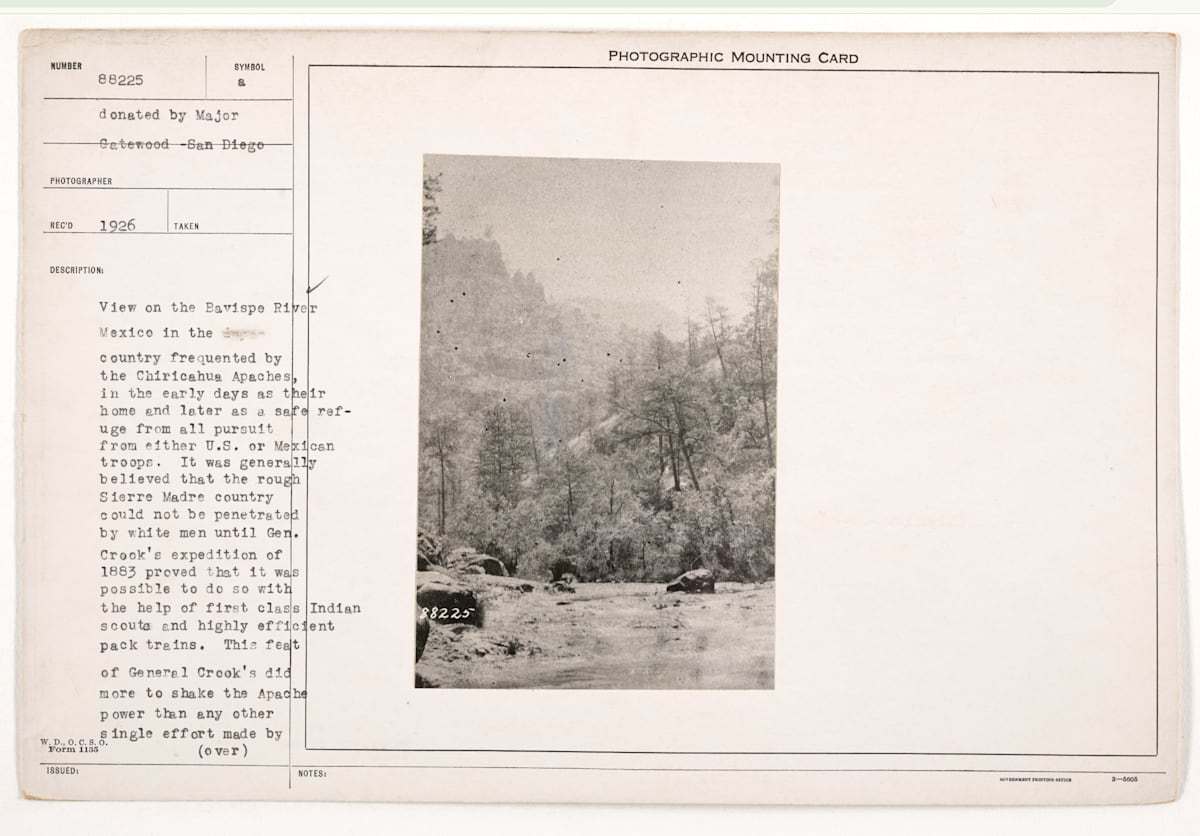
Apache bands stayed free in the Sierra Madre of Sonora and Chihuahua for decades after 1886. In 1926 a raid on Francisco Fimbres's ranch in Sonora killed his wife and carried off his infant son; in 1930 he tried to raise a party of American gunmen to hunt them, and Mexican authorities stopped him. In 1933 cowboys took a girl of twelve or thirteen in the Tasahuinora Mountains; she refused food and died in custody, and is generally called the last Apache captured in the Sierra Madre. The anthropologist Grenville Goodwin reckoned about thirty were still out there in 1934. He never managed to make contact.
Nearly all of that comes from elderly Mexican residents recalling events forty and fifty years later, not from contemporary records, and it should be read as memory rather than documentation.
Not in the Count
Which is the honest end of the matter. Nobody knows how many Chiricahua were never taken, because the ones who were never taken had made not being found their entire occupation.
There are numbers for the prisoners — 515, 394, 296, 246, 130 — because prisoners get counted. There is no equivalent number for the people who stayed out, and there never will be. A community whose survival depends on not appearing in a record does not appear in the record. The absence is not evidence that nobody was there. It is evidence that the strategy worked.
That gap is where The Stone Vigil begins. In 1924 a Yaqui refugee climbs into an Apache stronghold in the Chiricahuas that has been there a great deal longer than he has — "the ones the Army had missed in 1886, who'd chosen the risk of stone over the certainty of chains." Ghosts, by then, for nearly forty years.
Sources
- Fort Bowie National Historic Site, The Chiricahua Apaches, National Park Service
- The Incarceration of the Chiricahua Apaches, 1886–1914: A Portrait of Survival, Texas Tech University
- Alicia Delgadillo and Miriam Perrett, From Fort Marion to Fort Sill: A Documentary History of the Chiricahua Apache Prisoners of War, 1886–1913 (University of Nebraska Press)
- Grenville Goodwin's Sierra Madre field notes, and Neil Goodwin, The Apache Diaries
- Contemporary press and oral-history accounts from Nácori Chico, Sonora
- View on the Bavispe River, Mexico — NARA 494087311, local ID 111-SC-88225