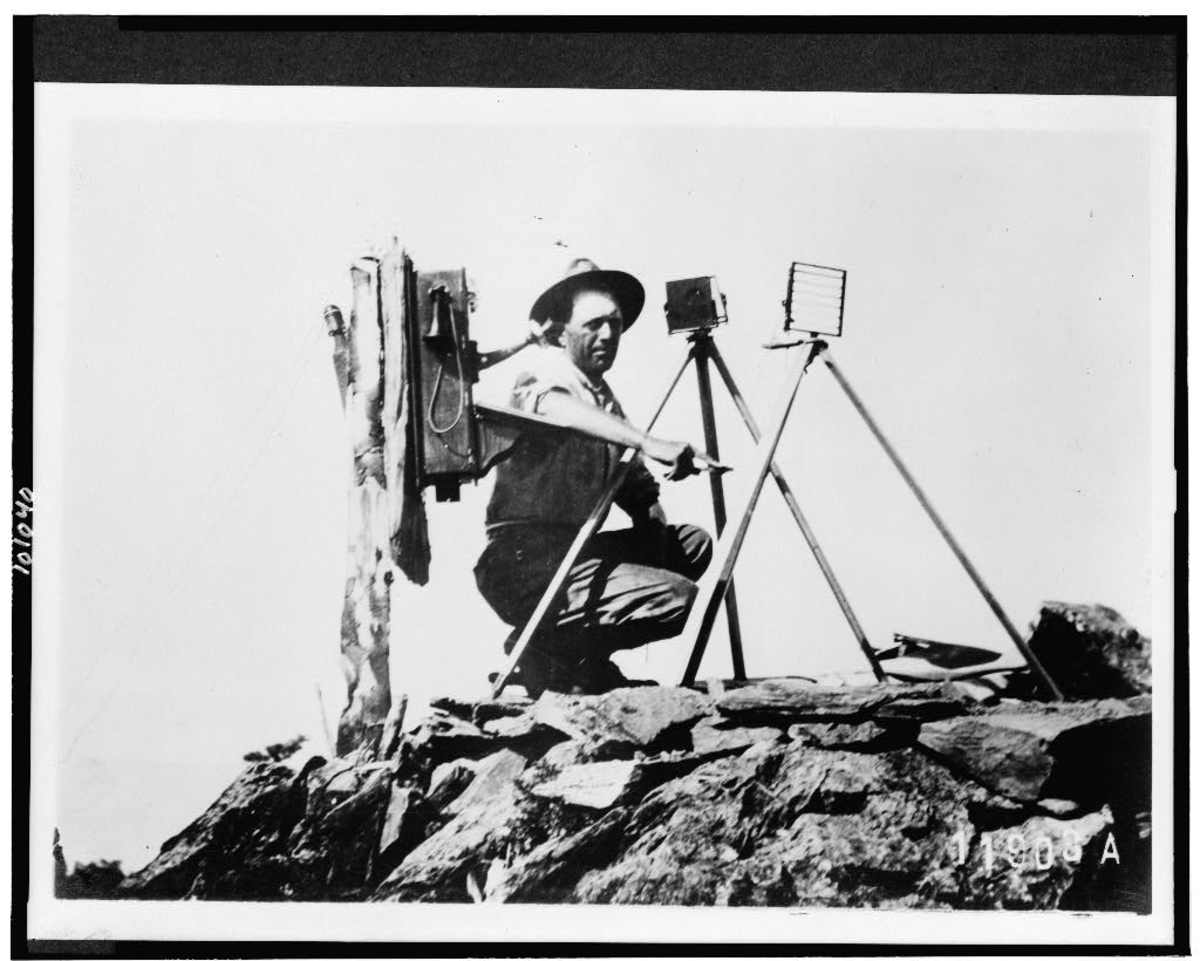
By August 1886 the US Army was working twenty-three heliograph stations across Arizona and New Mexico, flashing Morse code off mirrors to hunt a band of thirty-seven Chiricahua.
General Nelson A. Miles took command of the Department of Arizona in April 1886, and within a month he was asking his staff about mirrors. What he put on the peaks that summer was the most advanced field communications system the United States Army had ever deployed. A declassified National Security Agency history says there is no evidence that any message it carried ever resulted in military action against Geronimo.
Mirrors on the Peaks
A heliograph is a mirror on a tripod with a shutter in front of it. The operator lines the mirror up on a distant station, catches the sun, and works a key that breaks the beam into the dots and dashes of Morse code. The American pattern used a fixed square mirror instead of the tilting British design, which the Park Service notes gave it about twenty-five percent more reflecting surface.
The usual working range was fifty to sixty miles, with one recorded instance of a hundred. The greatest distance ever covered by heliograph was a hundred and eighty-three miles, between mountains in Colorado and Utah. Miles had seen it work in Montana in 1878, and southern Arizona was better ground still, with dry air, hard light and long sightlines between ranges.
The weaknesses sit in the same sentence as the strengths. A heliograph needs sun and an unbroken line between two peaks. Dust, haze, cloud and flat light shut it down, and so does night.
What the Mirrors Carried
Miles queried his adjutant about heliograph equipment on 2 May 1886. Three weeks later a lieutenant named Alvarado Fuller was reporting on where the stations should stand. By August the Army was working twenty-three of them across Arizona and New Mexico, spaced roughly twenty-five miles apart, with Fort Huachuca serving as Miles’s advance headquarters and forward supply base.
The traffic was heavy. One station in New Mexico sent 1,829 messages in July and August of 1886, totalling 35,727 words. Station No. 2 sent 334 over the course of the final campaign. Most of it moved in plain language rather than cipher, and most of it reads like the report that reached Fort Bowie on 6 June 1886: “Heliograph reports four indians going south passed station No. 5 - Antelope springs at dusk last night.”
Four people crossed a line of sight at dusk and the fact of it was at headquarters by morning. What anyone did with it is the harder question.
What the Light Missed
The campaign was enormous. The Park Service puts around five thousand United States Army personnel in the region, a quarter of the entire force. The free Chiricahua band they were all looking for numbered thirty-seven people: eighteen warriors, thirteen women and six children, two of them infants.
Nothing that summer was settled by a mirror. Geronimo surrendered on 4 September 1886 in Sonora, after Lieutenant Charles Gatewood walked into the Sierra Madre and talked, followed by Captain Henry Lawton and then by Miles in person. What ended it was two men, a conversation, and the news that the families had already been sent east to Florida. That story is told in Geronimo Surrendered in 1886. Not Every Apache Did.
The Park Service reads the same record differently. It records that once the heliograph went into a stretch of country, raiders were not seen in that vicinity again, which makes the network a deterrent rather than an interceptor, a thing that worked by being visible. Both readings come from institutions that have gone through the traffic. What is not in dispute is that the mirrors watched the ground superbly and caught nobody.
After the Campaign
That summer was one season of a much longer programme. Research mapping the Army lines counts almost ninety networked heliograph stations built between 1882 and 1893, reaching from Nogales, Arizona, to Fort Stanton, New Mexico, and it is the largest heliograph network ever built anywhere.
The instrument outlived the war it was bought for. The Signal Corps was still teaching the heliograph through the 1920s, by then a backup for emergencies, which is why mirrors were still flashing off desert peaks a generation after the Apache Wars ended.
Why This Book
“Tohua!” ends with two men walking north out of Mexico, and in chapter twenty they stop on a ridge and read the country below them as a machine. A rail line, telegraph poles, supply wagons between fly camps, mounted patrols in overlapping arcs, and every ten miles the glint of a heliograph station. “It’s a net,” Victorio says. “The wire tells the next camp when something moves. We cross, the mesh tightens.”
Later, on a mesa within sight of the border, they watch cavalry mirrors talking peak to peak and wait for sunset, because heliographs go blind when the light flattens. That is not invention: it is the one limitation every officer who ran a station knew about, and the kind of fact a man on foot can use.
The novel is not about the 1886 campaign. It is about a Yaqui boy carried off to the henequen fields of Yucatan and the long walk home. But the net he crosses at the end of it was strung across these mountains, by the men in this post, for a different quarry.
Tohua! is that walk, and the last ridge of it looks down on all of this.
Sources
- Fort Bowie National Historic Site, National Park Service, on the heliograph
- Chiricahua National Monument, National Park Service, on the Apache Wars and the final Chiricahua band
- A declassified National Security Agency cryptologic history, “Communications in a Flash”
- The United States Army, “Signal Corps Harnesses the Sun”
- Sharlot Hall Museum, Days Past archive, on the Army heliograph practice out of Whipple Barracks
- Cornelius C. Smith Jr., “Fort Huachuca: The Story of a Frontier Post,” Department of the Army
- Robert E. C. Davis, “Lieutenants and Light: Mapping the US Army Heliograph Networks in Late Nineteenth-Century Arizona and New Mexico,” University of New Mexico Press
- Fort Huachuca garrison history, United States Army