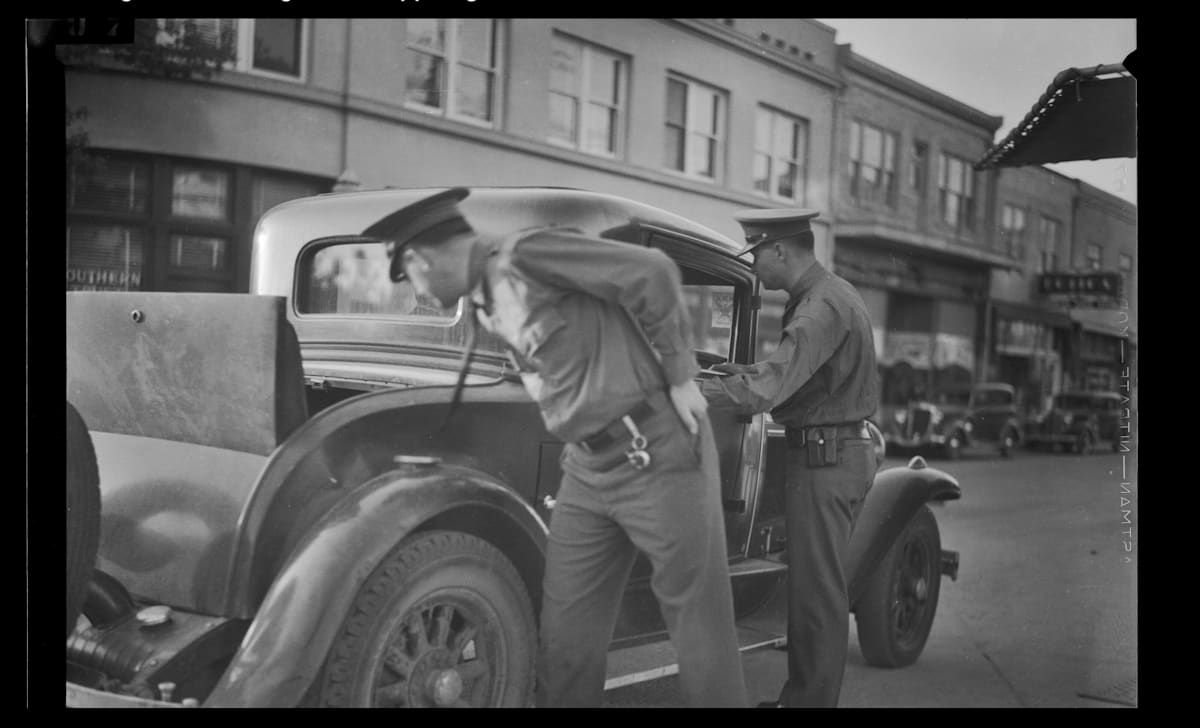
On 25 April 1934 a six-year-old girl was taken outside her Tucson school, and nineteen days later she was found chained inside an iron box buried in the desert east of town.
Federal agents worked the case for two and a half years and narrowed it to forty-three suspects. Nobody was charged. A federal grand jury was then persuaded to call the whole affair a hoax, and the file went quiet.
A Ford at Roskruge
June Robles was six, and walking home from Roskruge Elementary School in Tucson, when she got into an old Ford sedan at about three in the afternoon on 25 April 1934. Her father, Fernando Robles, ran the Robles Electric Company. Her grandfather, Bernabé Robles, was a rancher the Journal of Arizona History puts at roughly a quarter of a million dollars in assets — a conspicuous fortune in Arizona in the fourth year of the Depression. The Arizona Daily Star had an extra edition out that evening: “Six Year Old Girl Seized When She Leaves Roskruge For Home.”
Seventeen Numbered Instructions
The first note arrived at the electric shop the same afternoon, carried in by a boy paid a quarter to deliver an envelope. It asked fifteen thousand dollars, set out seventeen numbered instructions, warned that the child would be killed if the family did not obey, and was signed with the letters X Y Z and the word OBEY. A sealed envelope inside was marked for the father alone: drive a named route at nine every night and throw the money at a white cloth being dragged across the road.
More notes followed, and the sum moved between fifteen thousand and ten. One posted in Tucson at the end of April sent Fernando out to Gila Bend, then to Red Rock, Sasco, Vail and Continental on alternate nights: “You better listen to us we are not fooling with you.” On 7 May three more pages went under the county attorney’s door. No money was ever collected.
Three Hundred Armed Volunteers
More than three hundred men, most of them armed, answered the Pima County undersheriff’s call for volunteers, and fifty American Legionnaires turned out before daylight. The city police chief split his men into four-man teams and searched every one of Tucson’s eight thousand dwellings. Cowboys, prospectors and game hunters rode the washes and canyons, and spotters read the desert from the air. It produced almost nothing. “I have never worked on a case in which we have had so little authentic information,” the chief said.
The newspapers filled the gap by inventing ransom payments that were never made. This was Tucson four months after Repeal, in a state that had been dry since 1915: https://duanekeelingbooks.com/blog/prohibition-in-arizona-moonshine-and-the-mexican-border
A Postcard From Chicago
Federal agents had been in the case from the first day, but with no evidence the child had been carried across a state line there was no federal jurisdiction. The kidnappers handed it over themselves: on 10 May a letter was dropped into a Chicago post office, addressed to Governor Benjamin Moeur in Phoenix. Using the mail made it a federal crime.
The letter also answered four questions the father had put out publicly to prove the child was alive. What did she do with her bunnies in the morning? Give them water and feed them. The answers were right.
Under the Cactus Burs
The same letter gave directions: about a mile east of Wilmot Road, a hundred and fifty steps north of Rincon Way, and “CHILD IS UNDER SOME OLD CACTUS BURS.” It reached County Attorney Clarence Houston on 14 May. By the Journal of Arizona History’s account it was Houston and the child’s uncle Carlos Robles who came up on her at about midday, nine miles east of Tucson. He called to ask whether she was all right. “Hello there,” she said.
She had been kept in a box of sheet iron less than six feet long and thirty inches wide, buried under three inches of dirt and brush, with six or seven hundred nail holes punched through the hatch. A dog chain and a padlock held her leg. She was covered in ant bites, burned where she had touched the heated metal, and the chain had cut into her ankle. She would not be carried. She walked to the car.
A Case Never Closed
Investigators stayed on it for thirty more months and got the field down to forty-three names. There it stopped. The United States attorney, with the Bureau’s blessing, then persuaded a federal grand jury to declare the case a hoax, after which it vanished from the Bureau’s own account of its history. Paul Cool, who worked the files for the Journal of Arizona History, treats that finding less as an answer than as a tidy way of closing an embarrassment. The Arizona Historical Society puts it plainly: this was the first major case J. Edgar Hoover’s agents could not solve. June Robles lived a long life and never discussed it with a journalist or a historian, except to say that she had forgotten it.
Trail of Shadows, the second Bee Adkins novel, gives its 1934 chapter to this case. Bee is a tracker living off trap lines and bounty work in the mountains around Tucson, and the chapter opens with a lookout job he is offered, on a corner by the Roskruge school, and does not take. What follows is nineteen days of riding ground he knows better than the men in wool suits do: https://duanekeelingbooks.com/books/trail-of-shadows-bee-adkins-book-2
Sources
- The Journal of Arizona History, Paul Cool, “Desert Manhunt: Tucson’s 1934 June Robles Kidnapping,” volume 57, number 4, Winter 2016, published by the Arizona Historical Society
- The Arizona Historical Society, on Paul Cool and his book The Girl in the Iron Box
UCLA Library Special Collections, Charles E. Young Research Library, the Los Angeles Times Photographic Archives, the featured photograph of police officers searching a car in southern Arizona during the search for June Robles, 1934, used under a Creative Commons Attribution 4.0 International licence