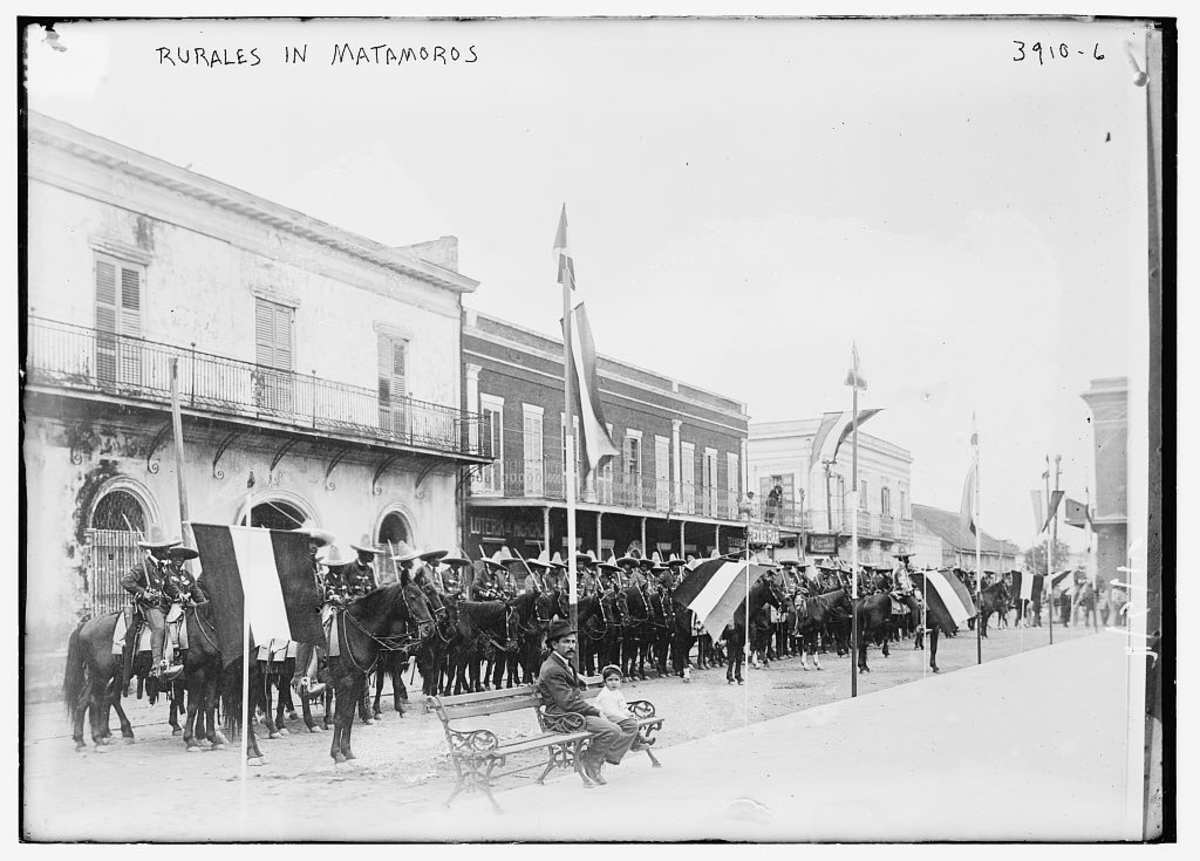
Porfirio Díaz’s rural police were the most photographed force in Mexico, never numbered much more than two thousand men, and a third of them deserted in the corps’ last decade.
The rurales are in every account of Porfirian Mexico somewhere: charro suits, a line of mounted men at the edge of a village, and the understanding that whoever deals with them has no appeal. The picture is right about the effect and wrong about nearly everything else: the corps was small, thinly staffed, and could not hold the men it recruited.
Four Corps, 1861
The idea arrived before the force did. A presidential decree of 16 January 1857 set up a nationwide Guardia de Seguridad, and by that summer five squadrons of rural police were in the field. In November the federal money ran out and it was phased out.
The second attempt stuck. On 6 May 1861 Benito Juárez issued a decree establishing four corps of rural police for the security of the roadways. Each corps was to hold 225 guards under a commander, with three corporals first class and fifteen second class, and a guard was paid 405 pesos a year. The first squadron put ninety-nine men on the road between Puebla and Mexico City. The founding purpose was roads, and everything the corps later became grew out of that.
Bandits into Police
Then there is the story everyone knows: the government hired the bandits it could not catch and made them police. It is not invented. The roughly two thousand men assembled by the 1870s included former guerrillas demanding payment for wartime service and, in the historian Paul Vanderwood’s account, bandits who threatened to pillage if they were not enlisted.
But the chronology matters. The recruiting of bandits happened under Juárez or early in Lerdo’s administration, exactly when is not clear, and it was said to have ended by 1875 — the year before Díaz took power. So the most famous fact about the Porfirian rurales describes the force that existed before the Porfiriato.
Two Thousand Men
Until 1905 there were about two thousand rurales, divided evenly into ten corps. An eleventh was added in 1905 and a twelfth in 1908. Authorised strength for the decade from 1901 was 2,400; Britannica puts the force at about 2,700 by the end of the reign. Either figure is small for what it had to cover: roughly a quarter of the nation’s territory and a third of its people.
Their work was broader than road security by then. Britannica’s summary is blunt: escorting prisoners, guarding public buildings, intimidating political opponents, and acting as a kind of praetorian guard for the dictatorship. The corps was disbanded in 1914.
The Desertion Rate
This is where the picture comes apart, and the numbers are Vanderwood’s.
Desertion ran at 8 per cent in 1880–85, 18 per cent from 1886 to 1890, 32 per cent through the 1890s, and 35 per cent in the corps’ final decade. Over the same years Canada’s Royal Mounted Police lost 6 per cent or fewer, the United States Army 6.7 per cent, the British Army 1.7 per cent. Men who quit inside their first month went from 8 per cent to 47.8 per cent. The share who finished their term fell from two-thirds to 13.4 per cent, and re-enlistment fell from 30.5 per cent to 5.
To hold about two thousand posts between 1885 and 1910, headquarters had to take in some thirty-five thousand recruits. Vanderwood’s verdict is flat: it is not possible to sustain an effective police force with so rapid a turnover. In 1910 the inspector of the First Corps called most of the corpsmen he met alcoholics.
What They Actually Did
Horsemanship and marksmanship were never conditions of enlistment, though the official story made it look as though they were, and most posts were stationary and needed no riding at all. Men accounted to their superiors for every bullet they fired. What the public saw was the other thing entirely: carefully selected horses, charro outfits, a parade in front of the presidential palace. Vanderwood’s summary of the gap is the sentence worth keeping — the rurales became a mainstay of Porfirian rule, although their public image was far more striking than their performance.
The killing was real enough. The ley fuga was never a law; José Luis Soberanes Fernández, writing for the National Autonomous University of Mexico, calls it a sarcastic phrase for shooting a prisoner and reporting that he ran. The 1876 decree on bandits, which allowed summary execution of men taken in the act or in uninterrupted pursuit, supplied the cover. Rural police usually did the shooting, often on a jefe político’s order, and the deaths ran into the thousands.
That convention has already appeared on this blog: The Yaqui Wars: Mazocoba and the Sierra de Bacatete ends with Cajeme captured in April 1887 and killed on the way to his cell.
Why This Book
Tohua! does not describe the rurales. It puts a boy’s hands on a rock in 1903 and lets him feel them coming — iron-shod horses on caliche, a vibration his grandfather calls a bruise on the ground. Six of them in grey stop where a path narrows between two hills, because there is no way around, and wait for a family with a loaded burro to come up the trail.
That is the corps at its real work, and what two thousand men across a quarter of a country amount to: not a net, but a fixed point on a road, and no appeal.
Tohua! starts at that checkpoint.
Sources
- Paul J. Vanderwood, “Mexico’s Rurales: Image of a Society in Transition,” Hispanic American Historical Review 61:1 (1981), Duke University Press — the desertion, turnover and recruitment figures
- Paul J. Vanderwood, Disorder and Progress: Bandits, Police, and Mexican Development, University of Nebraska Press
- “Genesis of the Rurales: Mexico’s Early Struggle for Public Security,” Hispanic American Historical Review 50:2 (May 1970), Duke University Press — the 1857 and 1861 decrees
- José Luis Soberanes Fernández, “La ‘ley fuga’ en el porfiriato,” Revista Mexicana de Historia del Derecho XLII (2020), 41–60, Instituto de Investigaciones Jurídicas, National Autonomous University of Mexico
- Encyclopaedia Britannica, entry on the Rurales
- Library of Congress, Prints and Photographs Division, George Grantham Bain Collection