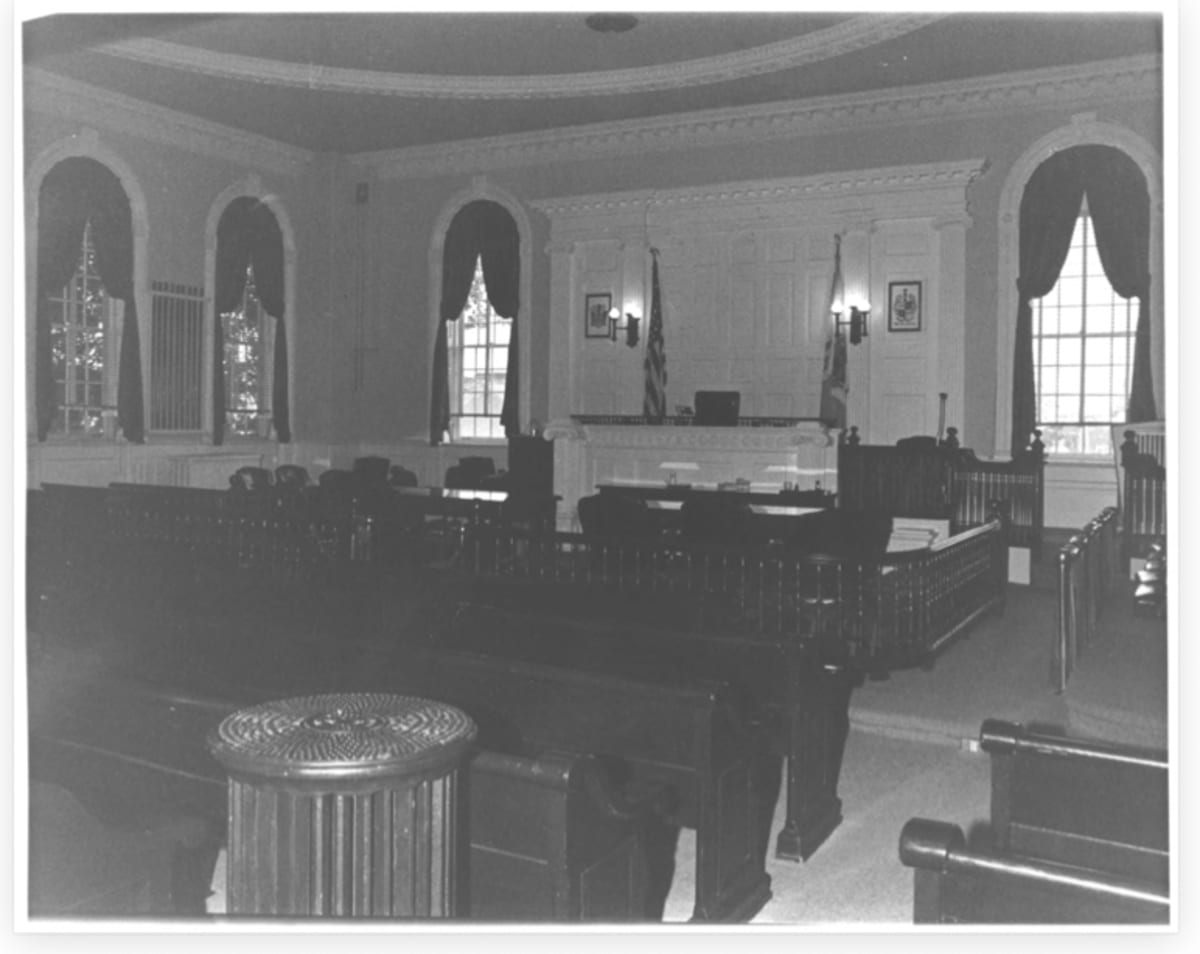
On 31 March 1976 the New Jersey Supreme Court let Karen Ann Quinlan’s father order her respirator switched off, and she went on breathing without it for another nine years.
The machine in the room was an MA-1 respirator, and the question put to the court was who had the right to switch it off. The Supreme Court of New Jersey answered in 1976, and the answer carried far past the one bed it was written for.
A Night in April
The Hastings Center, a bioethics research institute, puts the night at 14 April 1975, two weeks after Karen Ann Quinlan’s twenty-first birthday. She had been drinking with friends at a bar, went home, lay down and stopped breathing. She did not die and she did not wake.
By the time the case reached the state’s highest court she had spent months at Saint Clare’s Hospital, and the opinion sets out her condition in the language of the physicians who testified. She was in a chronic and persistent vegetative state, it says, having no awareness of anything or anyone around her, and she could never be restored to cognitive or sapient life. She was emaciated, having lost at least forty pounds, her posture fetal-like and grotesque. She breathed with the help of the respirator, was fed through a tube in her nose, and was twenty-two.
Ordinary and Extraordinary
Her father, Joseph Quinlan, a Roman Catholic who the opinion says first sought solace in private prayer, asked to be appointed her guardian so that he could have the respirator withdrawn. The trial court, before Judge Muir, refused him.
The argument they carried up on appeal came out of Catholic moral theology, and turns on a distinction between ordinary and extraordinary means of preserving life. Bishop Lawrence B. Casey, for the New Jersey Catholic Conference, put it to the court that the mechanical measures sustaining her body functions were extraordinary means of treatment, and quoted Pius XII: there is no obligation to use such means, nor to give a doctor permission to use them.
The court made that argument medical rather than doctrinal. The same respirator, it wrote, might be ordinary for a possibly curable patient and extraordinary for one irreversibly doomed.
What the Court Ruled
The case was argued on 26 January 1976 and decided on 31 March, Chief Justice Richard J. Hughes writing for a court of seven with no dissent.
The ruling rests on a right of personal privacy the United States Supreme Court had recognised in earlier decisions, and the New Jersey court held that the right does not lapse because the person holding it cannot speak, and could be asserted for her by her guardian and her family. Joseph Quinlan was appointed guardian of her person.
The mechanism the court built was deliberately not a court. If the attending physicians concluded there was no reasonable possibility of her returning to a cognitive, sapient state, they were to consult the hospital Ethics Committee. If it agreed, the life-support system might be withdrawn without civil or criminal liability for any participant. There would be no criminal homicide, the court said, in the circumstances of this case.
Nine More Years
What happened next is the part almost nobody remembers.
The respirator was not simply switched off. It was taken away and given back, taken away for longer, given back again, and at the end Karen Quinlan was breathing on her own. A professor of bioethics at Upstate Medical University in New York describes the weaning in just those terms.
The Hastings Center records that she went on breathing unaided for nine years after the ventilator was disconnected, and that she died on 11 June 1985. Through all nine years she depended not on a respirator but on a feeding tube, which no court had been asked about.
So the decision everyone cites as the right-to-die case did not end a life. It removed one machine, and not the one doing the keeping.
What Came After
The hospital ethics committee, named almost in passing in the opinion, became ordinary afterwards. The American Medical Association’s Journal of Ethics writes of post-Quinlan institutional ethics committees, and notes that the national hospital accreditation body now requires some mechanism for ethics review without saying what it must be. The same bioethicist dates the first advance-directive statute to California, and reckons every state had one within about fifteen years.
Duane R. Keeling’s novel Out of Touch follows Helen Calloway through twenty-three years of a Los Angeles obstetric practice, and dates itself by what was in the newspapers rather than by announcing a year. It opens in the 1971 Sylmar earthquake, covered here already: https://duanekeelingbooks.com/blog/the-1971-sylmar-earthquake-and-olive-view-hospital
The case reaches the fourth chapter the way it reached most working doctors. A folded newspaper on the front desk, a phrase caught in passing, and later, at the end of a long delivery, a thought that will not quite settle. The novel does not argue the case. It notices that the argument ran on while ordinary medicine carried on in the next room.
Out of Touch: https://duanekeelingbooks.com/books/out-of-touch
Sources
- The Supreme Court of New Jersey, its opinion in the matter of Karen Quinlan, decided 31 March 1976
- The Hastings Center, its fiftieth-anniversary account of the case
- The American Medical Association’s Journal of Ethics, on hospital ethics committees, consultants and courts
- Upstate Medical University, State University of New York, an interview with a professor of bioethics
- National Park Service, the National Register of Historic Places nomination file for the Morris County Courthouse, the featured photograph of Courtroom Number One in Morristown, New Jersey, made in 1976 by the Morris County Bureau of Criminal Identification