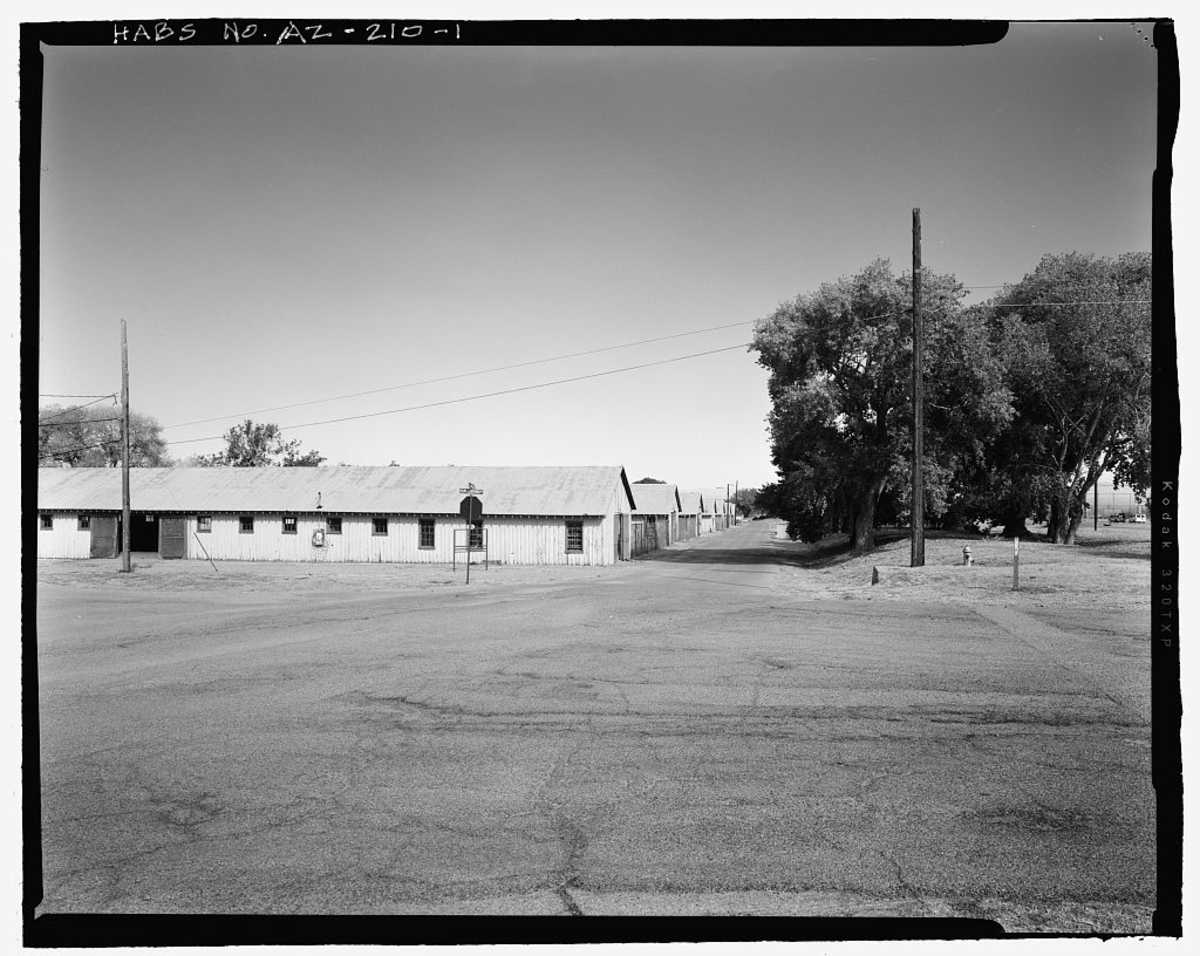
The 10th Cavalry rode into Fort Huachuca in 1913 and Black regiments held the Arizona post for thirty years, until two segregated divisions trained there for the Second World War.
Fort Huachuca stands at the foot of the Huachuca Mountains in southeastern Arizona, close enough to the Mexican border that the line is a morning’s ride. It is the last of Arizona’s frontier posts still in operation. Its remoteness is why it was built where it was, and why it outlived every other post in the territory — and, as the fort’s own history does not hide, a good part of why the Army kept sending Black regiments to it.
A Camp in 1877
The post began on 3 March 1877, when Colonel August V. Kautz ordered Captain Samuel Marmaduke Whitside to set up a cavalry camp “protecting settlement and travel in southeastern Arizona’s San Pedro Valley.” Whitside chose the mouth of a canyon on the east slope of the range. The Army’s own account gives his reasons plainly: water, trees, observation points and defensible terrain. Camp Huachuca became a permanent fort in 1882, and it outlasted every other post in the territory — partly because it was well sited, and partly because it was far from anywhere anyone wanted to be.
The Tenth Arrives
Congress created six all-Black regiments in 1866, consolidated to four shortly afterward. The National Park Service records the traditional account of their nickname: Plains Indians who fought them called them “buffalo soldiers,” for their hair and for the way they fought. The name is repeated everywhere and documented nowhere in the men’s own words, which is worth saying out loud before repeating it.
The 10th Cavalry arrived at Fort Huachuca in 1913 and served as the garrison regiment for twenty years. In that time it rode with John J. Pershing into Mexico on the 1916 expedition and then spent the First World War holding a long stretch of border against German infiltration. In 1933 the 25th Infantry Regiment, another of the four, took over and did much the same work until 1942, when it was absorbed into a division.
Thirty Thousand Men
That division was the 93rd Infantry, reactivated at Fort Huachuca on 15 May 1942. It shipped for the Pacific in 1943 and was replaced on the post by the 92nd Infantry Division, activated at Fort McClellan, Alabama, on 15 October 1942 under Major General Edward M. Almond, brought to Huachuca to finish its unit training, and sent to Italy in the autumn of 1944 with the Fifth Army. The Army’s history of the post states that more than thirty thousand Black soldiers, men and women, passed through Fort Huachuca between 1941 and 1945 on their way to every theatre of the war.
The Army did not put them there by accident. The Buffalo Soldiers National Museum is blunt about the reason: Huachuca was one of the few places in the country where a division of that size, composed of African American soldiers, could train together “without concerns being raised by the local white community.” The isolation that made the post useful in 1877 made it useful again in 1942, for an entirely different reason, and a less creditable one.
The Mountain View Club
One building survives from that period. In 1942 the contractor Del Webb put up the Mountain View Officers’ Club, a plain two-storey wood-frame building following the Army’s 700-series mobilization plans for service clubs. It was the recreational centre for the post’s African American personnel — which is to say a segregated club on a segregated post, and the only such building left standing at Fort Huachuca today.
It has been empty since 1998. The National Trust for Historic Preservation named it one of America’s 11 Most Endangered Historic Places in 2013 after the Army proposed demolition; the National Park Service put $500,000 toward its restoration in 2018.
What the Cabin Hears
The Memory Keepers opens in 1942 in a rented cabin in Ramsey Canyon, on the eastern slope of the Huachucas, before dawn. Bee Adkins steps into the yard to load a truck and hears aircraft engines coming off the canyon walls as the fort wakes up across the valley. He had tried to enlist and been told straight away that he was too old.
The novel is a lion hunt in the Chiricahuas and it does not tell the Buffalo Soldiers’ story. The fort in that scene is weather and season, a way of fixing the year. But the noise crossing the valley that morning was two divisions’ worth of men training for a war they would be sent to fight in units the Army kept separate. Bee never learns that, and the book never says it. The mountains in that book keep the things people forget — which is also the subject of The Ghost of a Winchester .30-30, on what sound does in that country.
Read The Memory Keepers, Book Three of The Ridge Watcher.
Sources
U.S. Army Garrison Fort Huachuca, official post history. The United States Army, “Bring on the Buffalo,” on the 92nd Infantry Division. The Army Historical Foundation, on the 93rd Infantry Division. National Trust for Historic Preservation, Mountain View Officers’ Club at Fort Huachuca. Buffalo Soldiers National Museum, “Blue Helmets: The 93rd and Stateside Training.” National Park Service, Buffalo Soldiers subject pages.