The 1932 kidnapping act did not make kidnapping a federal crime. It made it federal to carry the victim across a state line, and for two years that condition decided everything.
A federal crime has to be a federal crime on paper. In the spring of 1934 the Bureau could put agents on a kidnapping in Arizona, work the ransom letters and run the laboratory tests, and still have no settled authority to arrest the man at the end of it. The law that gave it that authority was two years old and deliberately narrow, and it was about to be rewritten twice inside a single month.
The Lindbergh Law
Congress acted after the Lindbergh kidnapping. The statute it passed was approved on 22 June 1932, the date the 1934 amendment itself cites when it names the act it is changing, and the Attorney General was still calling it the so-called Lindbergh kidnaping statute two years later.
What it did was narrower than its reputation. It did not make kidnapping a federal offence. What the act reached was the act of transporting a kidnapped person in interstate or foreign commerce, held for ransom or reward. The crime Washington could prosecute was the journey, not the seizure.
What the Act Covered
The National Archives, describing the case classification the Bureau opened under the new law, sets out three conditions that had to hold together: a person unlawfully seized, that person transported across state lines, and that person held for ransom or reward. Conspiracy to kidnap was made a violation as well.
Everything outside those conditions belonged to the states, and the Attorney General said so in a radio address in May 1934. Most criminal activity, he told the country, is not a violation of the laws of the United States at all; the federal government possesses only the powers the Constitution grants it.
The Seven Day Rule
On 18 May 1934 Congress amended the 1932 act. The new text made death a possible sentence where the jury recommended it, and barred the court from imposing it if the kidnapped person had been liberated unharmed beforehand. Then came the clause that mattered to investigators: failure to release a victim within seven days of the seizure created a presumption that the person had been transported in interstate or foreign commerce, a presumption the act said was not conclusive.
The National Archives describes those seven days differently, as a working understanding reached between the Bureau and the Department of Justice. Both accounts turn on the same interval. In 1956 Congress cut it to a single day.
Guns and Arrest Powers
A month later, on 18 June 1934, a second act changed what an agent could physically do. It empowered the Justice Department’s investigators to serve warrants and subpoenas, to make seizures under warrant, and to make arrests without a warrant for federal felonies where there was reasonable ground to believe the man guilty and a likelihood of his escaping before a warrant could be got. One short sentence authorised them to carry firearms.
Until then, by the Bureau’s own published account, a special agent could make only a citizen’s arrest, and otherwise had to call on a United States marshal or a local police officer to take a suspect into custody.
A Tucson Statement
June Robles, six years old, was taken outside her Tucson school on 25 April 1934 and found alive nineteen days later, on 14 May, in the desert nine miles east of downtown. The search is told here: https://duanekeelingbooks.com/blog/the-june-robles-kidnapping-of-1934-in-tucson-arizona
Writing in the Journal of Arizona History, Paul Cool makes the jurisdictional point exactly. The Bureau had entered the case early, and there was no evidence that June had been carried across a state line. What settled its authority was a ransom letter dropped on 10 May into the general post office in downtown Chicago. The seven day presumption became law on 18 May, four days after she was found.
What the Novel Takes
Trail of Shadows follows Bee Adkins, a rancher who tracked for the lawmen during that search and asked to be kept out of the papers. In late November 1934 two agents come up his drive for a formal statement and he will not give it at the house. He gives it the next day downtown, in a hotel room. The novel is interested in what a federal file costs a man who still has to live in those hills: https://duanekeelingbooks.com/books/trail-of-shadows-bee-adkins-book-2
Sources
The United States Statutes at Large, published by the Government Publishing Office, for the acts of 22 June 1932, 18 May 1934 and 18 June 1934
The National Archives and Records Administration, on the kidnapping case classification
The Federal Bureau of Investigation, published history timeline
The United States Department of Justice, radio address of Attorney General Homer Cummings, May 1934
Paul Cool, Desert Manhunt, in the Journal of Arizona History, published by the Arizona Historical Society
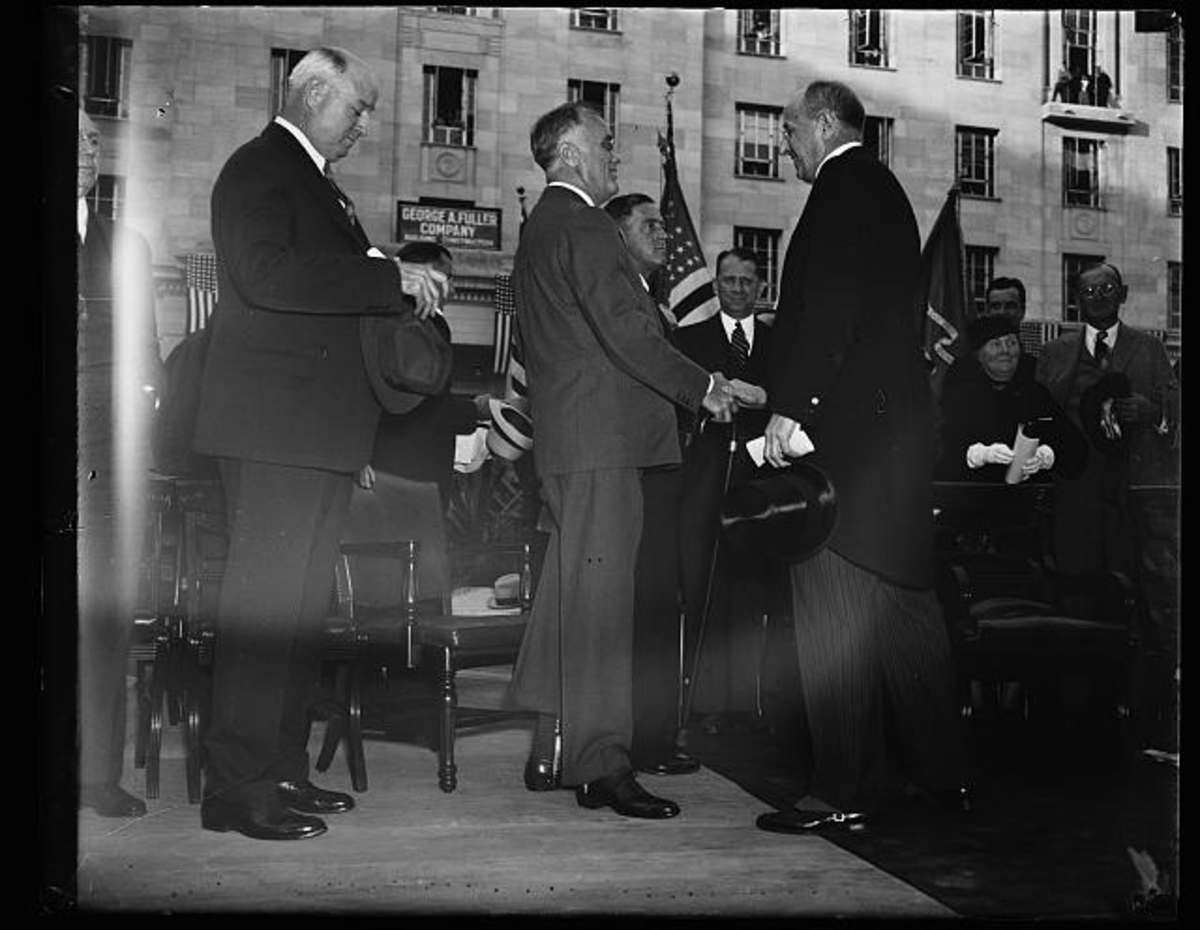
Library of Congress, Prints and Photographs Division, the Harris and Ewing photograph collection, the featured photograph of the dedication of the Department of Justice building in Washington, 1934