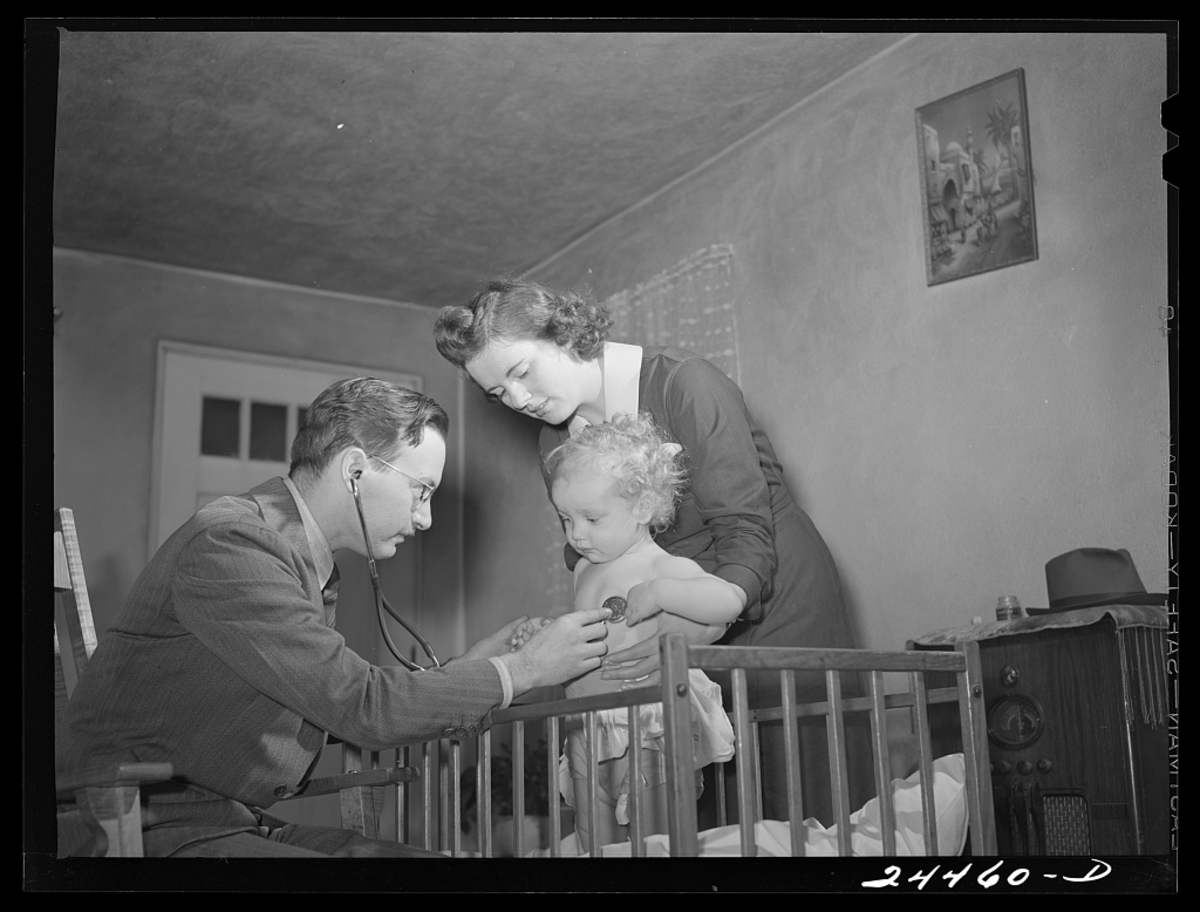
In 1816 a Paris physician rolled a sheet of paper into a tube to listen to a patient’s heart, and within three years had published two volumes naming the sounds of the chest.
Everyone can draw a stethoscope. Almost nobody can say where it came from, or why a doctor still reaches for a two-hundred-year-old idea when there is a machine down the corridor that would turn the same information into a picture. The answer starts with a problem of manners.
Ear Against The Chest
Before 1816 a physician had two ways to learn what was happening inside a living chest, and both were blunt. He could tap it. Percussion, tapping the chest with the fingers, had been set out by Leopold Auenbrugger of Vienna in a short book of 1761, the Inventum Novum. Or he could listen directly, laying his ear on the patient. Ohio State’s Medical Heritage Center puts it plainly: heart sounds were at first auscultated by placing the ear directly on the chest of the patient. Both worked on a thin, co-operative patient in a quiet room, and neither worked well on anybody else.
Paris 1816
In 1816 René Laennec had just taken charge at the Necker Hospital in Paris. The accounts differ in emphasis. The Linda Hall Library says he was treating a young woman for a heart complaint and that, the patient being stout, percussion was useless. The University of Iowa’s rare book room stresses the other reason: the embarrassment direct listening caused patient and physician alike. Either way he rolled up paper, a tube in one account and a cone in the other, set one end against her chest and the other to his ear, and found it far better than listening directly. He named it from the Greek words for chest and examination.
A Turned Wood Cylinder
Laennec was a skilled wood turner, and the paper did not last. He replaced it with a hollow tube he made himself and carried on his rounds. One of his own instruments survives in the Wood Library-Museum of Anesthesiology, catalogued as wood, brass and varnish, thirty-six centimetres long and four across: two varnished hollow cylinders that screw together, and a funnel-shaped chest piece. The museum notes that his earliest instruments were longer than the version illustrated in his book, so the object was already being shortened before anyone else had seen it.
Naming The Sounds
Three years later the work went to press as De l’auscultation médiate, ou Traité du diagnostic des maladies des poumons et du coeur, on mediate, which is to say indirect, listening. The Hardin Library at the University of Iowa describes the Paris printing of 1819: two volumes, twenty-three centimetres tall, with four folded plates at the back of the first. The larger half of the achievement was a vocabulary. Laennec had to find words for sounds nobody had written down, and the ones he settled on, among them rales, rhonchi, crepitance and egophony, are still in use and still argued over.
The Binaural Stethoscope
The wooden cylinder served one ear. In the early 1850s, by the Ohio State account, there was a rush of designs for a stethoscope that used both. The Medical Heritage Center credits Arthur Leared with inventing a binaural instrument in 1851 and George Cammann with perfecting it for commercial production the year after. East Carolina University, cataloguing a Cammann instrument held by the Country Doctor Museum, says flatly that Cammann of New York invented it in 1852. The two claims are not quite compatible, and the difference is worth leaving open. By 1889 the firm of Tiemann and Company were selling them for four dollars fifty. An earlier post follows the same instrument into obstetrics: https://duanekeelingbooks.com/blog/rheumatic-heart-disease-in-pregnancy-in-the-1960s
What the Novel Takes
Out of Touch opens its ninth chapter in December 1989 with a doctor taking a bag out of a hall closet: stethoscope, penlight, blood pressure cuff. Helen Calloway flies to Phoenix, sits down in a kitchen chair pulled up beside a bed, and works in the old order, a hand laid flat on the chest first and the instrument after it. She warms the diaphragm in her palm before she uses it. What she hears is coarse movement, a shallow pull and a wet drag at the bases. Then she folds the stethoscope and sets it on the coverlet, which is the part of the examination Laennec never wrote about.
Out of Touch, book two of Legacy’s Child: https://duanekeelingbooks.com/books/out-of-touch
Sources
The Linda Hall Library, on René Laennec.
The John Martin Rare Book Room at the University of Iowa, on the first edition of 1819.
The Wood Library-Museum of Anesthesiology, its catalogue record for a Laennec stethoscope of about 1819.
The Medical Heritage Center at the Ohio State University.
East Carolina University Digital Collections, for a Cammann binaural stethoscope held by the Country Doctor Museum.
Wellcome Collection, for the catalogue record of Auenbrugger’s Inventum Novum of 1761.
Library of Congress, Prints and Photographs Division, the Farm Security Administration and Office of War Information Photograph Collection, the featured photograph of a doctor examining a child in Dailey, West Virginia, by Arthur Rothstein, December 1941.