A Civil War mother could claim twelve dollars a month from the federal government, but first she had to prove in writing that no one else alive was able to support her.
A pension is usually imagined as something a soldier draws. For most of the Civil War generation the money went the other way, to the people the soldier had been supporting when he died. The hardest of those claims to prove belonged to mothers.
Two Kinds Of Claim
The system that grew out of the Civil War recognised two kinds of applicant: the soldier asking because his body had been damaged in the service, and the survivor asking because the man who had kept her was dead.
Survivors were ranked, and the order mattered. A widow came first, then children under sixteen, and only after them a dependent parent. The Social Security Administration put the rule flatly: dependent parents are not entitled to pension while there is a widow or child so entitled. A mother whose son had died unmarried stood at the head of the queue. A mother whose son had left a wife did not stand in it at all.
The Law Of 1862
The category begins with the general pension law of 14 July 1862. It covered service from 4 March 1861 and it was the first federal law to provide for dependent mothers and for dependent orphan brothers and sisters.
What it demanded was a connection. The soldier had to have died of a wound or a disease traceable to his service, and the survivor had to prove both that connection and her own dependence upon him. For a mother the second was harder. She had to establish that the dead son had been supporting her, and establish it about a farm household that had never kept an account of who fed whom.
The Act Of 1890
Two later laws changed the arithmetic. The Arrears Act of 1879 let a successful claimant collect from the date of the soldier’s death rather than the date of the application, provided the claim was filed before 1 July 1880.
Then came the act of 27 June 1890, titled an act granting pensions to soldiers and sailors who are incapacitated for the performance of manual labor, and providing for pensions to widows, minor children, and dependent parents. For a widow it dropped the service connection altogether: ninety days of service, an honourable discharge, and eight dollars a month, in the statute’s own words without proving his death to be the result of his army service.
Twelve Dollars A Month
The twelve dollar figure that turns up in so many family stories does not come from the 1890 act. It comes from a short law of 19 March 1886, an act to increase the pensions of widows and dependent relatives of deceased soldiers and sailors, which raised the rate for widows, minor children and dependent relatives to twelve dollars per month.
By the summer of 1891 the government was paying 676,160 pensioners of all classes at an average of about eleven dollars a month, and a year later the roll had grown to 876,604.
Proving You Had Nothing
What the 1890 act asked of a parent was not what it asked of a widow. The statute set the test in the present tense: a parent had to be without other present means of support than their own manual labor.
The Pension Bureau read that as a question about the entire family. The National Archives describes what a parent had to establish: that he or she was dependent solely upon the son who died in the war, and, where there were other children, it was necessary to explain that the other children were deceased or for some other reason unable to support the parent.
What The Novel Takes
Chapter seventeen of Seventeen and One stages that accounting at a kitchen table in Adair County, Missouri, in October 1899. A pension attorney takes the declaration of Elizabeth McClanahan, who is ninety-one, as the mother of a soldier of Company A, 39th Missouri Infantry, killed at Centralia in 1864. She recites ten children in order, with dates and fates, and signs with an X. The same act capped what the attorney could charge her at ten dollars.
The novel invents no part of the procedure. What it supplies is the price of saying the list aloud.
A companion post on proving a fact to the government with no paper to prove it: https://duanekeelingbooks.com/blog/proving-a-birth-without-a-birth-certificate-in-1954
Seventeen and One: https://duanekeelingbooks.com/books/seventeen-and-one
Sources
United States Government Publishing Office, the Statutes at Large, the act of 27 June 1890 and the act of 19 March 1886
The United States National Archives and Records Administration, on the anatomy of a Union Civil War pension file
The Social Security Administration, its Bulletin account of veterans pensions and their dependents
Virginia Commonwealth University Libraries, the Social Welfare History Project, on the early history of veterans pensions
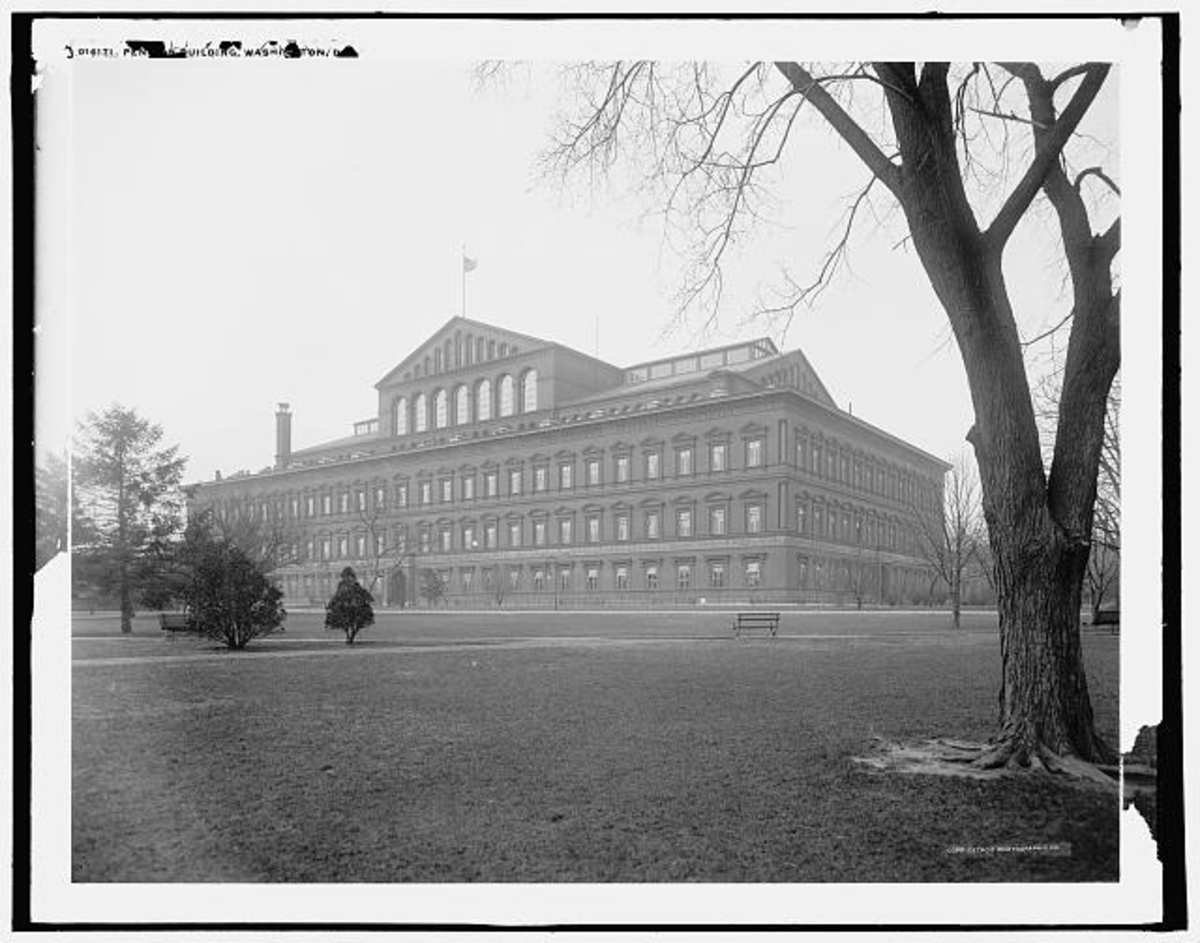
Library of Congress, Prints and Photographs Division, the Detroit Publishing Company photograph collection, the featured photograph of the Pension Building in Washington, District of Columbia, by William Henry Jackson, taken between 1900 and 1906