The national birth-registration area was established in 1915 with ten states and the District of Columbia; not until 1933 were all forty-eight states participating in it.
A birth certificate is a strange kind of proof. It is not a memory of the birth; it is a record made at the time by somebody required to write it down. For most of the nineteenth century, on both sides of the border, nobody was required to write it down. What happened to the people that left behind has a detailed answer.
A Birth Nobody Recorded
Mexico moved registration from the church to the state in a single stroke. Manuel de Jesús Arroyo Monsivais, writing in Fuentes Humanísticas, dates it: on 28 July 1859 the decree on the civil status of persons was promulgated, one of the series of laws that became the Reform Laws. Before it, as he puts it, there were no records other than those the Catholic clergy kept in their parish books; after it, the church’s records lost validity before the civil authorities. But the office had to be built municipality by municipality, and his study of one town in Zacatecas finds the work slow and the registers still very scarce years later.
The American Gap
The United States had the same hole and filled it even later. The Technical Appendix to Vital Statistics of the United States, the National Center for Health Statistics volume that explains how the figures are made, states that the national birth-registration area was proposed in 1850 and established in 1915, and that the original area consisted of ten states and the District of Columbia. Not until 1933 were all forty-eight states and the District participating. Adjustment for under-registration was discontinued only in 1960.
The List Of Substitutes
Anyone claiming an old-age benefit has to prove when they were born, so the government that could not produce the record had to decide what it would take instead. The Social Security Handbook still carries the list: if a public or religious record of birth established before the fifth birthday is not available, the agency accepts other documentation. A school record. A census record. A Bible or other family record. A religious record of confirmation or baptism in youth or early adult life. An insurance policy, a marriage record, a military record, a vaccination record, a passport.
The Delayed Certificate
The other route is to create the missing record late, and the rules are stricter the longer you wait. Texas, through its Department of State Health Services, still issues a delayed certificate of birth, and for an applicant aged fifteen or older it asks for three or more documents from independent sources. Any document other than an affidavit must be five years old or older. Only one of the three may be an affidavit of birth facts, and that affidavit has to be signed in front of a notary public by an immediate family member at least ten years older than the applicant.
The Parish Book Survives
Notice what sits in both systems. The parish register Mexico demoted in 1859 is the same baptismal record the Social Security Handbook still names, and for the same reason: it was written near the birth, by somebody with no stake in the answer, long before anyone needed it to settle a pension or a passport. The proof that works is almost never the newest paper. It is the oldest one. An earlier post took a different object out of the same chapter of the same novel:
https://duanekeelingbooks.com/blog/the-1933-gold-ban-and-the-rare-coin-exemption
What the Novel Takes
The Last Report opens that problem in 1954. A Yaqui man born near Hermosillo, Sonora, in 1893 needs to go home, and he has no document of any kind. What he gets is a county judge at a hospital bedside with a leather portfolio, asking three questions in Spanish — full name, place of birth, year — and typing the answers into an affidavit under the Cochise County seal. It is enough for the passport office. It is nearly not enough on the road: a soldier at a checkpoint turns the English paper over as though the Spanish might be on the back, and at the crossing an official says flatly that this is an affidavit and not a birth certificate. What settles it is an older official remarking how uncommon records were in the year the man was born. The novel is here:
https://duanekeelingbooks.com/books/the-last-report
Sources
National Center for Health Statistics, the Technical Appendix to Vital Statistics of the United States
Social Security Administration, the Social Security Handbook, on other evidence of date of birth
Texas Department of State Health Services, Vital Statistics, its requirements for a delayed certificate of birth
Universidad Autónoma Metropolitana, the journal Fuentes Humanísticas, Manuel de Jesús Arroyo Monsivais on the Registro Civil in Villa del Refugio, Zacatecas, 1859 to 1874
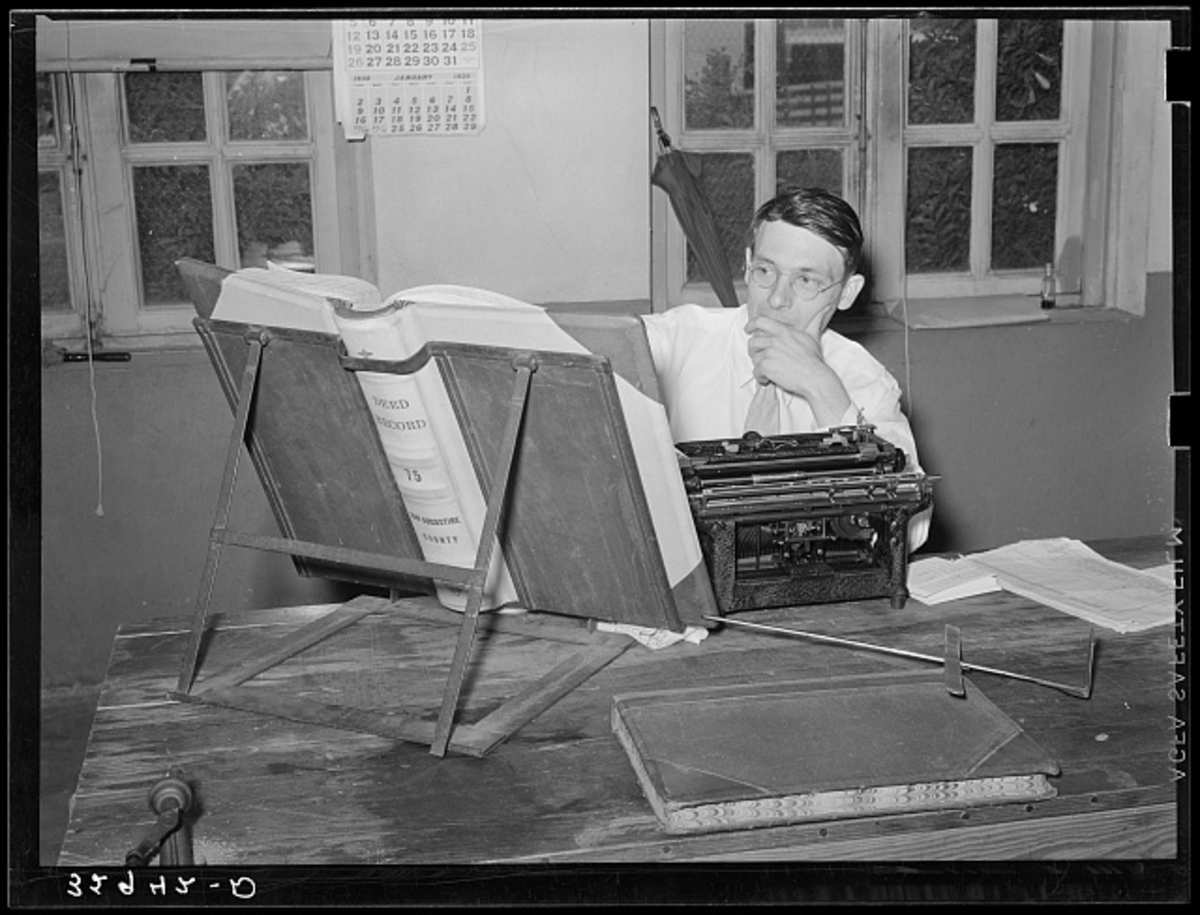
Library of Congress, Prints and Photographs Division, the Farm Security Administration and Office of War Information Photograph Collection, the featured photograph of a county clerk at San Augustine, Texas, by Russell Lee, April 1939