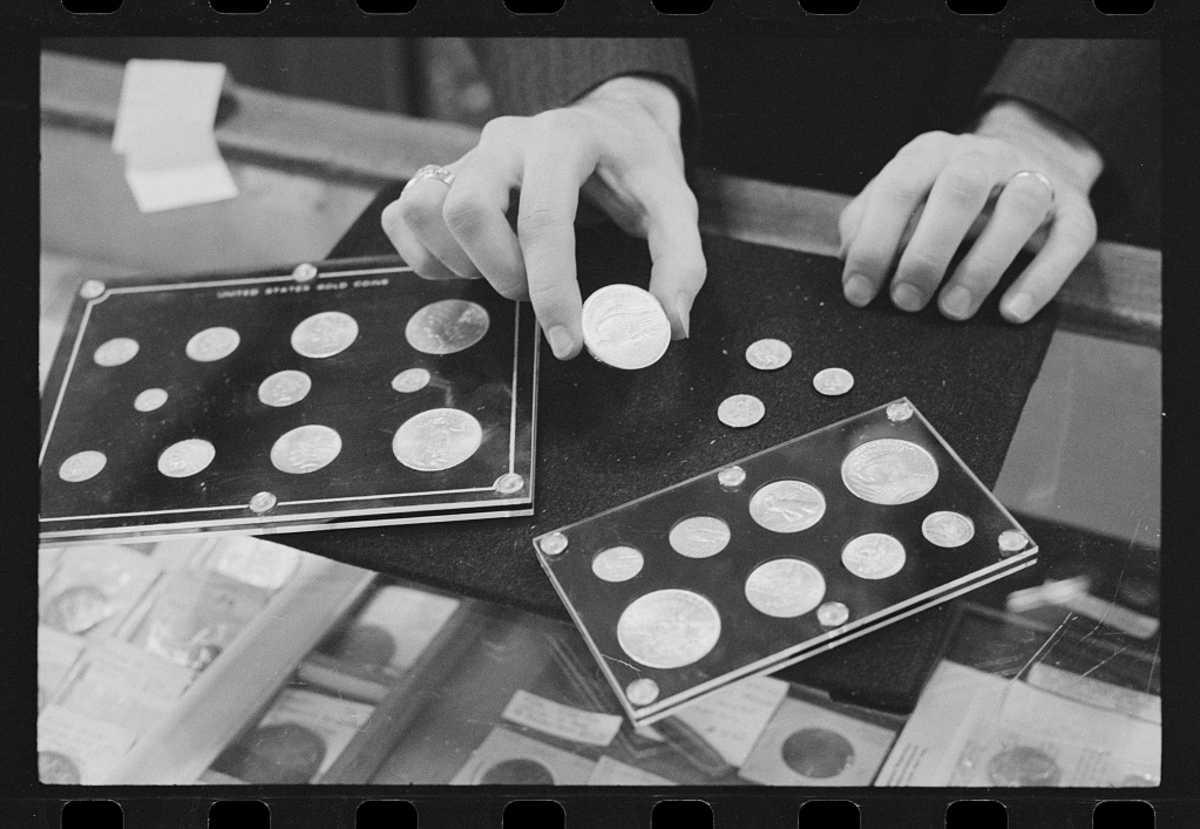
Executive Order 6102 required Americans to deliver their gold by 1 May 1933 on pain of a ten thousand dollar fine, and exempted only coins of special value to collectors.
For forty-one years it was a federal offence for an American to hold gold. The exception was narrow and it was strange. A coin somebody wanted to collect stayed legal. The same metal in any other shape did not.
The Order of 1933
Executive Order 6102 went out on 5 April 1933, a month into Roosevelt’s first term. It required all persons to deliver, on or before 1 May 1933, their gold coin, gold bullion and gold certificates to a Federal Reserve bank or to a member bank, taking currency in exchange. That is a deadline twenty-six days after the signature. A wilful violator might be fined not more than ten thousand dollars, imprisoned for not more than ten years, or both. The object was to get the metal into federal vaults before the dollar was devalued.
The Collector Exemption
Three kinds of gold were let through. Gold required for legitimate and customary use in industry, profession or art. Gold coin and gold certificates in an amount not exceeding in the aggregate one hundred dollars belonging to any one person. And, in the order’s own words, gold coins having a recognized special value to collectors of rare and unusual coins. A hundred dollars was the limit on ordinary gold coin, and there was no limit at all on coins a collector would want. A second order of 28 August 1933 restated the exemption almost word for word.
Thirty Five Dollars
Before all of this the Treasury had converted dollars into gold at a fixed price of twenty dollars and sixty-seven cents an ounce. The Gold Reserve Act, signed on 30 January 1934, transferred ownership of all monetary gold in the United States to the Treasury, and the president set a new price by proclamation the following day: thirty-five dollars an ounce. Under the regulations that followed, monetary gold was to be held as bars. Coins were forbidden. That price did not move for a generation. There was a legal market in old coins, and it was the only one left.
A Bank in 1954
Twenty years on, it was still being explained to tellers. In February 1954 the Federal Reserve Bank of New York issued a circular headed United States Gold Coin of Recognized Special Value to Collectors of Rare and Unusual Coin. The test it set was historical: whether a coin had that special value on 5 April 1933. A holder could keep such coins, acquire them, move them and sell them. And any gold coins, rare or not, once deposited in a bank became the property of the United States. The ban held until 31 December 1974, when an executive order revoked the order of 28 August 1933 and the orders amending it.
An Eight Escudos Piece
So the question in 1954 was never whether gold was legal. It was whether a particular coin was old enough and wanted enough. A Spanish eight escudos settled that on sight. The Smithsonian’s National Numismatic Collection holds one struck at the Mexico City mint in 1732, an inch and seven sixteenths across. Its reverse carries arms and a motto, INITIUM SAPIENTIAE TIMOR DOMINI, the fear of the Lord is the beginning of wisdom. By 1954 any surviving piece of that coinage was more than two centuries old, which put it inside the exemption without an argument.
What the Novel Takes
The Last Report opens in August 1954. Tohua, a Yaqui man who has kept a long vigil in the Chiricahuas, collapses on his own trail and wakes in the Copper Queen Hospital in Bisbee, where a nurse named Helen Calloway has decided he should see Sonora once more before he dies. The hospital has its own history here: https://duanekeelingbooks.com/blog/the-copper-queen-hospital-company-medicine-in-bisbee
He has no money. What he has is a Spanish gold coin he lifted out of the dirt of a collapsed mine years before and kept as a reminder of why men dig. A doctor at the hospital looks at it and tells him it is valuable. In 1933 that judgement was the whole of the law, and in 1954 it still was. The coin pays his way south.
The Last Report, the fourth Ridge Watcher book: https://duanekeelingbooks.com/books/the-last-report
Sources
The American Presidency Project at the University of California, Santa Barbara, for Executive Order 6102 of 5 April 1933.
The Federal Reserve Bank of St. Louis, its FRASER digital library, for Federal Reserve Bank of New York circulars 1273 of 31 August 1933 and 4071 of February 1954.
The Federal Reserve System, its published histories of the Gold Reserve Act of 1934 and the Roosevelt gold programme.
The National Archives and Records Administration, Office of the Federal Register, for Executive Order 11825 of 31 December 1974.
The Smithsonian Institution, National Museum of American History, its National Numismatic Collection, for the eight escudos struck at the Mexico City mint in 1732.
Library of Congress, Prints and Photographs Division, the U.S. News and World Report Magazine Photograph Collection, the featured photograph of gold coins for sale at a department store in Washington, D.C., by Warren K. Leffler, 26 December 1967.