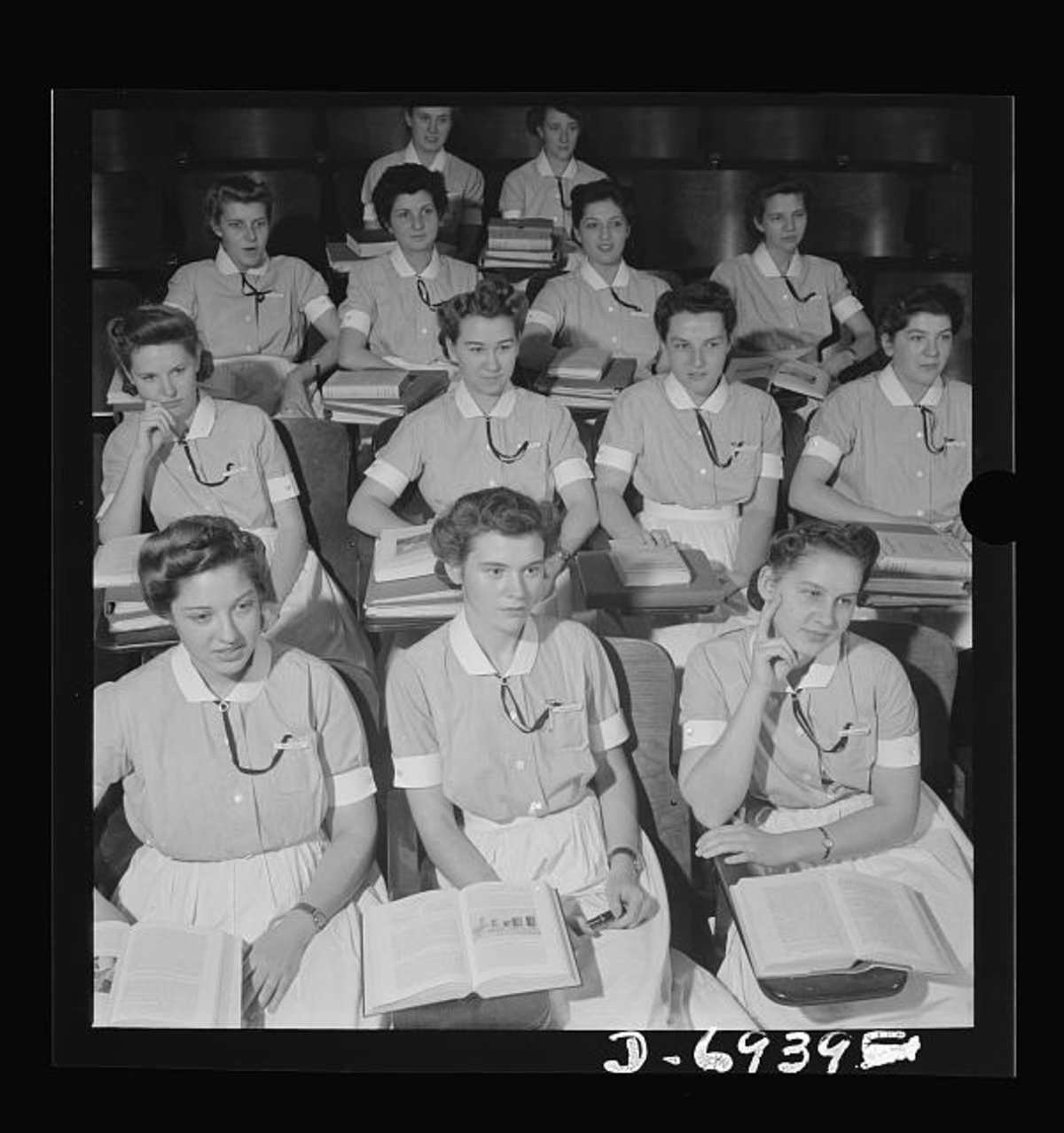
On 15 June 1943 Congress began paying young women to train as nurses, covering tuition, uniforms and a monthly stipend, and forbidding discrimination by race, creed or color.
A young woman entering nursing in 1940 did not pay her way through training with money. She paid in hours. The hospital gave her a bed, a uniform and three years of instruction, and in return she ran its wards, including at night. The arrangement had built American nursing. In the middle of the war, Congress decided it would not build nurses fast enough.
Paid In Ward Hours
The hospital diploma school was not a school in the way a college is a school. It was an exchange. A hospital opened a training programme and counted on its students to do the bulk of the patient care on its floors. Dartmouth Medicine, writing the history of the Mary Hitchcock Memorial Hospital School of Nursing, records a first-year student earning eight dollars a month, rising to twelve by her final year. A national committee had already called the practice what it was in 1923, decrying the exploitation of student nurses as cheap labour. The criticism did not end the system. The system was how the wards got staffed.
The Shape Of Training
The course itself had lengthened from two years to three in 1905, and an entrant served two to four months of probation first. The same Dartmouth history describes students working six and a half days a week in twelve-hour shifts, nights included, and the hospital finding it impossible to bring the working day down to the recommended eight hours until 1938. Catholic schools of nursing ran the day on the same arithmetic with a chapel bell in front of it. Attrition was heavy, and nobody considered that a failure of the school. It was understood to be the point.
What Congress Passed
The bill that changed it was introduced by Representative Frances Payne Bolton of Ohio. Approved on 15 June 1943 as Public Law 74 of the Seventy-eighth Congress, it set out to provide for the training of nurses for the armed forces, and it paid the schools directly. The Treasury covered reasonable tuition and fees, reasonable maintenance for the first nine months, uniforms and insignia, and a stipend of at least fifteen dollars a month for the first nine months and twenty thereafter. In exchange a cadet stated in her application that she would remain available for military or essential civilian service for the duration of the war. The Public Health Service, under Surgeon General Thomas Parran, ran it, and expected cadets to finish in thirty months rather than thirty-six. Service histories date it to the first of July; the statute carries 15 June.
No Discrimination Allowed
One clause of the act is easy to read past and was not a small thing in 1943. It states plainly that there shall be no discrimination in the administration of the benefits and appropriations on account of race, creed, or color. The National Women’s History Museum records roughly three thousand African American cadets, and forty Native American women drawn from twenty-five tribes, and notes that the money helped open nursing programmes that had until then admitted white students only. A school that wanted the funds took the clause with it.
What It Produced
The Public Health Service historian’s account puts the recruiting target at sixty-five thousand nurses a year, and records that the Corps met it three years running. Between 1943 and 1948 the programme counted 124,065 graduates, and then it ended. What came next for the women who went into uniform was a separate fight over whether an Army nurse held real rank or only a shadow of it: https://duanekeelingbooks.com/blog/army-nurse-corps-relative-rank-and-public-law-350
What The Novel Takes
Within Reach puts Helen Calloway into a Catholic diploma school in Tucson in September 1940 and takes her out of it in 1943, which places her, by a margin of weeks, on the wrong side of the law. Her training is the old kind: chapel before dawn, three hours on the ward, five hours of classes, three or four more hours on the ward, lights out at ten. Nearly half the girls who started with her are gone before the end. At the capping service the others are already talking about Army posts and the new money that has come for the classes behind them. She came before the wave, and she paid in ward hours. The novel lets the arithmetic sit there.
Within Reach: https://duanekeelingbooks.com/books/within-reach
Sources
United States Statutes at Large, volume 57, the act approved 15 June 1943, Public Law 74 of the Seventy-eighth Congress The Public Health Service historian’s Chronicles article on the Cadet Nurse Corps, in Public Health Reports, May and June 1994 The National Women’s History Museum, on the United States Cadet Nurse Corps Dartmouth Medicine, on the history of the Mary Hitchcock Memorial Hospital School of Nursing Library of Congress, Prints and Photographs Division, the Farm Security Administration and Office of War Information Photograph Collection, the featured photograph of student nurses in a classroom in New York by Fritz Henle, November 1942