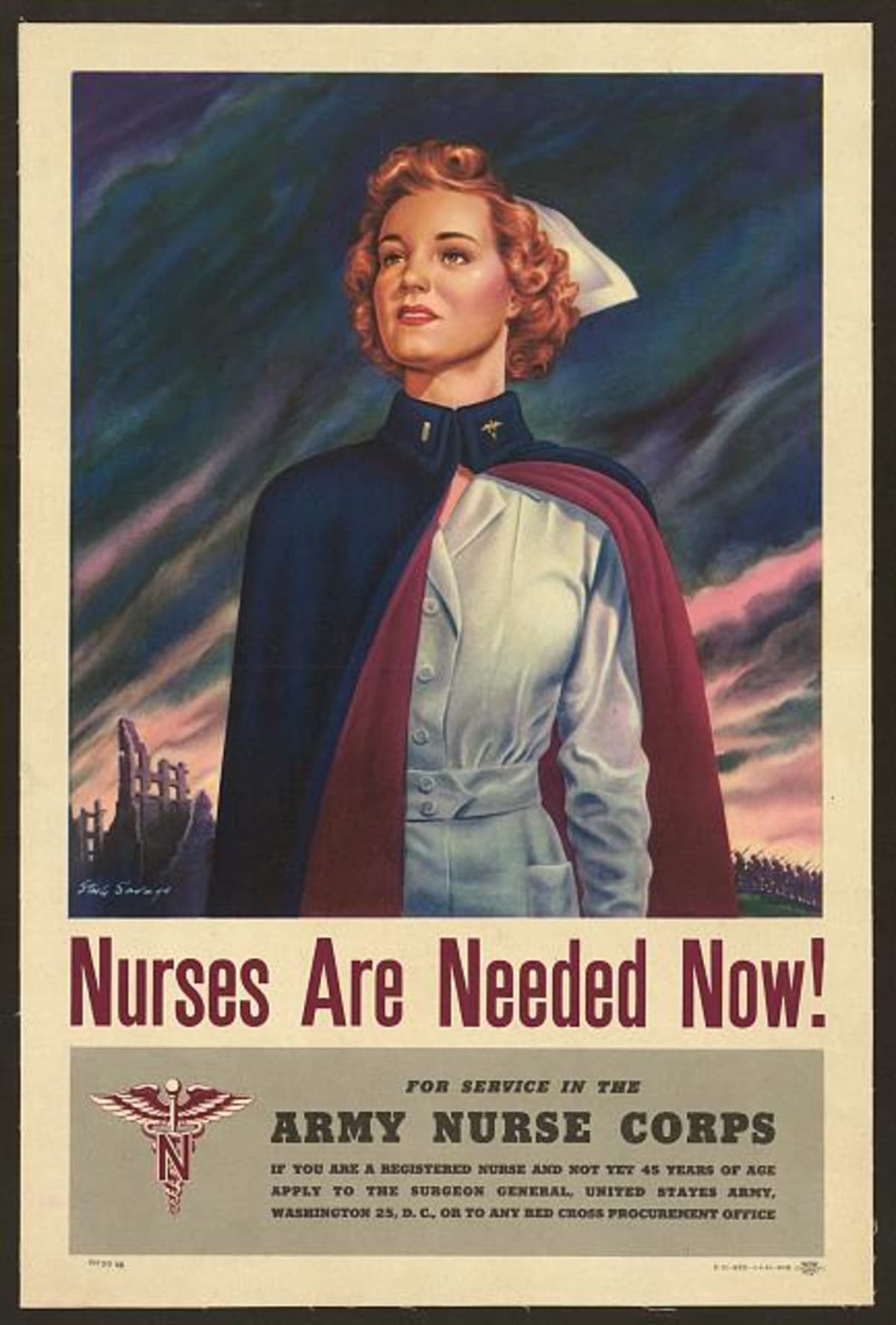
From 1920 until June 1944 an Army nurse wore a lieutenant’s bar and held no commission behind it: relative rank gave her the grade, the insignia and the title, and little else.
Rank is usually the simplest fact about a soldier. For Army nurses it was, for twenty-four years, the most complicated one. A woman could be addressed as Lieutenant, wear the bar, and be carried on the rolls in a grade, and still hold no commission. The Army called this relative rank: a legal category invented to give women a place in a hierarchy that had no provision for them. It lasted from 1920 until the summer of 1944, and what it withheld explains a good deal about how the Second World War was nursed.
Rank Without The Rank
For its first twenty years the Army Nurse Corps had no rank at all. The Army Nurse Corps Association, writing its own history, puts it flatly: from 1901 to 1920 Army nurses were appointed to active duty status without authorization of military rank or grade. They outranked nobody and could be overruled by any man in uniform who cared to try it.
That is the problem relative rank was built to solve. A nurse holding it was assigned a grade and wore its insignia, and orders addressed her by it. What she did not have was the commission that gives a grade its force.
What 1920 Gave
The Army Reorganization Act of 1920 granted relative rank to all Army nurses and authorized them to wear insignia. In the Association’s account the Act did some real good: it clarified the lines of authority with subordinates and superiors, so that a nurse could at last exercise authority over the ward she ran.
What the War Department held back, it held back deliberately. It chose not to prescribe rights and privileges on parity with male officers. The fight for full rank, the Association notes, lay in the future.
The Pay Gap
How narrow the ladder was shows in the Army Medical Department’s own wartime personnel history. At the end of November 1941 the whole Corps held one major, 35 captains, 365 first lieutenants and 6,642 second lieutenants. More than nine of every ten Army nurses stood in the lowest grade the Corps had.
Pay came closer to parity than rank did. The Medical Department history records that the arrangement gave nurses a remuneration substantially equal to that of commissioned officers. But unlike male officers, it adds, they did not receive increased allowances as their rank increased, and the allowance for dependents was withheld from them entirely.
The June 1944 Act
Congress ended the arrangement on 22 June 1944. The statute is chapter 272 of that session, known as Public Law 350, and it takes the plainest title available: an Act to authorize temporary appointment as officers in the Army of the United States.
Two things in the text matter. The first is that it works by conversion rather than application. The President was authorized to appoint the personnel by blanket order into commissioned grades corresponding to the relative rank each already held. The second is that the money followed automatically: those appointed by blanket order drew the pay and allowances of the grade from the effective date, unless they expressly declined it.
After The Blanket Order
The effect shows in the same tables. At the end of December 1944 the Corps carried one colonel, 58 lieutenant colonels, 166 majors, 1,014 captains, 9,871 first lieutenants and 31,138 second lieutenants. The shape had changed as much as the size: field grades where there had been almost none, and a colonel at the top of a corps that in 1941 reached no higher than one major.
The dependency allowance arrived with the commission in June 1944.
A related post, on women meeting a different gate in the same profession: https://duanekeelingbooks.com/blog/women-in-medical-school-in-the-1960s-and-la-county-general
What the Novel Takes
Within Reach follows Helen Calloway out of a Bisbee copper town and into the Army Nurse Corps. When she reports to a station hospital outside Tucson in the summer of 1943, the Chief Nurse lays out the terms in a handful of sentences, and one of them is the whole of this post: Helen is told she is relative rank, and told not to confuse it with command.
She is a second lieutenant with a serial number beginning in N and a caduceus carrying a red N, and she will be most of a year into the war before the law catches up with the bar on her collar.
Within Reach: https://duanekeelingbooks.com/books/within-reach
Sources
The Army Nurse Corps Association, its history pages on relative rank and Army nurses
The United States Army Medical Department, Office of Medical History, its official volume on personnel in the Second World War, chapter twelve
The United States Government Publishing Office, the Statutes at Large, volume fifty-eight, the Act of 22 June 1944
Library of Congress, Prints and Photographs Division, the featured recruiting poster for the Army Nurse Corps by Stu L. Savage, issued for the Army Recruiting Publicity Bureau, 1944