In 1915 Congress put one hundred and twenty-five thousand dollars behind federal predator hunters, and by 1919 New Mexico barred its counties from paying a bounty on their kills.
Every cattle range in the Southwest once had the same answer to a stock-killing lion: pay somebody to bring in the carcass. It was a system with no payroll, no districts and no accounting, and it rested on the assumption that a rancher, a drifter or a boy of fourteen would go after the animal if the price was right. What replaced it was a federal bureau with salaried men on assigned ground.
Bounties Before The Bureau
Paying for a dead predator is older than the republic. The first American bounty system was established in Massachusetts in 1630 against marauding wolves, and the practice reached the Midwest and the West around 1860, mostly aimed at coyotes. Across the line from New Mexico, the Arizona territorial legislature declared mountain lions predatory and put a bounty on them, and Cochise County paid on a scale running from one dollar for a skunk up to ten dollars for a lion.
The ranges those bounties were meant to protect were being redrawn in the same years: https://duanekeelingbooks.com/blog/the-stock-raising-homestead-act-of-1916-and-640-acres
Washington Enters The Field
By 1914 Congress had explicitly authorised work to protect livestock by destroying wolves. The following year it appropriated one hundred and twenty-five thousand dollars to the Bureau of Biological Survey for experiments and demonstrations in controlling wolves, prairie dogs and other animals injurious to livestock, and for organised control on public land. Part of that money went immediately into hiring trappers. There was plenty to build on: the Forest Service had reported seventy-two wolves killed in the Gila and Datil forests in 1907, by rangers and by outside trappers. The appropriation did not abolish the bounty. It put a second and better-funded system beside it.
One District Two States
The campaign that followed treated the whole territory as one problem. The Bureau of Biological Survey’s annual report for 1917 and 1918, digitised by the Arizona State Library, is titled for a predatory animal campaign in Arizona and New Mexico together, and it carries a map. A lion crossing from the Animas Valley into Cochise County changed no jurisdiction, and after 1915 neither did the men paid to kill it.
Ligon And His Numbers
J. Stokley Ligon ran the Survey’s predator work in New Mexico. Wolves, he wrote, had to be fought with scientific methods. His annual report for 1917 recorded his belief that at least fifty per cent reduction in the damage done by wolves had been accomplished in New Mexico during the previous twelve months, and his estimate that no more than seventy adult gray wolves remained in the state. A year later he predicted the gray wolf would be exterminated throughout the west within reasonable time. These are the hunter’s own figures in his own report to the bureau that paid him, and nobody audited them.
The Law Of 1919
New Mexico settled the overlap two years after Ligon wrote that. Chapter 119 of the Laws of 1919 committed the state to a cooperative agreement with the secretary of agriculture, the work to be carried on under the direction of the bureau of biological survey. The same chapter closed the seam where the two systems met: no bounty was to be collected from any county for animals taken by hunters or trappers operating under such agreements. A man could be paid by his county or by the federal government, and not by both for one animal.
What The Novel Takes
Shelter, the Bee Adkins short story, opens with a boy of fourteen sent out alone after a lion that has been killing calves on the Diamond A in southern New Mexico. The foreman’s charge is to find it before it kills again, and there is a bounty waiting at the end of it. The novelette names no year and no agency. Nobody in it is on a federal payroll, and the hunt is a job handed to whoever on the place can do it. That is the honest picture of a range with only a few seasons of the old arrangement left to run.
Shelter and the rest of the Bee Adkins books: https://duanekeelingbooks.com/series/the-bee-adkins-series
Sources
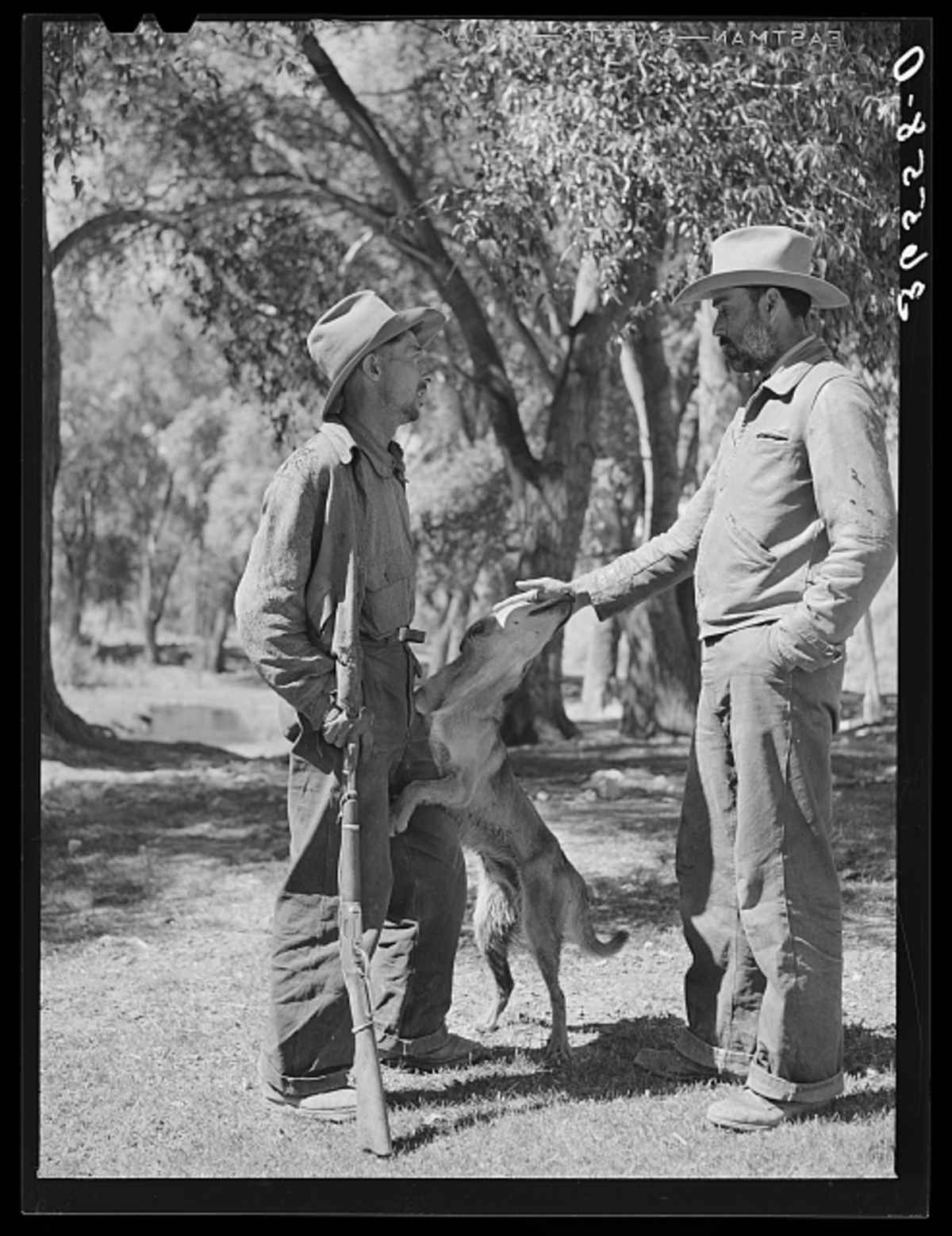
Oregon State University Libraries, Scholars Archive, on the history of predator control The Natural Resources Journal, University of New Mexico School of Law, on the Biological Survey and the Ligon reports Arizona State Library, Archives and Public Records, for the digitised Bureau of Biological Survey annual report on the Arizona and New Mexico predatory animal campaign United States Department of Agriculture, Forest Service, for the Cochise County bounty schedule The compiled statutes of the State of New Mexico, Chapter 77, Article 15 New Mexico Department of Game and Fish, on the mountain lion’s change of legal status Library of Congress, Prints and Photographs Division, the Farm Security Administration and Office of War Information Photograph Collection, the featured photograph of a rancher and a herder in Catron County, New Mexico, by Russell Lee, June 1940