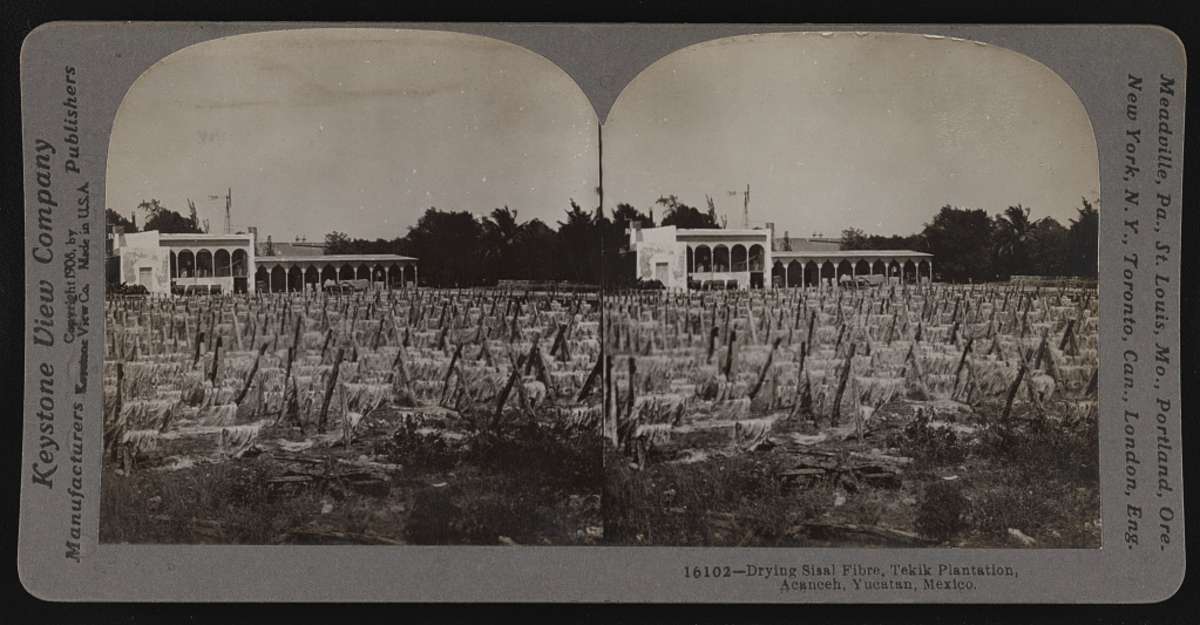
By 1916 Yucatan carried eleven hundred henequen haciendas and 850 rasping mills, and the men who cut the leaves were held there by debts one estate could buy from another.
Sisal reaches most people as a word on a rope label. In Yucatan it had a history. The fibre was cut by hand from a spiny agave, fed to a machine that threw away almost everything it was given, and shipped out of estates that kept their workers on an account book.
Green Gold and Twine
Henequen is Agave fourcroydes, a perennial, drought-tolerant fibre plant native to Mexico and Guatemala. It is slow: four to six years to harvest maturity, then productive for more than two decades. The twine-binding harvester, invented in the United States in 1878, needed a cord that would hold a wheat sheaf and then rot in the field. Yucatan had the plant for it. Exports rose from under six million kilos in 1875 to forty-three million in 1885 and eighty-one million in 1900.
The Rasping Machine
By weight a henequen leaf is about four parts fibre in every hundred; the other ninety-six are water and pulp. Stripping that by hand is not an industry. Not until the mechanical rasper, the desfibradora, arrived in the late 1850s did growing the crop become commercially viable. The machine was local, invented by a Yucatecan, Jose Esteban Solis, in a competition the state government sponsored. By 1916 eight hundred and fifty rasping mills were at work, fed by eleven hundred haciendas across seven hundred and ninety thousand acres. Each mill made fibre and a wet mountain of bagazo, the fermenting pulp waste.
Inside the Works
An archaeological survey of three of these estates lists the standing parts as a main house, a machinery house with its diagnostic chimney, an administration, a warehouse and a chapel. Around the works lay a village: at San Pedro, single-room houses along several streets, enough for at least a hundred and fifty people. The streets still carry vestiges of the Decauville mini-rail system, the narrow-gauge track that brought cut leaves in from the fields.
Debt and the Store
The estates did not hold their workers with walls. They held them with accounts. An 1882 state law, the Ley Agricola Industrial del Estado de Yucatan, restated earlier peonage law: a peon who left work without paying what he owed might be legally prosecuted. The hacienda store, the tienda de raya, sold corn and clothing against wages. The ledger of one estate, Itzincab Camara, shows debts for sixty-four continuing Maya workers averaging just over a hundred and twenty-five pesos in 1912, and records ten men whose cartas cuentas — their debt accounts — were bought by the hacienda between 1908 and 1910. The account changed hands and the man came with it, and a debt could be inherited by a widow or a child. The ledgers are read more than one way: the economists who published them argue debt also worked as an advance.
Who Cut the Leaves
The workforce was mixed. The weekly sheets at Itzincab Camara, in the district of Acanceh, list for 1905 eighty-three Maya workers, roughly twelve Yaqui, twenty-two Koreans and sixteen boys. The Yaqui had been deported from Sonora, a traffic covered separately here: https://duanekeelingbooks.com/blog/yaqui-deportations-to-the-yucatan-henequen-fields
Outsiders ran more often than the Maya did: the difference between a man with relatives in the next village and a man two thousand miles from home. What a day came to is disputed. One account has a worker weeding one or two mecates or cutting roughly two thousand leaves, while a 1966 study gives an average task of three thousand leaves, an effort it calls performable without strain in six to eight hours. The system ended on paper before it ended in fact. Mexico outlawed debt peonage in 1914, wages more than doubled between 1913 and the start of 1915, and Salvador Alvarado entered Merida on 19 March 1915.
What the Novel Takes
Tohua! takes a Yaqui man from Sonora to a Yucatan estate the book calls Hacienda San Jose, and builds those chapters from the furniture the record describes. A mule draws a flatcar along narrow-gauge rails between rows whose leaf spines would shred a man who jumped. A chimney stands up out of flat country before any other building resolves. At the gate the new men are handed wooden tokens and their names stop being used. A litre of water at the store costs half a day of cutting. The workers call the decorticator La Rueda, the Wheel, and the day is measured by it. The novel does not argue the history. It puts a man inside it.
Tohua!, book one of The Ridge Watcher: https://duanekeelingbooks.com/books/tohua
Sources
The National Bureau of Economic Research, working paper 13852, Alston, Mattiace and Nonnenmacher, on coercion, culture and debt contracts in the henequen industry, 2008
Mexican Studies, Estudios Mexicanos, volume 30 number 2, 2014, Mattiace and Nonnenmacher, on hacienda labour during the Mexican Revolution
Heritage, volume 3, 2020, Zimmermann and others, on archaeology at three henequen haciendas in Yucatan
Scientific Reports, 2026, Pathan and others, on fibre extraction from the leaves of Agave fourcroydes
Library of Congress, Prints and Photographs Division, the Stereograph Foreign Geographic File, the featured view of fibre drying at the Tekik Plantation, Acanceh, Yucatan, published by the Keystone View Company, 1909, photographer unrecorded