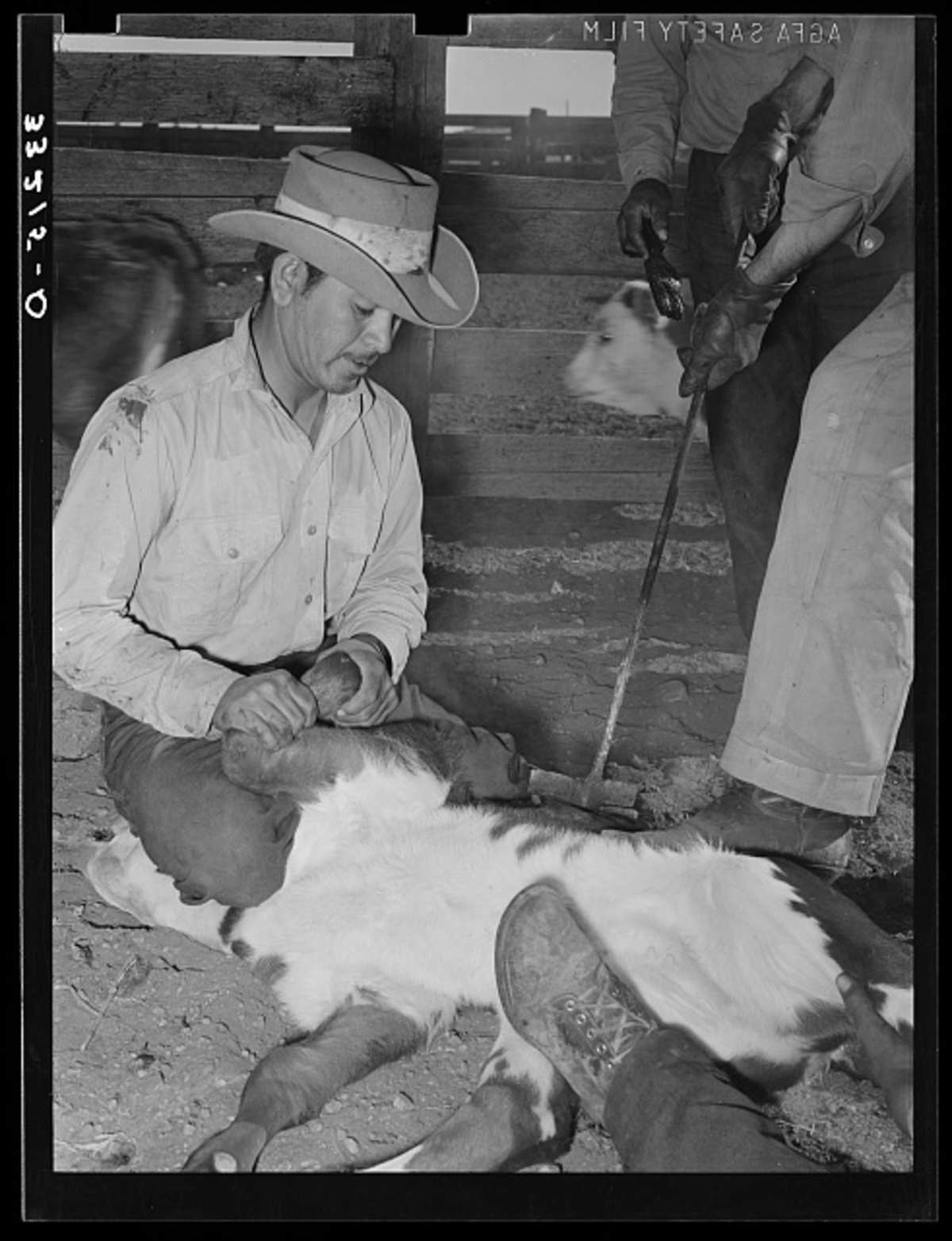
Before 1895 an Arizona cattle brand was filed with the county; the first territorial brand book appeared in 1897, and by 1919 more than seventeen thousand brands were on record.
A brand is a scar, and on open range it was the only title a cow carried. Everything else about ownership — who bought the animal, who bred it, who was owed money against it — lived on paper somewhere else. The law of the cattle country had to be built around reading a mark correctly, and around the men who made it unreadable.
A Mark With Standing
The National Park Service, teaching the subject in its classroom materials, defines branding as pressing hot metal symbols into the skin of livestock to mark ownership, and puts the question that made it necessary: when cattle from several outfits intermixed on unfenced country, there was no other way to tell whose was whose. Arizona Highways, in November 1960, gave the legal weight plainly — a brand is an owner’s mark, an indication that the animal wearing it is the legal property of a named person or outfit.
From County To Territory
Arizona Highways states that prior to 1895 cattle brands in Arizona were recorded with the counties, and that Arizona was the last of the range states to adopt a central method of brand registration. The body that took it over was the Live Stock Sanitary Board. The Arizona Historical Society, describing its holdings of that board’s records, says the commission was created by legislative enactment in 1887 to make and enforce rules and regulations governing the admission of livestock into the territory. Disease came first; ownership followed. The land under the herds had its own arithmetic:
https://duanekeelingbooks.com/blog/the-stock-raising-homestead-act-of-1916-and-640-acres
The Brand Book
The Historical Society puts the turn at 1897. In that year the board was given power to enforce registration of all brands for legal recognition in the Territorial Brand Book, and complete information as to brands, the name and address of the owner and so on was required. Arizona Highways dates the first Arizona territorial brand book to the same year. The register grew. By 1919, a year in which brands had to be re-registered, more than seventeen thousand were on record. A state law of 1931 required re-registration every ten years thereafter.
Inspected At The Rail
Registration settled what a mark meant; inspection settled whether the animal was leaving in the right hands. The University of Arizona Libraries holds, among the records of the Empire Ranch, a Live Stock Sanitation Board of Arizona certificate of inspection of cattle shipped or driven, dated 22 December 1902. It shows eight different brands and the markings for 818 cattle shipped by Vail and Gates from Pantano, Arizona, to Gaviota, California. The library adds one detail of its own: the inspector was E. L. Vail.
Beating The Brand
The National Park Service names the tool: a running iron, a straight piece of metal with a plain end, used to change or alter the brand on cattle, after which the thief claimed the altered brand as his own. Arizona Highways is useful on why that was harder than it looks. A twice-scarred burn can be detected. One method got around that by scalding the hair off an area so that when it grew back the ground could be re-branded; against skilled work of that kind, the magazine says, the only sure method of detection is to kill and skin the animal. The easiest theft needed no alteration at all: the magazine describes a man who always had more branded calves than he had adult cows.
South Of The Line
South of the border the same stock ran on the same ground, and the Revolution had thinned it. El Colegio de México, publishing on livestock in northern Mexico in the first decades of the twentieth century, finds that livestock farming suffered more in Chihuahua than in Sonora, and that herd recovery was faster in Sonora — a recovery the journal credits to postrevolutionary elites rebuilding regional economies in the 1920s. Path of the Peacemaker sets a chapter in Sonora in 1921 on a ranch losing a few head at a time to men the local law cannot find, and the cattle standing in the rustlers’ corral are carrying the Mendoza brand. The mark is the whole of the evidence, and a hired American with a string of dogs, not a court, acts on it.
https://duanekeelingbooks.com/books/path-of-the-peacemaker-bee-adkins-book-1
Sources
Arizona Historical Society, its library guide to the records of the Arizona Live Stock Sanitary Board
Arizona Highways, Edna Hoffman Evans, Arizona Cattle Brands, November 1960
University of Arizona Libraries, Special Collections, the Records of the Empire Ranch
National Park Service, its classroom materials on cattle brands and rustling
El Colegio de México, Historia Mexicana, Revolution and Livestock Farming in Northern Mexico
Library of Congress, Prints and Photographs Division, the Farm Security Administration and Office of War Information Photograph Collection, the featured photograph of a ranch hand branding a calf at the Walking X Ranch near Marfa, Texas, by Russell Lee, May 1939