On 3 October 1950 California gave every public employee thirty days to swear a loyalty oath, and the penalty for not signing was not a hearing but the loss of a paycheck.
The loyalty tests of the early Cold War are remembered as hearings: a committee, a witness, a microphone. California built something quieter and far larger. In the autumn of 1950 the legislature put a printed form in front of every person the state and its counties and cities paid, and made signing it a condition of being paid at all. No accusation, no board, no appeal. There was a line, and either a name went on it or the salary stopped.
A Signature or Nothing
The Levering Act took effect on 3 October 1950 and gave the people it covered thirty days. What happened to a man who let them pass is set out in the court’s opinion in Pockman against Leonard. The petitioner was an associate professor at San Francisco State College. He did not take the oath. The college officials refused to certify his name to the payroll and withheld his salary for October and November, and the court held he was entitled to pay only for services through thirty days after the Act took effect. No hearing was held, because none was required.
What the Act Required
Under sections 3100 and 3101 of the Government Code, public employees became civil defense workers, subject to such civilian defense activities as might be assigned to them by their superiors or by law. The reach was deliberately wide: the state, any county, any city, any state agency and any public district. The oath went with the job rather than with an office, which meant it was administered by whoever kept the payroll, from a school principal to a regional director.
The Oath Itself
Section 3103 set out the words. Its first paragraph is the ordinary one, to support and defend both Constitutions and to take the obligation freely, without any mental reservation or purpose of evasion. The second paragraph is the new part. The signer swore that he was not a member of any party or organization advocating the overthrow of either government by force or violence or other unlawful means, and that he had not been one within the five years immediately preceding, except as written into a blank space beneath, with instructions to enter the words No Exceptions if there were none. An oath of office looks forward. This one looked back five years and handed a man a blank to fill in.
The University Fight
The University of California had got there first. Its Regents imposed an oath of their own in 1949, a year before the legislature acted. The counts of what it cost differ. The university’s own history archive records that thirty-one non-signers were dismissed in the summer of 1950. The California Supreme Court Historical Society puts the number who refused higher, at thirty-nine professors and eighty-four other staff, and adds fifty-five cancelled courses and forty-seven scholars who declined appointments. The two counts measure different things and the record does not reconcile them. No evidence was produced that any non-signer was a communist.
Two Rulings One Day
On 17 October 1952 the California Supreme Court decided both halves of the question on the same day. In Pockman against Leonard it upheld the Levering Act, holding that the oath did not offend the state constitution’s ban on other oaths or tests. In Tolman against Underhill it struck the Regents’ separate declaration down, holding that the legislature intended to occupy this particular field and that there was no room left for supplementary regulation. The state’s oath stood; the university’s did not.
Another statute that changed a whole class of people’s standing by its own words, with no hearing anywhere: https://duanekeelingbooks.com/blog/army-nurse-corps-relative-rank-and-public-law-350
What the Novel Takes
Road to Redemption runs across the years the Levering oath was new. Its chapter for 1952 puts Bee Adkins, a hound man drawing a government wage in Perris, in his regional director’s office to be briefed on a Malibu mountain lion. On the corner of the desk is a loyalty oath, dated more than two weeks earlier, the signature line still blank. Bee is not asked to sign; the form went to the grades above him. He puts his finger on the empty line and asks a question, and the argument that follows costs him the job.
Road to Redemption: https://duanekeelingbooks.com/books/road-to-redemption-bee-adkins-book-3
Sources
The Supreme Court of California, its opinion of 17 October 1952 in Pockman against Leonard, which sets out the Levering Act oath in full
The Supreme Court of California, its opinion of 17 October 1952 in Tolman against Underhill
The California Supreme Court Historical Society, its account of the University of California loyalty oath fight
The University of California, Berkeley, its university history digital archives exhibit on the loyalty oath controversy
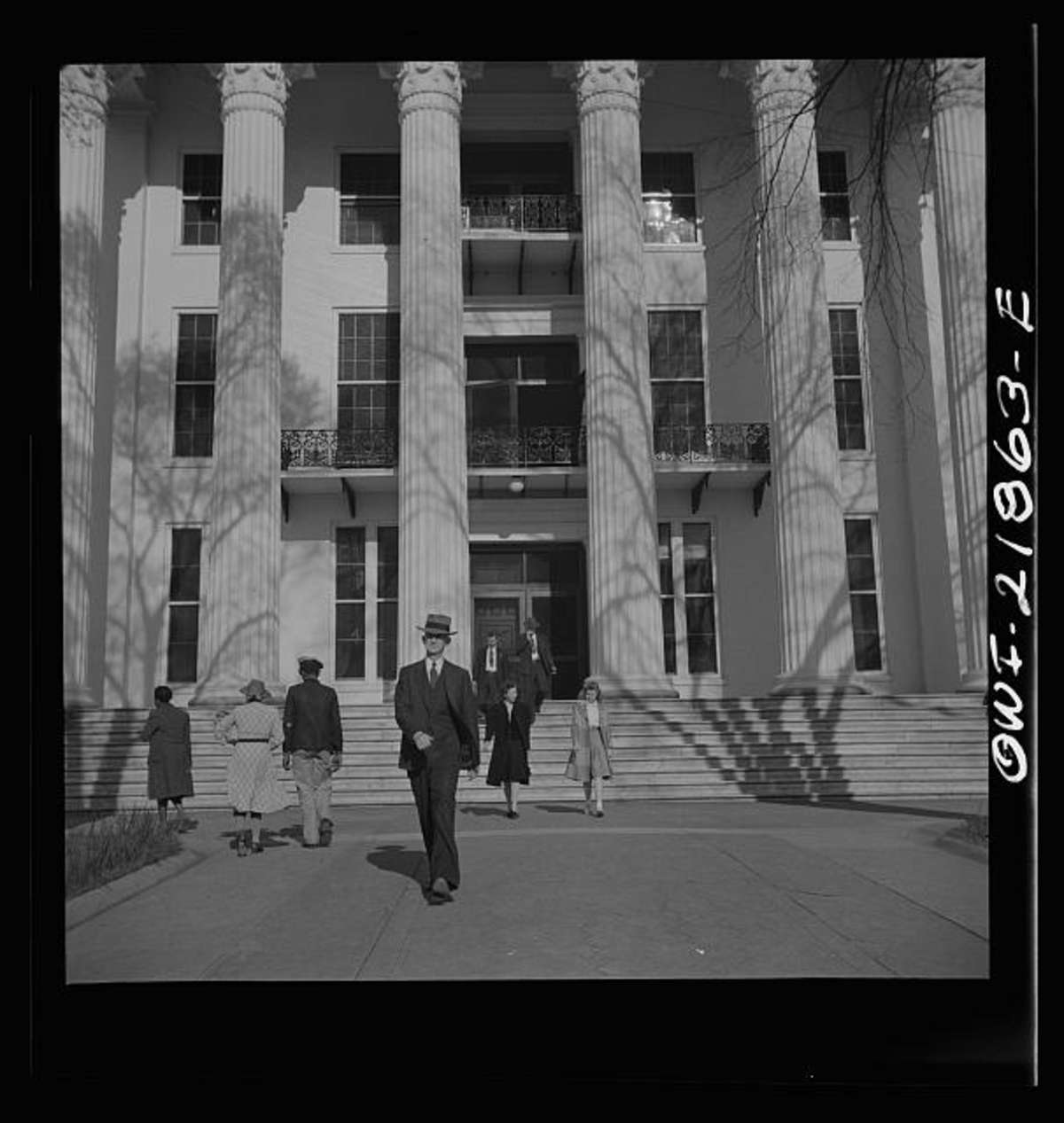
Library of Congress, Prints and Photographs Division, the Farm Security Administration and Office of War Information Photograph Collection, the featured photograph of state government employees leaving the state capitol in Montgomery, Alabama, by John Vachon, March 1943