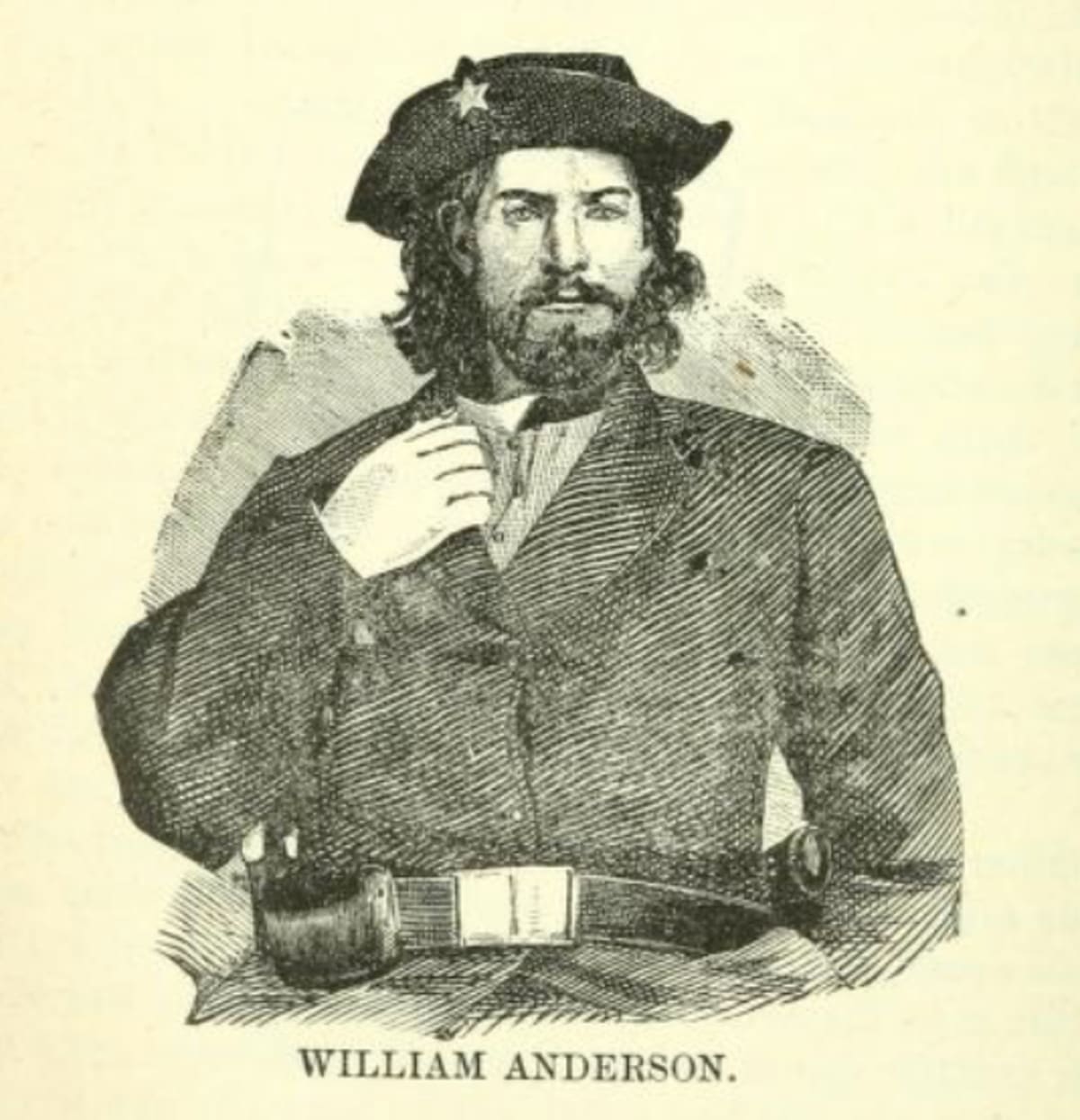
William T. Anderson was dead at about twenty-five, killed by Missouri militia in October 1864 — fourteen months after a Kansas City jail collapsed on his three sisters.
The man Missouri remembers as Bloody Bill Anderson spent barely three years at war. He was born in Hopkins County, Kentucky, most likely in 1839, though the year is not settled and Anderson himself claimed Missouri as his native state. His father moved the family to Missouri and then, in 1857, onto a claim near Council Grove, Kansas, where the Andersons owned no slaves but were, in the Kansas City Public Library’s phrasing, “deeply proslavery.”
By 1861 they had a local reputation as horse thieves. In 1862 a proslavery judge named Baker shot and killed Anderson’s father. Anderson killed Baker on 2 July 1862 and crossed into Missouri. He was in his early twenties, and everything he is remembered for happened in the twenty-eight months that followed.
The Jail Collapse
On 13 August 1863 a three-story building in Kansas City — property of the painter George Caleb Bingham’s estate — came down on a group of women and girls held by Union authorities as guerrilla sympathizers. Four prisoners died. All three Anderson sisters were inside. Josephine was crushed in the rubble; Martha came out with both legs broken. Union guards had been pulling bricks and supports out of a cellar wall to widen their quarters, and whether the collapse was carelessness or design has never been settled. The bushwhackers settled it for themselves.
Eight days later Anderson rode into Lawrence, Kansas, with William Clarke Quantrill and some 450 others, and between 150 and 200 men and boys were killed there. The Handbook of Texas records what he said: “I am here for revenge, and I have got it!”
Fayette and Centralia
That winter, in Texas, Confederate Major General Sterling Price made Anderson captain of a guerrilla company of his own. The quarrel with Quantrill turned permanent by spring, and Anderson came back into Missouri with between forty-five and sixty-five men. Through the summer of 1864 he worked the central counties. His band acquired a signature: PBS’s American Experience describes them as “known for decorating their saddles with the scalps of slaughtered foes.”
On 24 September 1864 he and George Todd sent nearly two hundred men in stolen Federal uniforms against the garrison at Fayette. The Union troops were inside blockhouses. The guerrillas charged three times and were thrown back three times. Frank James remembered it as “like charging a stone wall, only this stone wall belched forth lead.” Central Methodist University, which stands on that ground, counts six to eight guerrilla dead; other accounts run to thirteen. Fayette was the failure that came three days before the atrocity.
On 27 September Anderson took about eighty men into Centralia, stopped a North Missouri Railroad train, and had the unarmed furloughed soldiers aboard it killed at the depot. That afternoon a much larger force destroyed the pursuing detachment of the 39th Missouri Infantry on a field two miles out. Colonel Draper’s report counted seventeen of the dead scalped and recorded that “every man was shot in the head.”
Albany, October 1864
A month later Lieutenant Colonel Samuel P. Cox drew Anderson’s band into an ambush near Albany, in Ray County, on 26 October 1864. Anderson charged through the Union line and was shot from behind it, falling with two minié balls in his head. The men who searched him found a silk cord knotted many times over — each knot, it was assumed at the time, standing for a dead Unionist.
The body went to Richmond, Missouri, where a local doctor photographed it propped up with a revolver in its hand. The State Historical Society of Missouri records that militia officers then decapitated him; the Handbook of Texas adds that the head was hoisted onto a telegraph pole and the body dragged through the streets. He was buried in a field and moved to Richmond’s Pioneer Cemetery in 1908.
Who Made the Legend
Nearly everything durable about Anderson reaches us through two channels pulling opposite ways. One is the Official Records — Federal officers writing days after the fact, with every reason to make the enemy sound like animals. The other is John Newman Edwards, who wrote Jo Shelby’s military reports during the war, followed Shelby into Mexican exile, helped found the Kansas City Times in 1868, and published Noted Guerrillas, or the Warfare of the Border in 1877. Edwards, in the State Historical Society’s summary, presented “Confederate soldiers and bushwhackers as heroic warriors defending a just cause,” and his later glorification of Jesse James was “part of his larger plan to instill pride in ex-Confederates.”
Both the sober version and the heroic one are partisan, and the case has never closed. The historian Matthew Hulbert, writing for the Essential Civil War Curriculum, declines to break the tie: the jury, “especially in Missouri’s ‘Little Dixie’ region, will remain split over Anderson’s legacy — as it has been since 1864.”
Why This Book
Seventeen and One is built around 27 September 1864 and told in three strands — a farm family in Adair County who sent a son to the 39th Missouri, the Confederate captain John Thrailkill, and Sergeant Thomas Goodman, the one man taken off the train who was not shot. Anderson is in the novel without being at the centre of it. He is the condition the other three have to live inside.
Read more about Seventeen and One, or read the companion post on The Centralia Massacre of 1864.
Sources
Birth in Hopkins County, Kentucky, the move to Council Grove, the Baker killing and “deeply proslavery” — Civil War on the Western Border, Kansas City Public Library
Birth year, the Kansas horse-thief reputation, the Lawrence quotation, the decapitation and the telegraph pole — Handbook of Texas, Texas State Historical Association
The three sisters, Josephine’s death, Martha’s broken legs, the Price commission, the forty-five to sixty-five men, the silk cord, Cox at Albany, and the “Little Dixie” verdict — Matthew C. Hulbert, “William ‘Bloody Bill’ Anderson,” Essential Civil War Curriculum
The jail collapse — date, building, four dead, the undermined cellar wall — Civil War on the Western Border
Death date, the Richmond photograph, the decapitation — State Historical Society of Missouri, Historic Missourians
Scalps on the saddles; one sister killed and two injured — PBS American Experience
Fayette: nearly two hundred men, stolen uniforms, three charges, the Frank James quotation, six to eight guerrilla dead — Smiley Memorial Library, Central Methodist University
John Newman Edwards: Shelby’s reports, Mexican exile, the Kansas City Times, Noted Guerrillas — State Historical Society of Missouri, Historic Missourians