On 27 September 1864, eighty guerrillas took Centralia, Missouri, and left twenty-six dead men arranged on the depot platform — bait for the three hundred waiting at Young's Creek.
Centralia was a railroad town of a few hundred people in northern Boone County, and holding it for six hours accomplished nothing military. That was not what the morning was for. What happened on the depot platform was staged, and it was staged for a Federal column that had not arrived yet.
Sterling Price had crossed into Missouri that month with an army, drawing the guerrilla bands north to cut rail and telegraph ahead of him. Anderson, George Todd and John Thrailkill had assembled the largest combined force any of them ever led. The ground at Young's Creek was chosen before the train was stopped; Centralia supplied a reason for a Federal column to ride onto it.
Half Past Eleven
The northbound North Missouri train came in around 11:30. Aboard were about a hundred and twenty-five passengers and twenty-three furloughed Federal soldiers coming home from the Atlanta campaign. Between them the soldiers had two revolvers. Ties went on the track and nobody on the train fired a shot.
The soldiers were marched onto the platform and ordered to strip. That was not only robbery. The laws of war attached to the uniform, and taking it off moved these men out of that protection one article at a time.
Anderson asked whether there was a sergeant in the ranks. Thomas Goodman stepped forward expecting to be shot and was taken prisoner instead — Anderson wanted one man alive to trade. He handed the rest to Arch Clement, eighteen years old, with the word "parole" and a laugh behind it.
Goodman counted twenty-six men in that line. The 1882 History of Boone County records twenty-three aboard and twenty-two killed. The numbers have never reconciled, and I follow Goodman.
Left to Be Found
The dead were not left as they fell. They were moved, positioned and mutilated — the work of men who had time and used it. The depot and coaches burned, and the passenger locomotive was sent west up the Sturgeon track on fire. Two columns of smoke stood over the town, visible from any road for twenty miles.
That is usually filed under atrocity and left there. It reads better as signalling: a burning town is a summons, and a platform arranged that way is not addressed to the people already standing in front of it.
Major A. V. E. Johnston had taught school in Monroe County for eleven years. His 39th Missouri Infantry had been mustered at Hannibal less than a month earlier and carried Enfield rifle-muskets — five feet long, single-shot, impossible to load from horseback — on plow horses and mules requisitioned around Paris. Infantry sitting on borrowed animals.
He was told eighty guerrillas. They might have the advantage in numbers, he answered, but he had it in arms: "My guns are of long range and I can fight them successfully at a distance." Then, shorter: "I will fight them anyhow." From the attic of Sneed's hotel he watched fifteen or twenty riders come out of the timber and sit in the open, letting themselves be seen.
Three Minutes
Johnston dismounted his men and formed a firing line on open ground. The decoy took the volley — Frank James said the shots went nearly all over their heads — and one guerrilla went down. In the fifteen to twenty seconds a green man needs to reload a muzzle-loader, the timber opened on three sides and four hundred riders came in with revolvers.
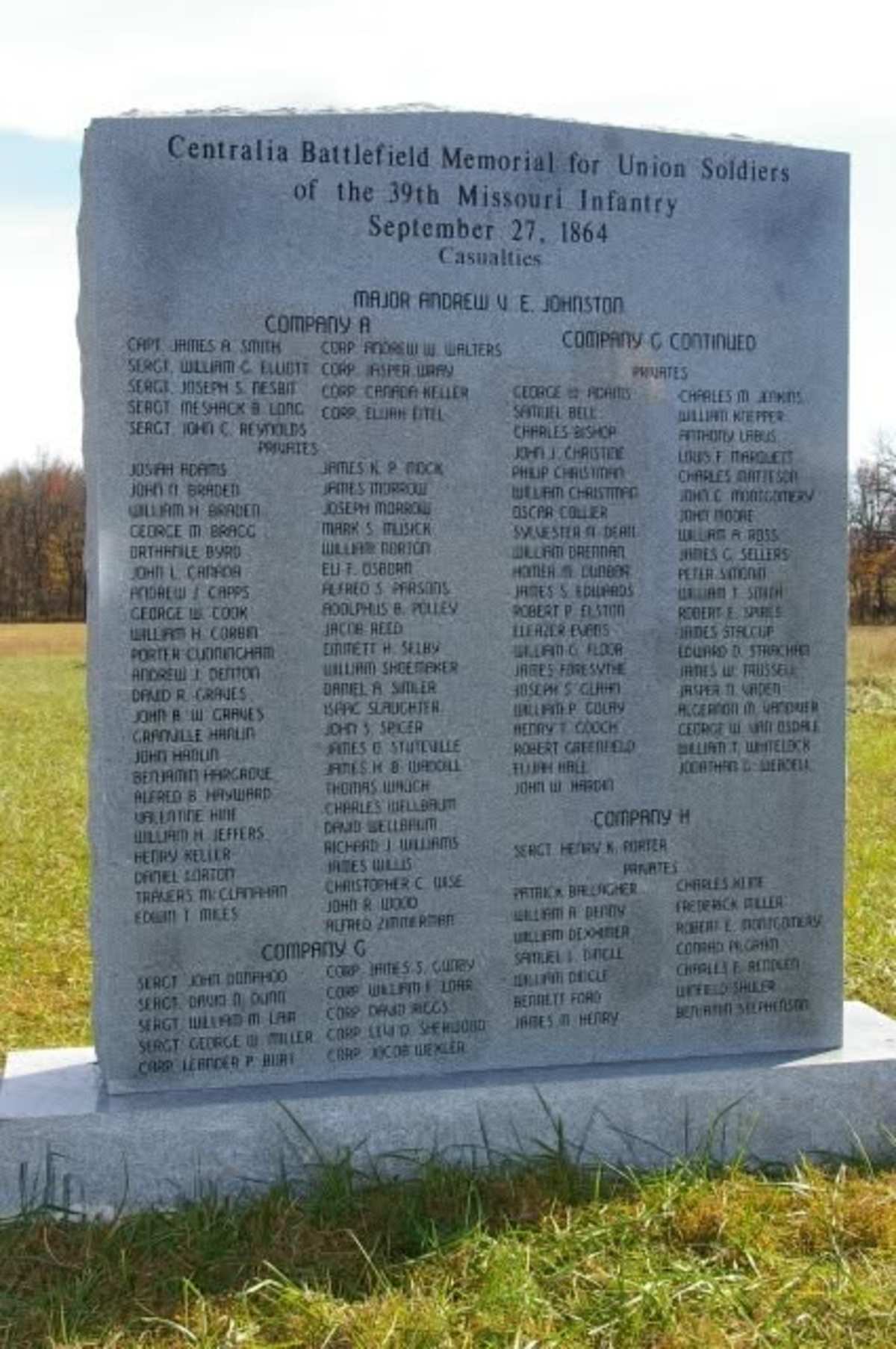
Citizens who walked the field next morning found sixty-eight dead where the line had stood. Eighty-three bodies were carried into town; seventy-nine went into one grave east of the railroad. The guerrillas lost three killed, all shot in the face, and one mortally wounded.
Seventeen and One
The count that came back through the camp that night was seventeen scalps taken on the field. There was also one thing done to one body that was not in the same category — though the Federal report put them in the same sentence, as if the distance could be measured on one scale.
It could not. That pairing is the moral arithmetic of the day, and it is where the novel got its title. Counts taken off such a field never agree; the citizens who gathered the dead recorded only three known scalped. What does not vary is that both numbers entered the record joined by an "and."
Why This Book
Private Francis Travers McClanahan, Company A, 39th Missouri, died on that field twenty-six days into his enlistment, before the first installment of his bounty came due. He was my third great-uncle, and the Army's misspelling of his name followed him onto the monument.
His mother Elizabeth waited thirty-five years, then filed for a mother's pension in October 1899 at ninety-one, signing with an X and listing all ten of her children from memory. She collected about six checks at twelve dollars a month and died on 4 September 1900.
My wife grew up in Centralia. John Thrailkill, who planned the right flank at Young's Creek, is her cousin.
Seventeen and One is that day, and the thirty-five years that came after it.
Sources
- History of Boone County, Missouri (Western Historical Company, 1882) — the fullest contemporary account, including the casualty lists
- Thomas M. Goodman, A Thrilling Record (1868), as told to E. B. Houston — the only account by a man who stood in the line
- The War of the Rebellion: Official Records of the Union and Confederate Armies, Series I, Vol. XLI
- Centralia, Missouri Centennial booklet (1957)
- Compiled service records and pension files, National Archives