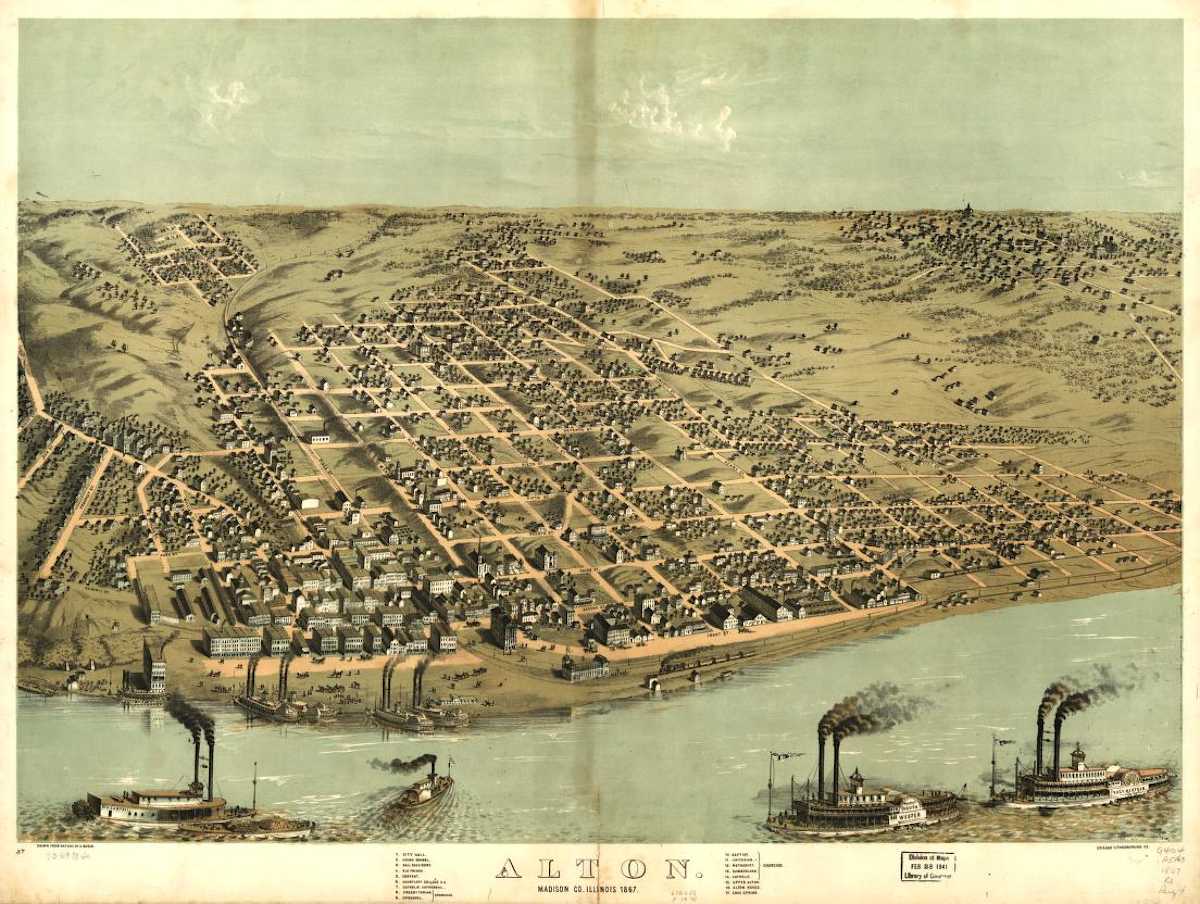
Illinois closed its first state penitentiary at Alton in 1860 as unfit to hold anyone, and fourteen months later the Army reopened it and put 11,764 Confederates through it.
Alton is a prison that nobody can count. The number of men who died there is given three different ways by three institutions, two of them reading the same monument. The number buried on the island offshore is given four ways. What is not in dispute is the building, and the building is the part worth knowing, because the state had already decided it was unfit before the Army ever put a soldier in it.
A Condemned Building Reopened
It opened in 1833 as the first Illinois State Penitentiary, on low ground by the Mississippi at the foot of the bluffs. The reformer Dorothea Dix reported it unfit for prisoners because of its dirt floors and unsanitary conditions. Accounts differ on when she saw it, one putting her before the Illinois legislature in 1847 and another dating her inspection to 1855. The last convicts went to a new penitentiary at Joliet and the Alton building was shut down in June of 1860. It stood empty for a year and a half.
Built for Nine Hundred
On the last day of 1861 General Henry Halleck sent Lieutenant Colonel James B. McPherson to Alton to look the empty prison over. McPherson reported that it could be made into a military prison and house up to 1,750 men. The first prisoners arrived on 9 February 1862, sent up from St. Louis.
McPherson was optimistic. Illinois Heritage puts the building’s working capacity at 900. Its average population ran to about 1,200 and peaked at 1,900 in January 1865. More than 11,764 Confederate prisoners passed through the gates in three years, and the place was overcrowded for most of them.
Sunflower Island
Smallpox came with the crowding, and the sources cannot agree on when. The Madison County Historical Society’s journal dates the alarm to the winter of 1862 and the spring of 1863. Its own online exhibit says the epidemic peaked in the winter of 1863 and 1864. Illinois Heritage puts the outbreak in late 1863. What the three agree on is the remedy. The Army set its quarantine hospital on a small island in the Mississippi about 200 yards upstream of the prison, Sunflower Island, also called Tow Head Island, and the sick were taken across to it. The dead were buried there as well. The island is under water now.
Going Over the Wall
About 80 men got out of Alton in the four years it operated, which is not many against 11,764. The best year was 1862, when 35 escaped and 27 of those went through a tunnel eighteen inches across. After that the Army tightened. Prisoners sent outside the walls wore a ball and chain so they would not make a break for freedom, and the work that took them outside was the work that gave them their chances. In 1864 an escape attempt from a quarry detail ended with seven prisoners dead.
Counting the Dead
The monument at the Confederate cemetery in North Alton is the nearest thing to an official answer, and even it is read two ways. The American Battlefield Trust takes 1,534 names from it. The Madison County Historical Society’s exhibit gives the official count as 1,354, and the society’s own journal prints both figures in the same article. Illinois Heritage says the records list about 1,300. The island is worse. One account puts its dead at up to 300, another at about 240 Confederates and 200 Union guards, a third at some 900 buried there with the true figure beyond recovery.
What the Novel Takes
Seventeen and One follows Travers McClanahan out of Adair County into the Missouri guerrilla war of 1864, and its fourth chapter goes inside Alton. It takes the building rather than the arithmetic: the coughing that was the ambient sound of the place, stone that sweated in the morning and dried by afternoon, men who arrived healthy and had the hollow sound within three weeks. It gives John Thrailkill an outside work detail and a guard with a wife, two children and a price. The Kansas City Public Library notes that discrepancies exist about Thrailkill’s actual war service, which is the ordinary condition of everyone in this story.
The Missouri war that filled Alton: https://duanekeelingbooks.com/blog/bloody-bill-anderson-and-the- missouri-guerrilla-war
Seventeen and One: https://duanekeelingbooks.com/books/seventeen-and-one
Sources
Madison County Historical Society, its online exhibit on the Alton Military Prison and its journal article on the prison at Alton, 1833 to 1865
Illinois Periodicals Online, Northern Illinois University Libraries, Terri Cameron in Illinois Heritage, 2007
American Battlefield Trust, its heritage site entry for the Alton Military Prison site
Kansas City Public Library, Missouri Valley Special Collections, its record for John Thrailkill
Library of Congress, Geography and Map Division, the featured bird’s-eye view of Alton, Madison County, Illinois, drawn by A. Ruger and printed by the Chicago Lithographing Company in 1867, two years after the prison closed