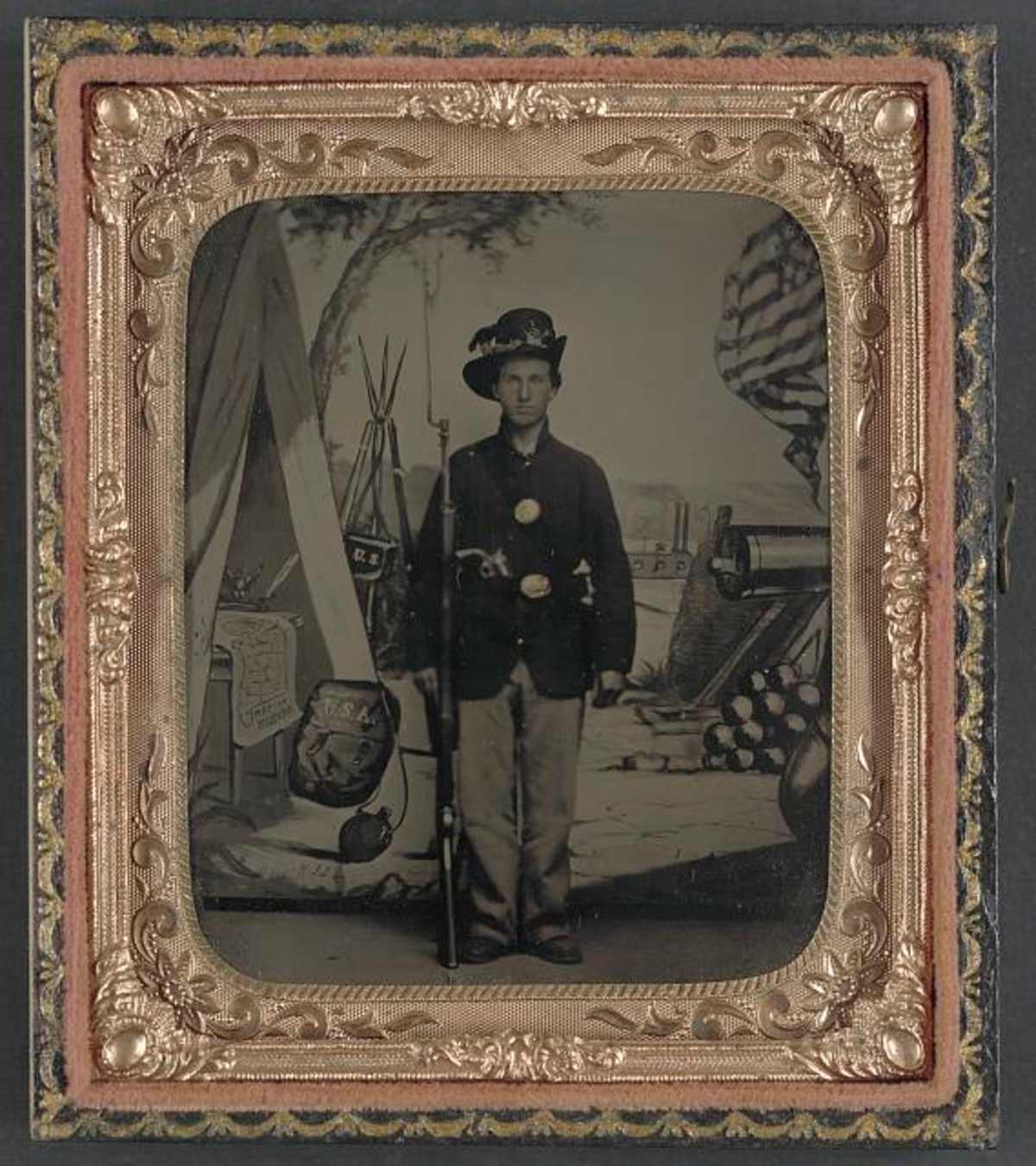
The 39th Missouri Infantry was raised at Hannibal in six weeks of late summer 1864, armed with infantry muskets, mounted on horses, and sent out after guerrilla cavalry.
A Regiment In Weeks
Most Union regiments took a season to build and asked their men for three years. The 39th Missouri Infantry asked for one year and took about six weeks. The National Park Service records it as organized at Hannibal, Missouri, between 18 August and 30 September 1864 - and before that organization was finished, companies of it were already in the field in the counties north of the Missouri River. That gap is the story of the regiment, and of others raised that autumn. Men who were farming in July were under arms in September, and the army that armed them was short of nearly everything except urgency.
Why Missouri Needed Men
By the summer of 1864 Missouri had sent its long-service regiments east and south, and what remained at home was a war of a different shape. Guerrilla bands moved through the river counties, and Sterling Price was preparing the expedition that would carry a Confederate army back into the state that September. The state answered by raising short-service infantry in a hurry. The 39th was one of a cluster: the 48th Missouri Infantry, by the same federal record, was organized at St. Louis, Jefferson City and Rolla between 3 August and 22 November 1864, and mustered out the following June. These were not three-year men filling gaps in veteran regiments. They were new regiments with new numbers, raised to hold ground for a single year.
The Rendezvous At Hannibal
Hannibal was a sensible place to gather them. It sat on the Mississippi, and it was the eastern end of the Hannibal and St. Joseph Railroad, the line that ran clear across the northern tier of the state. A man enrolled in a county two days west could be carried by wagon to a county seat, put on a train that evening, and be in camp on the river before midnight. That is what a rendezvous was in 1864: the railroad did the concentrating and the camp did the rest. What the camp could do in the time available was limited: drill, an oath, a uniform from a supply tent, a weapon, orders.
Muskets On Horseback
The weapon is where the hurry shows. The American Battlefield Trust describes the infantry arm of the war as a .58 or .577 calibre rifle-musket weighing between six and ten pounds, loaded by a sequence the Trust counts at nine separate steps. Cavalry did not carry those. Cavalry carried carbines, with barrels several inches shorter, because, in the Trust’s own words, the longer barrels were awkward and muzzle-loading was difficult on horseback. The 39th Missouri was mounted. The Kansas City Public Library’s encyclopedia of the war on the western border calls it the 39th Missouri Mounted Infantry outright. It was mounted so that it could chase men who rode, and it was armed as infantry, because infantry arms were what there were. Nobody reconciled the two.
What The Record Shows
The arithmetic sits in the federal record and it is not gentle. The National Park Service credits the 39th Missouri with 2 officers and 130 enlisted men killed and mortally wounded, and 64 enlisted men dead of disease, for 196 in all. The regiment mustered out on 19 July 1865, about eleven months later. The Kansas City Public Library records that at the one action the regiment is remembered for, 155 raw recruits under Major A. V. E. Johnston met a force it puts at close to four hundred, and that all but thirty-two of them were killed. Those men had been soldiers for about a month.
The federal prison that held captured Missouri men across the river in Illinois is its own piece of this history: https://duanekeelingbooks.com/blog/the-alton-military-prison-and-sunflower-island-in- illinois
What the Novel Takes
Seventeen and One follows one of those enlistments from the inside. A farm boy from Adair County rides thirty miles in a wagon, waits on a depot platform at dusk, reaches the river camp before midnight, and takes the oath at seven the next morning with his hand in the air. The uniform comes from a supply tent. The musket comes after it. The novel is interested in the part a regimental history leaves out - the twelve days between the oath and the orders, and what a man thinks about on a cot in a tent ninety miles from his mother.
Seventeen and One: https://duanekeelingbooks.com/books/seventeen-and-one
Sources
The National Park Service’s Civil War Soldiers and Sailors database, battle unit records for the 39th and 48th Regiments, Missouri Infantry
The Kansas City Public Library’s Civil War on the Western Border encyclopedia
The American Battlefield Trust’s article on small arms of the Civil War
Library of Congress, Prints and Photographs Division, the Liljenquist Family Collection and the Ambrotype and Tintype filing series, the featured hand-coloured ambrotype of an unidentified soldier of the 33rd Missouri Infantry by Enoch Long, made at Benton Barracks in St. Louis, Missouri, between 1862 and 1865