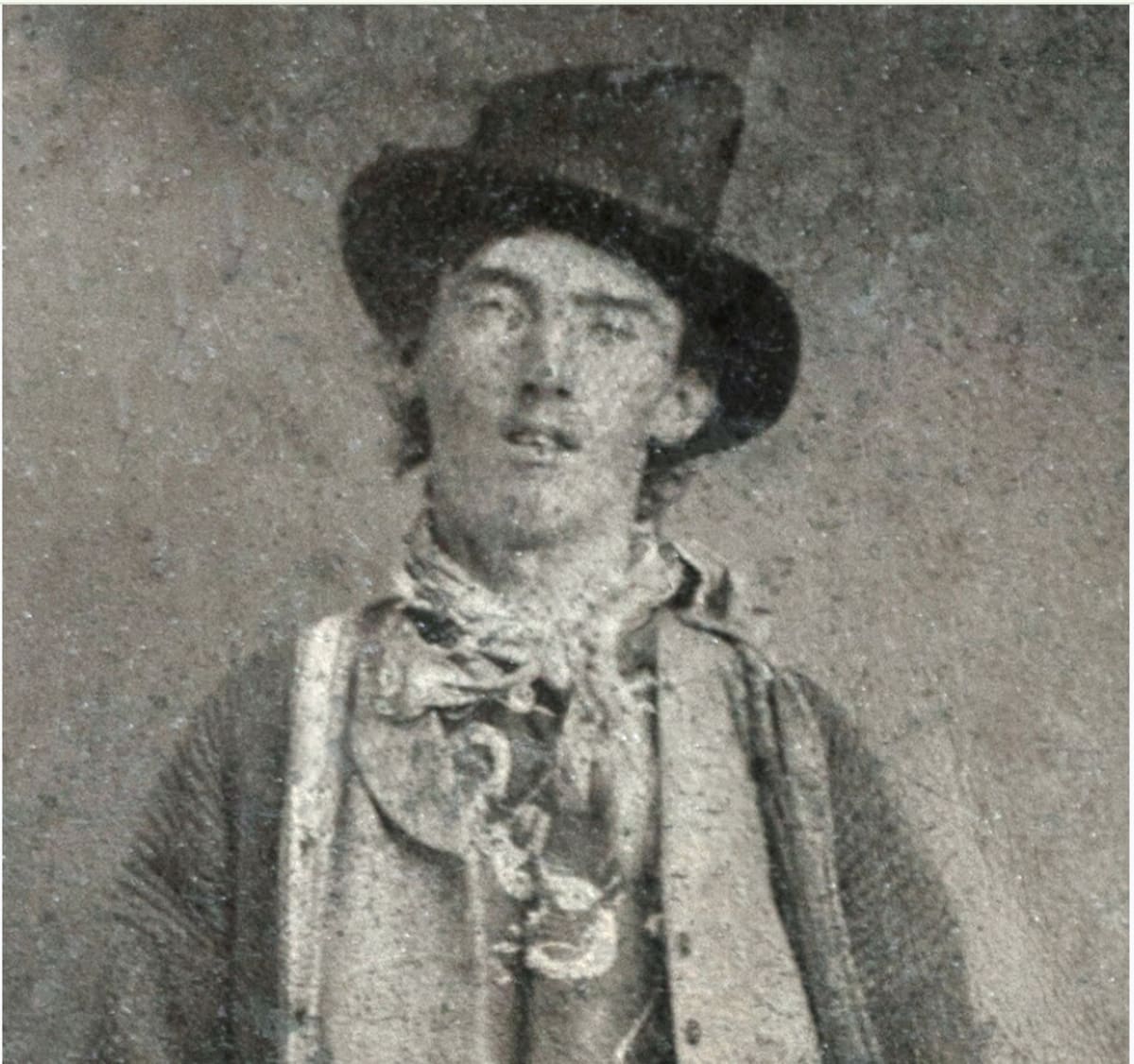
Billy the Kid was shot dead at Fort Sumner in July 1881, and a New York publisher had a book about him on the street before the year ended — the legend never needed the record.
Pat Garrett fired twice into a darkened bedroom at Fort Sumner, on the Pecos, on 14 July 1881, and Billy the Kid died without knowing who shot him. He was twenty-one. Forty years later, in a cattle camp in northern Mexico, men who had never set foot in Lincoln County were still using his name as a unit of measurement — the thing a braggart claimed he could beat.
That is a strange afterlife for a man who, alive, was a territorial problem rather than a national figure. The legend was not left over from his fame. It was built, fast, mostly after he was dead, and at no point did it require the facts.
Books That Same Year
He was born Henry McCarty, in New York City, most likely in 1859 — even that is not settled. He used the name William H. Bonney, and in Arizona he was Kid Antrim. He rode with the Regulators in the 1878 Lincoln County War, took part in the killing of Sheriff William Brady, survived the five-day fight in the town of Lincoln, was captured and was sentenced to hang. He escaped. Garrett caught up with him that July.
Before the year was out, the New York publisher Frank Tousey had The True Life of Billy the Kid in print, credited to “Don Jenardo.” It runs to fifteen pages. The Newberry Library holds a copy. The man had been dead a matter of months.
Garrett’s Correction
In the spring of 1882 Garrett published his own account, An Authentic Life of Billy, the Kid, out of Santa Fe. He did not write it; Ash Upson ghosted it for him. Garrett’s stated purpose was to correct “the thousand false statements which have appeared in the public newspapers and in yellow-covered, cheap novels.”
Read that again. Eight months after the shooting, there were already enough cheap novels about Billy the Kid to be worth complaining about.
Garrett’s book sold badly. It also became the foundation of nearly everything written about the Kid for generations afterward, which means Upson’s inventions were quietly promoted to history.
Eleven to Thirty-Six
Newspapers of the period put the Kid’s tally anywhere from eleven men to thirty-six. The Library of Congress puts the real figure at around ten, and only a few of those are firmly his alone — Frank Cahill in 1877, Joe Grant in 1880, and a share in the killing of Brady.
The number that stuck was twenty-one, one for every year he lived. That is not a count. It is a formula, and it is easy to hear why it lasted: it is tidy, it rhymes with his age, and a man can say it across a fire in six words.
Forty Years On
There was no Hollywood Billy to speak of in 1922. A silent film had been made in 1911, probably out of a stage play, and another followed in 1916. The book that made him a national figure — Walter Noble Burns’s The Saga of Billy the Kid — was still four years away. When it appeared in 1926 the Book-of-the-Month Club took it as a main selection and it sold accordingly; the historian Paul Andrew Hutton credits it with essentially creating the modern image of the Kid. MGM’s 1930 picture, directed by King Vidor, was drawn from it, and Hutton counts at least sixty Billy the Kid films since.
So a cowhand invoking Billy the Kid in 1922 was not quoting a bestseller and had not seen a movie worth quoting. He was repeating forty years of talk, carried along the border in Spanish and English by men who had it from other men.
Why This Book
Path of the Peacemaker is biographical fiction about my grandfather, Bee Adkins, who was born in Texas in 1903 and spent his teens working in revolutionary Mexico. In the 1922 chapter he hires on for a short cattle drive at a ranch in northern Mexico and meets Jed Tanner — fringed buckskin, polished chaps, matching nickel-plated Colts — who announces at the chuck wagon that a man in El Paso told him he could outdraw Billy the Kid himself. A vaquero named Ortega answers: “Billy’s been dead forty years, Jed. Ain’t much of a challenge.”
The camp laughs. Bee does not, and the chapter is about why.
Path of the Peacemaker — Bee Adkins, Book One
Sources
Paul Andrew Hutton, “Silver Screen Desperado: Billy the Kid in the Movies,” New Mexico Historical Review, vol. 82, no. 2 (2007), 149–196. Library of Congress, “Young Gun” (Library of Congress Blog, 2015). Texas State Historical Association, Handbook of Texas, “McCarty, Henry [Billy the Kid].” Don Jenardo, The True Life of Billy the Kid (New York: Frank Tousey, 1881); Newberry Library, Graff 2475. Pat F. Garrett, An Authentic Life of Billy, the Kid (Santa Fe, 1882). Turner Classic Movies, production notes on Billy the Kid (MGM, 1930). Wikimedia, Ben Wittick Photograph, Billy the Kid tintype, Fort Sumner, 1879-80-Edit2.jpg