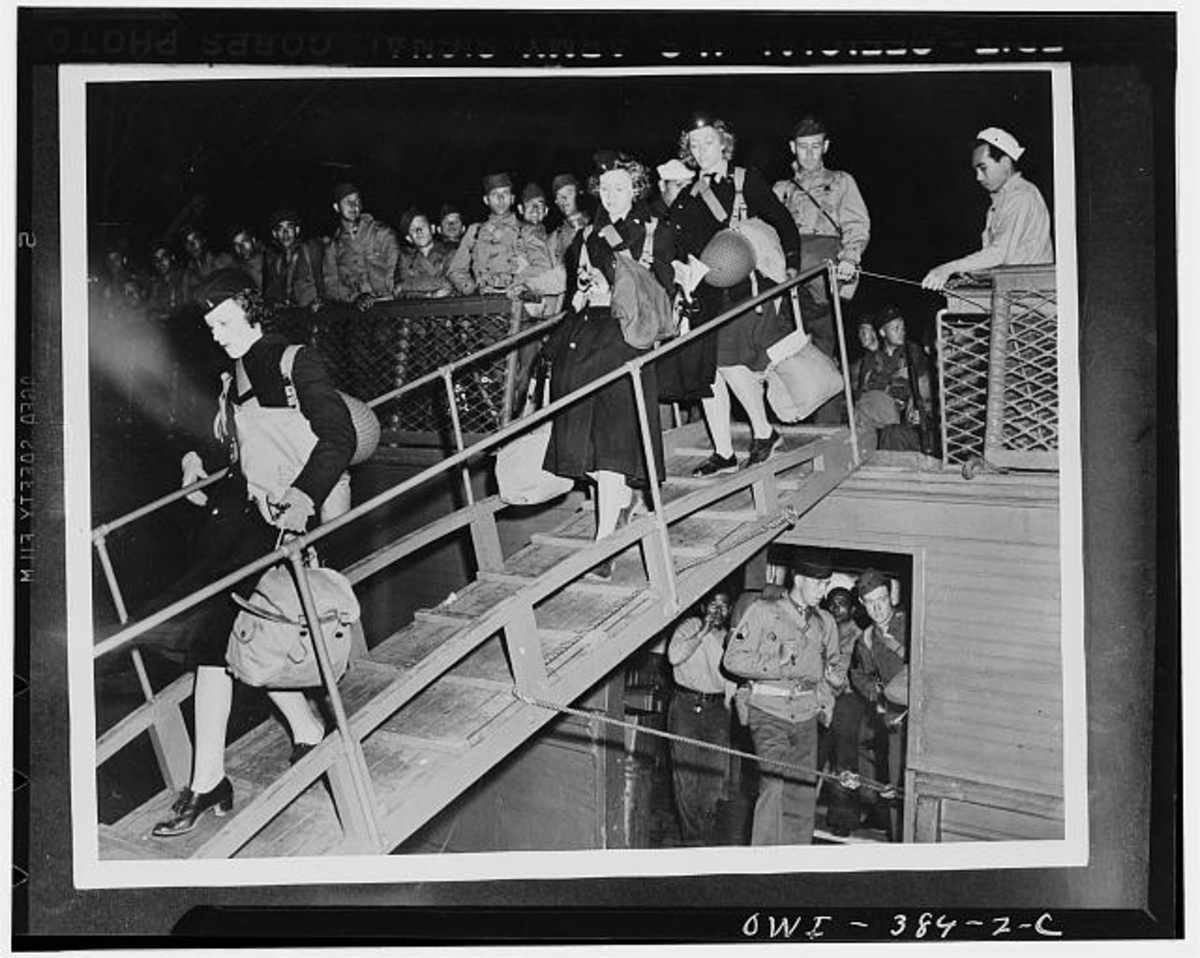
Four days after Germany surrendered, the Army set the number that decided who sailed home: eighty-five points for a man, and a lower, separately recorded one for a woman.
Everyone remembers the day the war in Europe ended. Almost nobody remembers that ending it was, for the United States Army, an accounting problem. Millions were in uniform, the shipping to move them was finite, and the war in the Pacific was not over. Somebody had to set the order of going, and the Army chose not to do it case by case. It published a formula instead and let every soldier work out his own answer, so that by the spring of 1945 a great many Americans knew their own number the way they knew their own name.
How The Score Worked
The instrument was the Adjusted Service Rating, set out in Readjustment Regulation 1-1, which the War Department issued on 30 August 1944, eight months before the Germans quit. It turned a service record into a single integer. A soldier earned one point for every month in the Army since 16 September 1940, and another for every month overseas, so a month abroad was worth double. Each combat decoration was worth five points, and so was each battle participation star. Each dependent child under eighteen was worth twelve, for no more than three children. Nothing else counted at all.
Setting The Critical Score
A formula is not a decision. The regulation told a soldier how to compute his score, not what score was enough. That second number, the critical score, was set on 12 May 1945, four days after the German surrender, and the official history of the Army Air Forces records the figure for men as eighty-five. For eight months men had been adding themselves up against a line that did not yet exist.
The Number Comes Down
Eighty-five did not hold, and was never meant to. After the Japanese surrender in early September 1945 the critical score came down from eighty-five to eighty, and the Army Medical Department, writing the history of its own demobilisation, records it falling from eighty to fifty-five inside three months. The Medical Department records the point score abandoned as a release criterion altogether on 31 August 1946.
Women Counted Differently
Women in uniform were scored too, and not on the same line. The Air Forces history gives the figures set that same 12 May as eighty-five for men and forty-four for women. The Army Medical Department, writing about its own people, records something else again: a critical figure of thirty for the Department’s female officers earlier in 1945, and a separate minimum for the Nurse Corps of forty years of age or sixty-five points. The accounts do not agree, and this piece picks no winner, because the disagreement is the fact worth having. There was never one number. Nurses held officer rank by then, which is part of the reason: https://duanekeelingbooks.com/blog/army-nurse-corps- relative-rank-and-public-law-350
Home Or The Pacific
The score did not only answer the question of home; it sorted men three ways. High scores were released. Low scores were liable to be held for the occupation of Germany, or put aboard a ship going the other way, toward an invasion of the Japanese home islands still being planned. For a young soldier lying in a hospital bed in May 1945, a low score did not mean waiting. It meant another ocean and another landing. Within days of the German surrender the Army was asking every soldier for his length of service and his dependent children, so the sorting could begin.
What The Novel Takes
Within Reach follows Helen Calloway through the Army Nurse Corps into a rear evacuation hospital in Europe. The novel puts the surrender inside that building, then does something quieter with the morning after. The end of the war arrives through carbon paper. Men who had sung on tables the night before stand in line outside the orderly room, caps in hand, wanting their points counted again. Enlisted men argue about eighty-five as though a number could hear them. Nurses compare scores in the mess over powdered eggs, and one of them says age ought to count double after this. Helen has not bothered to count hers.
Within Reach: https://duanekeelingbooks.com/books/within-reach
Sources
The Office of Medical History of the United States Army Medical Department, its volume on medical personnel in the Second World War The official history of the Army Air Forces in the Second World War, volume seven, Services Around the World The American Soldier in World War II, a digital project based at Virginia Tech Library of Congress, Prints and Photographs Division, the Farm Security Administration and Office of War Information Photograph Collection, the featured photograph of United States Army nurses boarding a troop ship, photographer unrecorded, 1942